these are a few of my favorite things

Leaving D.C. wouldn’t be complete without waxing nostalgic, so following is a list of my favorite memories from my almost seven years in the District. It was hard to rank them, so don’t read too much into the order.

7. Riding in Bike DC. I just participated in this event last weekend, and it was especially meaningful because of my upcoming departure. On that beautiful Sunday, I traversed the 25-mile route with the constant mental refrain of “I love this city so much.” We got to ride almost the whole time without competing with cars, and I especially enjoyed Rock Creek Parkway, K Street, and the George Washington Parkway — the latter of which was a unique, and not to-be-duplicated, experience. It was amazing to head up the Potomac along that scenic road.

home page of The Washington Post on September 19, 2009

6. Shouting at Elena Kagan. In July 2010, I went for a run on Capitol Hill in the middle of the day. As I passed the Supreme Court (just east of the Capitol building), I recognized the diminutive woman walking along the opposite side of the street, whose image had dominated the news in the months leading up to her Senate confirmation. It took a few moments for this to register in my brain — and of course I was still running as I was thinking, “That’s Elena Kagan!” — so by the time I decided to “say” something, I had to yell.

cars on o st nw, just south of logan circle; photo by salem pearce

“Congratulations on your nomination to the court!” I shouted back at her. She turned around, smiled, waved, and shouted back, “Thanks!”

5. Surviving Snowpocalypse. I’m including this one in part because of where I’m headed next: soon several feet of snow will be a regular occurrence. On December 20, 2009, a historic storm dumped almost two feet of snow onto the greater-D.C. area. Everyone panicked: store shelves were emptied of milk (for some reason snow requires an increase in lactose consumption), and the entire city shut down. The storm made local blog Capital Weather Gang the must-read it’s become. This Texas girl had never seen so much snow at once, and my personal record held until the advent of Snowmageddon two months later.

with dan gordon at the new nationals park; photo by dara oliphant

4. Attending opening day at Nationals Park. For the past five years, I’ve shared Nationals season tickets with a group of friends, so we managed to get three tickets to the first regular season game, on March 30, 2008, at the new ballpark along the Anacostia. It was so cold that evening that I had to buy a red Nationals hoodie to stay warm. Then-President Bush threw out the first pitch — and was booed, much to my pleasure — I ate a hot dog from the kosher cart near our seats, and, best of all, Ryan Zimmerman hit a walk-off homer to lift his team over the Braves, 3-2.
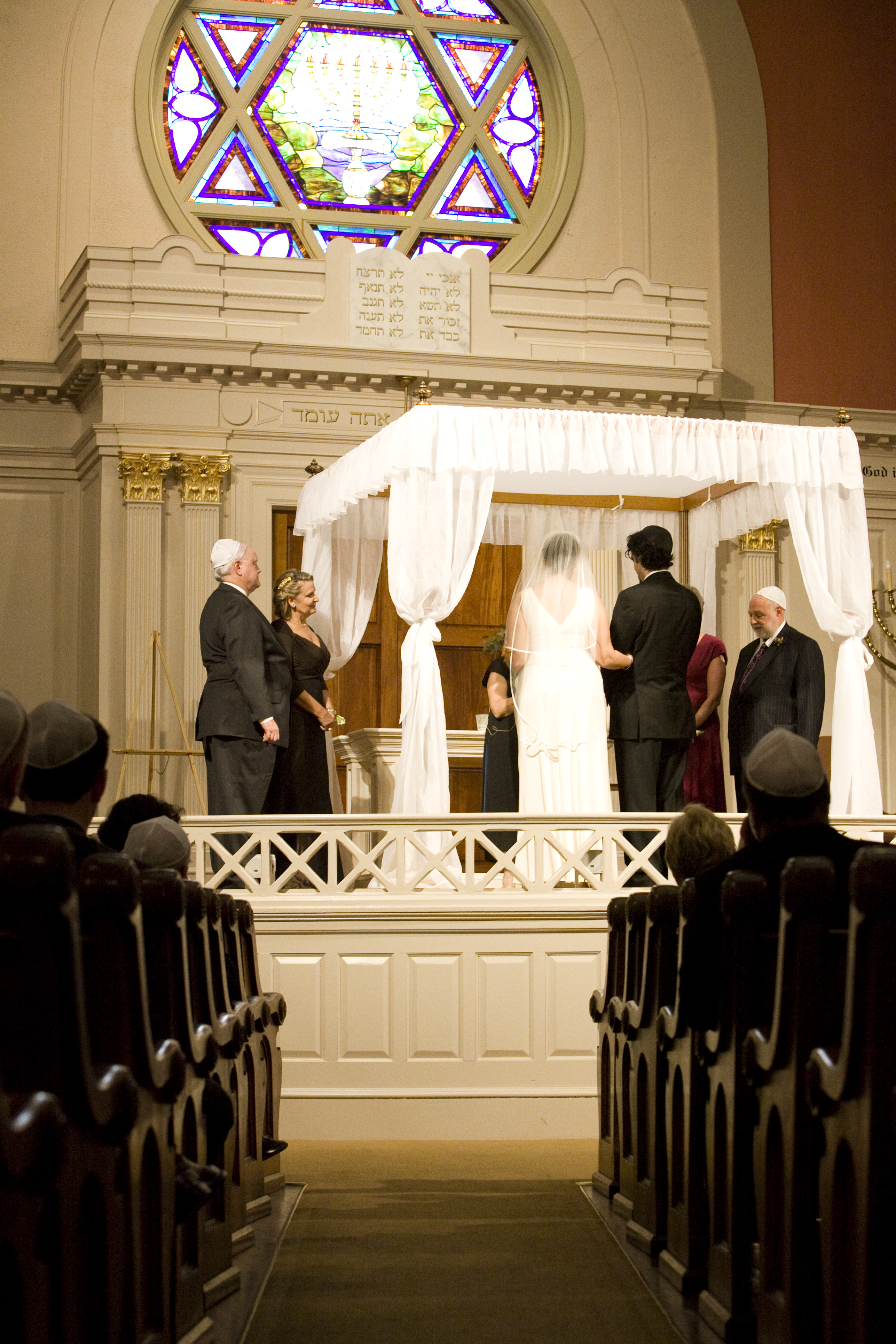
chuppah at sixth & i; photo by matt goldenberg

3. Getting married at Sixth & I Synagogue. (I should note that I am here talking about my wedding — as opposed to my much more important marriage and relationship with my husband, lest my readers get the wrong idea.) The building is beautiful, and as I’ve documented well on this blog, Sixth & I has been the center of my Jewish life in D.C. On October 25, 2009, we stood under the chuppah, under the lofty dome, and made a commitment to each other. Sometimes I still can’t believe that we were able to have our wedding in such a meaningful place.

2. Having my photograph in the Washington Post — twice. Oddly enough, both were because of Sixth & I. The first time was September 18, 2009, right after my conversion. I had volunteered at an Erica Brown Rosh Hashanah event at the synagogue a few days earlier, and there I fell into a conversation with a Post religion reporter, who called me the next day to ask if a staff photographer could take my picture for the story. The photographer and I met at Sixth & I — and the resulting photo (above) was taken in its balcony. It appeared on the Post homepage as well as on the front page of the print edition.
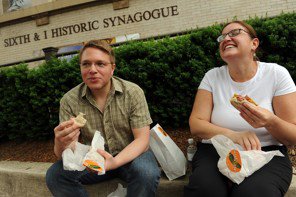
enjoying the first fruits of sixth & i’s kosher food truck

The next time was May 22, 2011, the day after Sixth & I’s kosher food truck, Sixth & Rye, debuted. I dragged my then-intern along with me to wait in the hour-long line, and it was worth every second. Again, I just struck up a conversation with the Post photographer who was covering the event. The resulting photo (left) appeared inside the A-section of the print edition; my hands also appeared on the front page of the website and on the iPhone app.

1. Meeting Michelle Obama. On January 21, 2009, the day after the president’s inauguration, my husband and I got to go to the White House; I had entered and won the lottery that the administration held for 200 District residents to meet their newest neighbors. After a bit of a wait, in a line that snaked around the public rooms of the presidential residence, we made it into the room where the first lady stood. (Apparently we missed the president by just minutes!) First of all, Mrs. Obama is tall (and she was wearing flats on this occasion). Second of all, she has that quality that is the hallmark of all great politicians: the ability to make you feel like you are the only person in the room. I shook her hand and told her it was an honor to meet her. Third of all, she is a funny and charming lady. The man in front of us told her he was a Tuskegee airman and then shared a short anecdote. She punched him lightly on the shoulder and said, “Get out of here!”

And that is when I fell in love with Michelle Obama, way before all the rest of y’all.
no milk and cookies

Or, in which I do not laud the president for his statement on marriage equality yesterday.

First: I absolutely support marriage equality. It makes me furious that in various parts of this country we are voting on and legislating against civil rights. Any two consenting adults should be able to get married — and this is one of those rare moral and ethical absolute rights. It should not even be an issue.

And . . . I’m not that impressed by the president’s televised statement that “I think same sex couples should be able to get married.”

I realize I’m in the minority among my progressive peers, if my Facebook feed is any indication. I acknowledge that words matter, and it matters what the president says: He can start and shift a national conversation. And, as a straight married woman, I can’t know what it feels like to have my relationship finally given the dignity that it deserves, by the most powerful man in the world, because my privilege is that my relationship has always been so accorded. In some ways, it was indeed an historic moment. (And I’m not completely hardhearted: I was touched by his crediting his wife and daughters for helping to shape his views on this issue. The women have always been my favorite Obamas.)

But many things about what happened yesterday — and, I suppose, what have been happening for a while, during the president’s “evolution” — were troubling. It’s hard to escape the fact that the decision to make this statement was born out of yet another vice presidential gaffe. Basically, Joe Biden went off the campaign script, and the president’s hand was forced. To avoid the impression that he and his running mate are not on the same page on this issue, the president quickly went on television to express what we’ve suspected he’s actually believed for a long time.

Indeed, the speed of the reaction (three days passed between Biden’s statement and Obama’s — did the president just happen to finish “evolving” at that point?) suggests that he already held the belief and was perhaps waiting until after the election to say so. His silence has then been a political calculation, about which I find very little commendable (particularly in light of the growing support for marriage equality in this country). It is incumbent upon us as human beings to speak out against injustice — and never more so when that human being is in a position of political power.

And even if I’m wrong in characterizing the action as political, and I take the president at his word that his personal belief has been evolving, I am still dismissive. A black man well knows the the history of injustice in our country’s marriage laws, and he should have been saying from day one, “I absolutely support equality because it is not okay to restrict marriage.”

Moreover, this seems to me a symbolic statement. Will he speak out against future measures like the one in North Carolina, which passed just the day before? Will he work to repeal the federal Defense of Marriage Act, which he has thus far only ordered the Justice Department not to enforce defend*? I want action with vague words. I don’t feel all that thrilled at what on its face was a simple statement of belief, the appropriate response to which is “duh.”

In the bigger picture, I share the concerns of many — particularly people of color, low income folks, and trans folks — in the queer community about the focus on marriage equality to the exclusion of other issues facing those constituencies (see also: hate crimes legislation). As a friend of a friend wrote on Facebook yesterday — and as my friend Alicia has eloquently written elsewhere:

WHAT about those of us who are raging queers? What about those of us who are poly, sex-positive, who don’t want kids, who have unconventional family arrangements? What about queers who have AIDS, who are homeless, who are gender freaks and warriors? Those of us who want working to dismantle the state, take apart the military, end capitalism, destroy the institution of marriage, and abolish prisons? What do we do when a movement for justice for LGBT people and the national discourse frames that movement as being about an institution that strengthens the power of a state that wages wars, puts people behind bars, profits off of land theft and slavery, and makes healthcare a right of the rich?

Marriage equality is a step. But I worry that the argument for it often devolves into, “Gay folks are just like straight folks. You don’t have to go out of your comfort zone to support marriage equality.” That’s insulting to everyone involved. I want support for people (straight people included) not to get married, too. I want support and attention for many, many other issues that, frankly, are more pressing for many folks than the right to marry.

Further, this does not change my position that I will not be giving the president anything other than my vote. He won’t have my time and money before the election as long he keeps signing bills allowing for indefinite detention, deporting record numbers of undocumented immigrants, and raiding medical marijuana dispensaries, to name a few issues on which he has utterly disgusted me.

Finally, while I’m on my soapbox, I’d really appreciate it if we could all stop using the term “gay marriage” (and the only somewhat better “same-sex marriage”), as it’s conceding the right’s narrative on this issue. “Marriage equality” affirms that existing marriage laws apply to everyone; we are not seeking to create a new institution for queer folks.

Marriage, as it stands (my issues with the institution, especially the state’s role it, notwithstanding), should be open to all.

*Update: My friend Brian Moulton, chief legislative counsel for the Human Rights Campaign, points out that the Obama administration has been “not defending” DOMA — not “not enforcing.”

praying with my feet

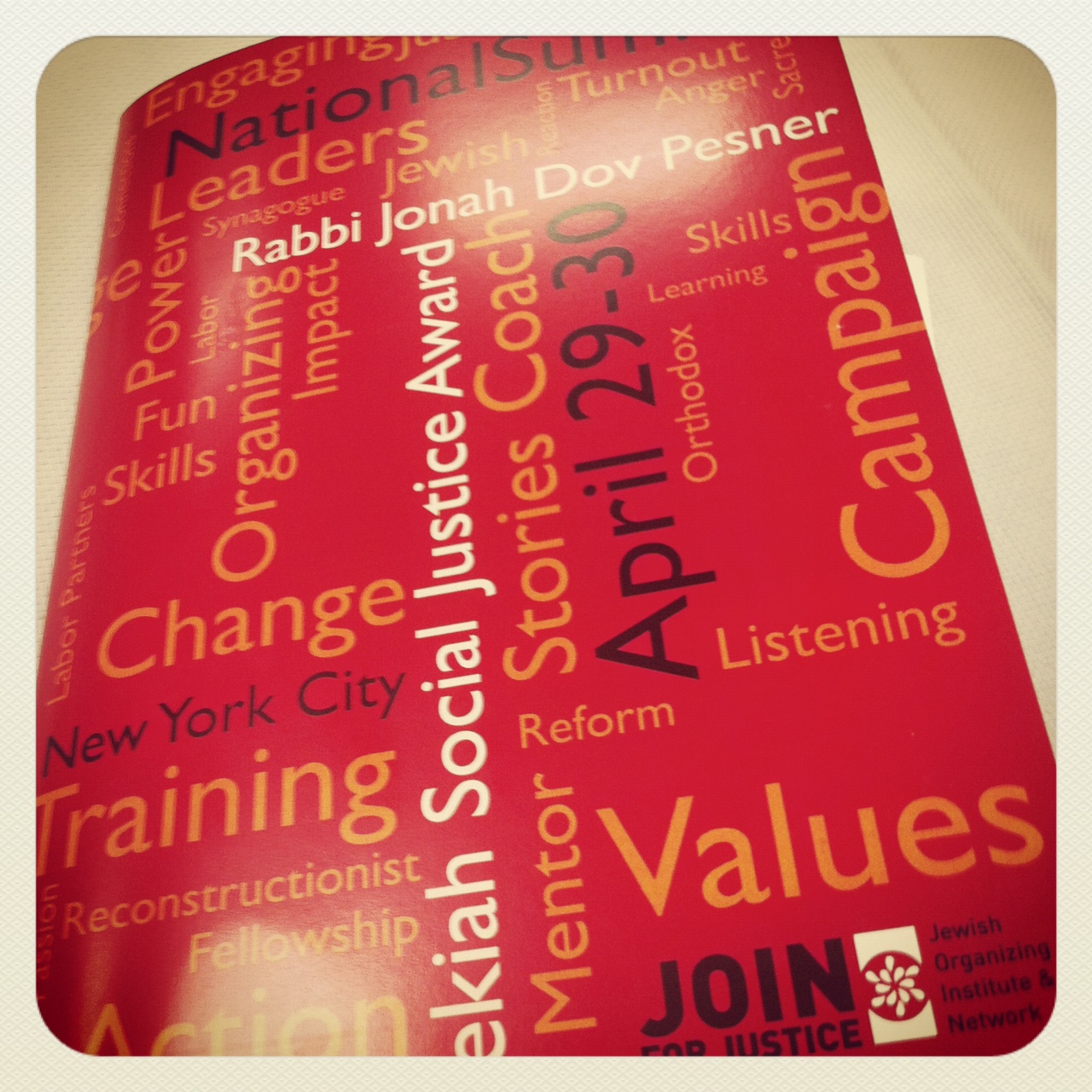
JOIN national summit program; photo by salem pearce (via instagram)

I spent last Sunday and Monday in New York, at the HUC-JIR campus, attending the Jewish Organizing Institute and Network for Justice (JOIN for Justice) first National Summit, the organization’s first. I heard about it through Jews United for Justice, one of my favorite D.C. organizations. As a rabbi, I want to do organizing, so it was a good opportunity to network with other Jews doing social justice work. Indeed, those two days I walked around thinking, “Yes. These are my people.”

Simply put, the conference was awesome, for little and big reasons. I am dork, so I really liked that everything ran on time and stuck to the schedule. (Not everyone showed up on time to sessions (myself included on one occasion!) but that’s a different kettle of fish.) Every session I attended had a written agenda of what was to be covered, and in good organizing fashion, the agenda was reviewed and affirmed before each session. What can I say? I like knowing that presenters know what they’re doing.

The conference also got me super excited about moving to Boston. Bostonophiles had told me what a great city it is for social justice, but seeing is believing. I heard about so much good work going on and/or based there (where JOIN itself is located!), through Moishe Kavod House, Jewish Association for Law & Social Action, Massachusetts Senior Action Council, Boston Workman’s Circle, Keshet, Jewish Community Relations Council of Greater Boston, and more. I’m thrilled about the potential opportunities I’m going to have in rabbinical school.

And I heard some downright inspiring speakers: In the opening assembly, Simon Greer of Nathan Cummings talked about the Jewish legacy and future of social justice: “At the March on Washington, Jews blended in; at Occupy Wall Street, Jews stood out.” Ai-jen Poo of the National Domestic Workers Alliance spoke about community/labor coalition building: “All progressive movements, worker-related or not, bank on the utilization of the labor movement. We have to lift it up.” Marshall Ganz of the Kennedy School highlighted the necessity of a moral aspect to social justice work: “One cannot long last as a light to the world and a darkness at home” (in reference to the occupation of Palestinian lands). Gordon Whitman of PICO emphasized the importance of religious Judaism: “We can’t have just a secular Jewish social justice movement.” Nancy Kaufman of the National Council of Jewish Women: “Social justice comes from Jewish values — but has universal goals.”

One of my favorite sessions was “Mindfulness and Organizing Work,” led by Rabbis David Adelson and Lisa Goldstein. I really identified with Rabbi Goldstein’s section on text study as a mindfulness practice. As she noted, looking at a piece of text is the default Jewish spiritual practice in organizing — but doing so often puts participants into an intellectual space that can be anxiety-producing and can lead to tearing others down. “How can I demonstrate that I know more about Judaism than others? What if I don’t understand what someone else says? How can I show my independence of thought by disagreeing with the author?” Instead, Rabbi Goldstein suggested looking at text from mindful perspective: “What it wise, beautiful, true, or helpful about this text? What does this text teach me about myself and about where I am in the world?”

the prophet isaiah (i love the prophet art at huc!); photo by salem pearce (via instagram)

Personally (as opposed to professionally), my favorite part of the conference was seeing my old friend David Segal (now Rabbi David Segal). We hadn’t seen each other since high school, when I was his yearbook editor. We’d friended each other on Facebook within the past couple of years, so we had some idea of what the other was doing. But because of the time built into the schedule for relational meetings (thanks, JOIN!), we were able to make that deeper connection as adults and as organizers. I got to hear about his path to the rabbinate and to Aspen, and I got to tell him about my path to Judaism and to the rabbinate. When we parted, headed to different sessions, he told me a story that gave me chills.

A friend of his, also a convert and a rabbi, shared with him a midrash (or perhaps a midrash on a midrash?): Between creation and when the Israelites went out of Egypt, G-d is said to have visited and offered Torah to all of the nations of the earth, who ultimately rejected it; only the Israelite nation, at Mount Sinai, accepted it — becoming the “chosen” people. David’s friend noted that in each of the rejecting nations, though, a few people in the back of the crowd raised their hands and said, “Wait! I want it.” That is him, he said.

That is me, too.

decision

This is perhaps more than a little anti-climactic now, since it says so in more than one place on this blog, but . . . I’ve decided to go to Hebrew College, the transdenominational rabbinical school in Boston (or, more accurately, Newton Centre).

It was in some ways a very simple choice. When I visited the first time in November, there was a moment — that scared me, that I didn’t talk about with anyone at the time — when I just knew: This is right. This is where I want to be. I didn’t want to say it aloud because I knew I wasn’t going to make a decision based just on a feeling. I was also not ready to put that intention out into the universe.

Besides, one of the most important things I took away from my tour of rabbinical schools is how great all of them are. It was amazing to see how each institution is so seriously engaged in thinking about how best to train rabbis to serve the Jewish people. I loved meeting the deans of admissions, faculty, and students at each school: They are all amazing people. I honestly believe I would have been happy at any of the four I applied to. In addition to other factors, it came down to which I thought would be the best fit. (More about that below.)

The decision was also simple in another, more surprising, way. In mid-March, after I’d received my acceptances, I narrowed the choice down to two schools in two cities: Hebrew College, and Reconstructionist Rabbinical School (RRC) in Philadelphia. I’d gotten the idea that my husband was leaning more towards the latter, and since I really wanted the decision to be transparent and mutually agreed upon and beneficial, I began to prepare for a lengthy conversation. I taped a piece of butcher paper on the door into the living room; it was divided into two sections, one for each city. We began to write down the pros and cons of each city and school. (Some of the more amusing cons were “Pats fans” and then “Eagles and Phillies fans.” In retrospect, we clearly should have added “Bruins fans” to that list.)

Shortly afterwards, I was looking at the paper and my husband came up to me and said, “Do we need to do this? I want to go to Boston.” And that was that.

On my conviction that Hebrew College is the best fit for me: During my interview, both Rabbi Art Green (a professor and one of the founders) and Rabbi Sharon Cohen Anisfeld (the dean) helped me to clarify my thinking on the issue. As Rabbi Green noted, the emphasis at RRC is on history, as reflected in its curriculum; Reconstructionism views Judaism as an evolving religious civilization, so each year is spent immersed in an historical period (biblical, rabbinic, medieval, modern and contemporary). Rabbi Green knows from what he speaks: He was the dean of RRC for six years.

At Hebrew College, the emphasis is on text, as reflected in its curriculum, in which each year is spent immersed in a book of Torah. Let’s face it: I was a Classics major for a reason. I spent my undergraduate years learning Latin and Greek — and then reading texts in the original. (There was a little culture and history thrown in, but not much.) And then I went on to learn German and Russian for the same reason. More than most things, I love reading and translating text. Grammar, syntax, vocabulary, sentence structure, nuances of meaning — they all thrill me. Simply put, I am a text dork.

yeminite beit midrash by geula twersky

But “best fit” also means something else to me. As I realized in my Hebrew College interview, RRC would have been, in some ways, the “safer” choice. The school, its students, and its alums are know for their political engagement (among other things). In that sense, I would fit right in. In contrast, Hebrew College, as a transdenominational school, doesn’t have the same political homogeneity. I anticipate that I will find it quite challenging at times to go to school with people who have different opinions than I do in this area. For one, I don’t have much experience; I tend to surround myself with like-minded people (as do most of us). Relatedly, I don’t have much patience with non-progressives/radicals.

The other aspect of a Hebrew College education that I expect to find challenging is its required beit midrash hours. Beit midrash literally means “house of study” and refers to the places of Torah study that the early rabbis used. In rabbinical schools, the beit midrash is a library that encourages talking, because studying there is done b’chevrutah (with a partner). Part of a transdenominational education is learning from others who may have different (in this case religious) viewpoints. But in general, the school values partnered learning, which means I’ll be required to spend several hours each week studying with someone else. As an introvert who prefers to work alone rather than in a group, I’ll thus have to work hard to make sure I am getting enough recharging time.

I’ve framed these last two factors in a negative way; indeed, it’s the challenge of them that appeals to me. I need to push myself out of my comfort zone. Doing so, I will be a better rabbinical student, and a thus a better rabbi.

Finally — and I can’t emphasize enough how awesome this was — my interview at Hebrew College ended with the room singing a niggun (wordless melody). What’s not to love?

distopiae

orphan master's sonI woke up on Sunday to a cold, rainy day, nixing my plans to do the first round of planting in my garden. Instead, I stayed inside and read all day. After I finished Adam Johnson’s The Orphan Master’s Son — a novel about a young man’s many careers under the North Korean regime of Kim Jong Il — I took a quick walk to the D.C. public library’s Martin Luther King Jr. Memorial branch to pick up a book on hold for me, Suzanne Collins’s The Hunger Games.

Although I’m not a huge fan of the YA genre, I haven’t been purposefully avoiding the novel — as I generally did with Harry Potter, for instance, the faux Latin of which set my teeth on edge. (I initially experienced a similar dread with the name of the country in The Hunger Games, Panem, but that’s where the Latin ended — and that reference was A) actually Latin and B) appropriate to the circumstance.)

I’d heard great things about Collins’s novel from people whose opinions I trust, and I even gave the book to my sister-in-law for Christmas last year based on those opinions. It was the hype around the movie — and the racism by its purported fans that it engendered — that finally piqued my curiosity. And the book was worth the wait: I read it straight through, finishing in a few hours by Sunday night.

My first reaction as I started reading, though, was, “Didn’t I just finish a novel about a central state government that tries to control its citizens in a society of a reality at odds with ideology?” And so I had, and so here I am, reviewing the two seemingly disparate novels together.

They certainly give each other a run for their money in terms of being disturbing — but also in being compelling. Many of the books I’ve been reading lately have managed to be suspenseful despite telling a story with a foregone conclusion (as for example here and here), and The Orphan Master’s Son was a complete break with that trend. I really had no idea what was going to happen next, much as the hapless denizens of the People’s Democratic Republic of Korea (DPRK) in the book. (Well, I had the tiniest inkling from the outset, but I had no clue how Johnson could possibly get there.) Pak Jun Do, the orphan who isn’t, climbs through his impossibly regimented society, going from the backwater Chongjin to the capital Pyongyang as army tunneler, state kidnapper, naval intelligence officer, and finally the prestigious Minister of Prison Mines. Through the 1982-esque propaganda that works indefatigably to make the “Dear Leader” seem like the greatest leader of the greatest nation on earth, it takes a lot of blood and torture to get Jun Do across the country and its class divide; Johnson’s work is not for the squeamish.

The Hunger Games also manages suspense despite the fact that a reader has to expect that a narrator of a to-the-death battle royal is likely going to make it out alive. The Buffy-like protagonist Katniss Everdeen makes a journey similar to that of Jun Do, from her home in District 12, the furthest outpost of the country Panem (which rose from the ruins of North America), to its capital. And she also takes on a new identity, as a competitor in the annual death match.

Side note: Regarding the “controversy” of casting black actors in the movie roles, I just about burst out laughing when Katniss explains, on her train trip to the Capitol, that it “was built in a place once called the Rockies.” I have family in Denver and spent many a summer there and environs, and my cousin and I regularly remark on how homogeneously white Colorado is. (Of course, that reminds me of one of my favorite Tracy Jordan lines ever.) Panem isn’t that different from North America, which means that people of color in the future probably live in the worst parts of that country, too. So astute readers shouldn’t have been at all shocked that a contestant from an outlying district, furthest from the prosperous Capitol, would be black. (Based on the book, the real surprise should have been that Katniss is played by a white actress, although I suppose not really in the whitewashing of Hollywood casting.) Then again, readers who can’t understand that “satiny brown skin” denotes a person of color are pretty much idiots.

Collins’s story is a little easier to take, despite that the fact that it features teenagers killing each other for sport. This is partly because Katniss is an unequivocal hero, pure in heart and deed: Collins carefully constructs the narrative so that Katniss kills only indirectly or with complete justification. The reader has to root for her, especially against the backdrop of the depravity of the other competitors — and of the society itself; indeed, Panem’s televised games were ostensibly established as punishment for rebellion against the Capitol, but it seems clear that entertainment was just as important a factor. Likewise, the extreme control in the DPRK stems from banal pandering to Kim’s ego, and Jun Do’s battering at the whims of the Dear Leader is in the main heartbreaking (although it stands to reason that a character in a “grown-up” novel might be more nuanced.)

Both societies are of course meant to be horrifying. But there are uncomfortable similarities with our own. Collins makes this clear by locating Panem in the not-so-distant future; she’s also stated that she drew inspiration for the novel while channel surfing, switching between a competition-based piece of reality TV and coverage of the invasion of Iraq, when the two “began to blur in this very unsettling way.”

The hallmark of Johnson’s DPRK is the contrast between what is said and what is done — which dissonance I’ve been thinking about in the U.S. recently, especially as it relates to motherhood. Pundit Hilary Rosen caused a firestorm a few weeks ago with comments about Ann Romney’s work as a homemaker. Taking the cake for dumbest “controversy” of the election season so far, Rosen’s statement and its aftermath led to an endless series of inane responses lionizing the work of mothers (as if Rosen, a parent of two, were somehow unaware of her own role). But the truth is that we as a society don’t in any way value motherhood — or more accurately, all mothers — in the way we love to claim we do, as Katha Pollitt so trenchantly articulates. The doublespeak on this and many other issues do the Dear Leader proud.

spring has sprung

swiss chard in my row-mate Sarah's plot

Today I wrote a short post for the Mamie D. Lee Community Garden blog, featuring a few photographs I took at the garden this morning. This is the third year I’ve had a half-plot in this community garden in upper Northwest, near Ft. Totten. I take simple iPhone photos each time I’m there to document my progress; I did my first round of planting this morning.

Gardening has become one of my absolute favorite hobbies — which I plan to write more about in a future post.

turning anger into change

Trigger warning: This entire post is about my experience as a volunteer for a rape crisis center, details from which may be upsetting to survivors.

In August 2005, shortly after I moved to D.C., I responded to an ad in the Washington Post Express, a call for volunteers at the DC Rape Crisis Center. That action has defined my experience in D.C. for the past six-a-half-years.

I still remember with total clarity my first visit to the Center’s then-basement office downtown — and my initial interview with then-volunteer assistant Jessica Ingram (who I recently reunited with in her current position as Assistant Director of Admissions at HUC-JIR!). I fumbled some of the questions that she asked me, but I must have said something right, because a few weeks later I began the twelve-week training to become a hotline counselor and hospital advocate. Those sessions took place at the Luther Place Memorial Church, one block from where I live now, where I’ll pack up to take my leave from D.C. in a few months. Talk about coming full circle . . .

During that training, I first learned about rape trauma syndrome, about inclusive language, about rape culture, about white privilege, about “isms” — all of which have had a profound influence on my intellectual development and worldview. I learned active listening skills, how to handle suicidal callers, and challenges specific to male and to deaf survivors. I learned how to talk to survivors’ loved ones. I learned to laugh on occasion in the face of horror — and why a sense of humor is one of the most important survival skills. I learned why we say “survivors.”

Since that training — over the course of at least 300 shifts — I’ve answered hundreds of hotline calls (and completed paperwork for each one), made dozens of hospital visits (and completed even more paperwork for each one of those), and ordered countless cabs for both volunteers and survivors (see above, re: paperwork). I’ve called every homeless shelter in the D.C.-area at least once, and I’ve spoken with emergency services in four states. I’ve seen almost 20 classes of volunteers graduate after me, and I’ve led training sessions for many of them. I’ve supported new volunteers as a “big vollie” and as a back-up supervisor during their hotline and advocacy shifts. I’ve served on the Center’s board, as volunteer liaison, for the past four years. I’ve seen eight amazing women lead the volunteer corps, with at least as many (no less amazing) volunteer program assistants. I’ve seen the Sexual Assault Nurse Examiner (SANE) program run by four different women at two different hospitals. A thousand times I’ve said, “I believe you. You’re not crazy. You’re not alone.”

My first visit to the hospital, back when survivors were routed to Howard, was in 2006. I had completed my training months earlier but just hadn’t ever gotten called to the hospital on any of my advocacy shifts. When I got the call just after midnight, I was afraid — that I wouldn’t remember what to do, that I wouldn’t be of any help, that the survivor would see my fear. When it was over, I called my back-up to lament my inadequacy. But a month later, the volunteer office shared with me a thank-you letter that the survivor had written to the Center. The initial flush of pride turned to fear (again), and I expressed the concern, “I don’t know if I can do that well again.” And that’s when the wonderful Kim Lopez smiled and said to me, “But you’ll try.”

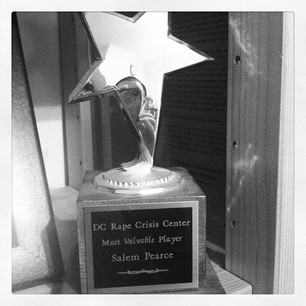
most valvable player; photo by salem pearce

I went on to win the “most valuable” volunteer award two years in a row. But I really, really don’t want this to seem like bragging. I am definitely proud of what I have done with the Center, but I haven’t done anything extraordinary. I just used the excellent training and support that the Center offered me. And it turns out that our society — not to mention the medical and legal systems that survivors must navigate — treat victims of sexual assault so badly that it doesn’t take much to seem practically like a ministering angel. In every encounter, I strove to meet survivors where they were and to treat them as what they were: human beings in pain.

I wish I could say that I remember every survivor I met in the hospital, but over the years the many faces and stories have run together. I’ve advocated for college students and for sex workers, for tourists and for homeless people. I’ve seen a survivor laughing and chatting with friends right before the exam — and I’ve seen a survivor beaten unrecognizable. I’ve had gifts pressed into my hands — and I’ve been told to “get the fuck out of my face.” I’ve helped a woman figure out how to keep an assault from her partner — and I’ve seen a man break down while trying to figure out how to tell his. I’ve seen survivors raped by lovers, family, friends, acquaintances, employers, caregivers, and strangers.

As might be expected, the work has taken its toll on me. On the hotline, I’ve been terrified by prank callers, worn out by repeat callers, cursed at by angry callers. A few years ago I suffered a bout of severe symptoms as a secondary survivor, as a result of exposure to so much trauma. I couldn’t hear or read anything related to sexual assault without being triggered. After a volunteering hiatus and numerous therapy sessions, the symptoms became less severe. And I’ve gotten much better at self-care, setting boundaries, and saying no.

Usually when I tell people that I volunteer at a rape crisis center, they assume the experience is thusly horrific. But — and this is why I decided to write this post — the experience was unquestionably and unbelievably rewarding. As I told my mom after I got that letter: I can die happy, since I know I have helped one person on this earth.

Even more, I found myself during training: I was unemployed when it started, and by the time it was over, I had my first job in D.C. Initially I wasn’t sure if I had the qualities to be a good volunteer, but the experience first showed me that I was capable of some measure of true selflessness and sympathy.

To be sure, I’ve seen possibly the worst thing one human being can do to another, but I’ve also seen the best thing one human being can do for another — in the form of the legions of (mostly) women willing to answer a phone or go to a hospital at any time of day for a total stranger. I’ve never stopped being amazed at my fellow volunteers. And some have become my closest friends or my (s)heroes: Mara Berman (who I met the first day of training!), Kim Shults, Edda Santiago, Ana Ottman, Mahri Irvine, Stacey Lantz, Chai Shenoy, Liz Nelson, Amy Gordon, Alicia Gill.

I can say with complete confidence that I’ve gotten more out of being a volunteer with the Center than I’ve given.

And yesterday, I asked to be removed from the active volunteer email list. More than anything else, this action has made real my upcoming move. I don’t know how to live in D.C. and not be a DCRCC volunteer; I’ve known the Center longer than I’ve known my husband.

But it’s time to go.

cutting for stone

Trigger warning: The book and this post, albeit briefly, explore the subject of sexual violence, which may be upsetting to survivors.

Each summer, my family rents a beach house in Atlantic Beach, N.C., and we spend a week together in what is always for me the most relaxing vacation of the year. I’m generally able to read four or five books — and everyone else passes the time the same way, often swapping books. Usually there’s at least one that forms a line: from the past couple of years, it’s been the latest in the Harry Potter series, Little Bee, and Water for Elephants.

Abraham Verghese’s Cutting for Stone was last year’s beach book, but vacation ended before the book was passed to me. I didn’t pick it up until recently, but apparently I’m on a kick of novels that take place during mid-20th-century upheaval in African countries. However, I think the book would have benefited more in terms of my review if I had read it last summer rather than when I did read it, which was mostly during Passover last week: my husband’s family is a little less used to me buried in a book than my family is. Some of the difficulty I had in concentrating may have spilled over into my opinion of the book.

Overall, I enjoyed the book — although I don’t think I liked it as much as my family did, or as much as the gushing reviews on the back cover. The story of extraordinary identical twins born under even more extraordinary circumstances, the novel takes the reader from India to Ethiopia, then to the U.S. and back, delving into the lives of a half a dozen medical professionals, most of whom are related.

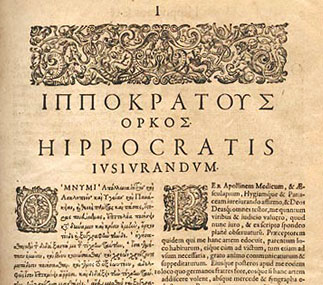
The title is a play on words that the book unfortunately doesn’t do much to explain. “Stone” is the surname of the twins, given to them in honor of their absent biological father. But it’s also a reference to a portion of the Hippocratic Oath: “I will not cut for stone, even for patients in whom the disease is manifest; I will leave this operation to be performed by practitioners, specialists in this art.” In this case, “stone[s]” refer to those of the kidney, bladder, and gallbladder, which must be removed via surgery — the distinction between physicians and surgeons an important one in 5th century BCE Greece. More generally, it’s a promise to do what is best for a patient — what is within the doctor’s skills — and not to overreach. It’s a lesson that the book illustrates, if not elucidates, well.

Born in the oddly-named Missing Hospital in Addis Ababa, Shiva and Marion are the improbable progeny of the hospital’s main surgeon and his surgical assistant, Sister Mary Joseph Praise. Their nun mother dies in childbirth, and their father leaves the country in grief, leaving the boys to be raised by two of the hospital’s other doctors. They grow up against the background of (historical) political turmoil in Ethiopia, which eventually forces Marion to flee to the U.S., where he pursues his medical studies, reunites with Thomas Stone, and finally decides to return to the land of his birth.

Verghese is a doctor, but he’s also a talented writer who is able to make compelling the intricacies of surgery (much like one of my favorite authors, Atul Gawande, who provided one of the adulatory blurbs). He weaves a beautiful story, told through the voice of Marion, an extremely earnest narrator. Marion is buffeted more than most by forces beyond his control, and my heart broke for him on more than one occasion (I was even in tears at the end of the novel). I was, however, not so sympathetic, when fueled by anger, he forces himself more than once on a vulnerable childhood friend. Verghese even has him use the phrase “took her” in describing one of the encounters, and the thrust of this part of the plot (excuse the terrible pun) is that Marion is justified in his behavior — although he certainly comes to to regret his actions (but for different reasons). It was a disappointing part of a story that otherwise treats relationships, not to mention the importance of humanity in practice of medicine, with sensitivity and wisdom.

first seder

louisville’s historic palace theatre on 4th Street; photo by eric hart

Last week my husband and I went to Louisville, Ky., where his parents live, for Passover. We had four days of absolutely gorgeous weather: sunny, blue skies, and cool. I’ve only visited my in-laws once before, so I still know very little about the city, but what I saw was quite lovely. Plus, my husband’s mother and step-father are really happy there: They never miss an opportunity to vaunt its advantages. After living their entire lives in New York, they’ve certainly found a new home. The pleasantness mirrored the overall visit.

But I was nervous beforehand, because my parents flew in from Houston to join us — and they’ve never celebrated Passover before. I didn’t know what they would think and whether they would have a good time, particularly my father, whose brand of evangelical Christianity makes it difficult for him, to say the least, to appreciate other religions.

Indeed, when I first converted to Judaism, he told me I was going to hell. He was very sad about it but nevertheless convinced of it. Of course, this meant that my mother-in-law’s declaration this weekend that she just couldn’t stand the belief of some Christians that non-Christians were going to hell created a bit of an awkward moment. (Weirdly, she has an employee who holds this very belief.) But I don’t think my dad was around at the time.

All of this is to say that I was pleasantly surprised that my dad agreed to come to seder. (My mom was very enthusiastic, having wanted to attend for a long time.) I’m not sure whether this indicates an a change or evolution in my father’s belief system. He and I don’t have direct conversations about my religion or my planned career in the rabbinate. It’s been painful for me to talk with him about it in the past, so as part of my self-care I’ve stopped trying. It’s now his issue to come to terms with. Plus, as my therapist has said, going back to that well is only trying to convince him of something — which is what I resent that he’s doing to me. So, as I’ve said before, we stick to safe topics. As for example, the fact that former Astro and Philly Brad Lidge now pitches for the Nationals, a fact I mentioned during the first night seder.

I had a great time at both seders. The first night were in attendance former neighbors of my in-laws, an older couple from the Ukraine; he was in a helicopter above Chernobyl when the explosion occurred and is one of the only survivors. My father-in-law’s cousin, his wife, and her son; my husband’s brother and his fiancée, as well as two friends of hers; and my father-in-law’s niece and her step-brother were there both nights. My father-in-law leads a pretty brisk and interactive seder — and is an expert afikomen hider, to boot — and my mother-in-law is a great cook. Add to that a fair amount of wine and great company, and there’s not much that could go wrong.

traditional seder plate with a few non-traditional items

In her typical unfiltered way, my mom pronounced the seders “more fun that I thought they’d be,” which I both laughed at and took as a compliment. As usual, it was hard to read my dad. But he dutifully read his parts of the haggadah and seemed to enjoy talking baseball and other topics with my father-in-law, whose worldview he shares. And in my family, uneventfulness at a gathering can often be considered enormous success. And on Sunday, he who has never met a burger joint he didn’t like got to try a new one, Smashburger, which he corralled all of the men to while the women were at the bridesmaid’s brunch of my husband’s soon-to-be sister-in-law. (By the way, there should be a better term for that relationship.) Obviously, not everyone in my husband’s family eschews chametz during Pesach.

Apparently my father-in-law never does the second half of the seder after the meal, which includes the second two cups of wine and the arrival of Elijah, so on the first night I got to lead it — which means I also got to insist that we sing Eliyahu HaNavi. I’m not a big proponent of the messianic era, but I do love the song. And in case you’re interested, we also sang Dayenu and Chad Gadya. And I got to explain the orange on the seder plate, which my mother-in-law included for me.

It was a lovely, restful weekend — and best of all, I didn’t have to do a thing but enjoy myself (read: did not have to cook). Thank you, Louisville!

anatomy of injustice

Raymond Bonner’s Anatomy of Injustice reads like a true-crime thriller, and I would say I enjoyed if I hadn’t spent the entire book alternating between anger and horror. A New York Times reporter, Bonner wrote the book from his journalism research, which started in Texas after then-Governor George Bush — who had presided over more executions than any other governor in history — stated on Meet the Press, “I’m confident that every person that has been put to death in Texas on my watch has been guilty of the crime charged and has full access to the courts. I’m confident.”

Since Governor George Ryan of Illinois had just two weeks before suspended the death penalty in his state because of eleventh-hour exonerations of several condemned prisoners, Bonner and a colleague were first sent to Texas, and then later other states, to investigate Bush’s claim and the state of the death penalty in America today. Anatomy examines just one of the many cases they looked into: that of Edward Lee Gilmore, a young black man of limited intelligence convicted of murder in South Carolina in a seven-day trial.

I’ll be the first to admit that I am not impartial on this issue. I think capital punishment is just the most egregious evidence that our criminal justice system is broken (second only to the atrocities of mass incarceration, prison-industrial complex, and drug war, among others). One of my dream jobs would be to work against the death penalty as a rabbi.

So it wasn’t going to take much to convince me of the miscarriage of justice. Tragically, it took 30 years to convince those who could actually do something for Elmore. He had three trials before he was sentenced to death for the last time, and it took almost 20 years to locate a potentially exonerating piece of evidence that the state thought was lost. The book ends before Elmore’s saga does: Last month, Elmore left a courthouse in Greenwood as a free man for the first time since 1982.

Bonner chose the case as emblematic of the many death penalty cases that occur in the 36 states in our country that allow the punishment. He notes, “Elmore’s story raises nearly all of the issues that mark the debate about capital punishment: race, mental retardation, bad trial lawyers, prosecutorial misconduct, ‘snitch’ testimony, DNA testing, a claim of innocence.”

It’s because so many death penalty cases have at least one of these issues that Elmore’s story is sadly familiar, so I won’t go into the details of his story. Bonner is able to make the case for Elmore’s innocence, overwhelming in the narrative and affirmed by his later release, even more compelling by being able to pretty reliably point to the real perpetrator, a neighbor with whom the victim was suspected of having an affair and who died years before Bonner started covering the case. He “discovered” the body and pointed the original investigators to Elmore, and they never even considered the former a suspect.

edward lee elmore, a few years before his arrest for murder

Several things struck me as I read. Abysmally represented at his original trials, Elmore benefited immensely from later (competent, not to mention tenacious and passionate) counsel from the South Carolina Death Penalty Resource Center. This is typical of many of these cases: The best representation is available on appeal. A huge part of Elmore’s experience was the direct result of the complete incompetence of his original lawyers. There are many dedicated lawyers and law students today working on the cases of death row inmates, so why aren’t more of them clamoring to be the original lawyers on these cases? Indeed, the book makes clear that one of the enormous hurdles that Elmore had to overcome during all the years of appeals was that, despite massive evidence of defense ineptitude, no one wanted to imply that previous lawyers, juries, and judges had made a mistake (especially not multiple times), or perhaps more perniciously, were racist or classist (which of course they were). It seems to me that the priority of death penalty opponents should be ensuring that those accused of crimes eligible for capital punishment get the best representation at their initial trials.

Secondly, Bonner devotes a good number of pages discussing the differing roles of prosecutor and defense attorney. The book opens with two epigrams on the subject from Supreme Court cases. Justice Byron White:

Law enforcement officers have the obligation to convict the guilty and to make sure they do not convict the innocent. They must be dedicated to making the criminal trial a procedure for the ascertainment of the true facts surrounding the commission of a crime. . . . But the defense counsel has no such comparable obligation to ascertain or present the truth. Our system assigns him a different mission. He must be and is interested in preventing the conviction of the innocent, but, absent a voluntary plea of guilty, we also insist that he defend his client whether he is innocent or guilty.

In other words, defense lawyers’ primary responsibility is to their clients, guilty or not; prosecutors’ primary responsibility is to the truth. Bonner argues that this prescription for prosecutors has gotten lost — and in the vacuum has risen a culture that values winning above all. Today, prosecutors of death penalty cases are generally more interested in convictions, in assigning blame for (what are often heinous) crimes, in assuaging public outrage and fear, in securing “justice” for the families of victims. Perhaps some of these are admirable, or at least understandable. But ultimately, Bonner argues, prosecutors are derelict in their duties when they lose sight of the fact that they are instead (or at least also) supposed to strive to protect the innocent.

What I know about the practice of law could fit into a coffee cup (just as everything I know about law school I learned from Legally Blonde, as I am fond of telling my amused law student interns), so please excuse my ignorance when I say that I simply didn’t know this legal principle. In popular culture, particularly in sympathetic portrayals of wrongly convicted criminals, prosecutors are routinely portrayed as cravenly careerist and eager to convict. While that may be an at least a somewhat accurate portrayal of reality, it’s not what the law proscribes. And Bonner’s book is an object lesson of why not.