rabbinical students on israel

j street's "fill to the green line" shot glass; photo by salem pearce via  instagram

j street’s “fill to the green line” shot glass; photo by salem pearce via instagram

Last Sunday, I managed to walk the five blocks from my apartment to the convention center to attend a session at J Street’s annual conference. I say “managed” because Sunday was a busy day for D.C.-area Jewish organizations. I ran Sixth & I’s Exodus 5K in Rock Park in the morning and went to JUFJ’s Labor Seder in the evening. Among the events I couldn’t squeeze in were Federation’s “Good Deeds Day” and a lecture by Anat Hoffman. (I think it’s possible that the Jews need to coordinate their events a little more.)

I’m really glad I took the time to attend the panel, called “The Changing Attitudes of Rabbinical Students on Israel: Perspectives from the Deans.” The deans in question were HUC-JIR’s Renni Altman; JTS’s Danny Nevins; and Hebrew College’s Daniel Lehmann (who I’m pretty sure is actually the president of Hebrew College, but no matter).

The creation of the panel was prompted by an article by Daniel Gordis published last year in Commentary: “Are Young Rabbis Turning on Israel?” The response was of special interest to me as an enrolling rabbinical student — but also because part of what prompted Gordis’s article was the commemoration of Yom Hazikaron at Hebrew College (where I’ve decided to enroll). The article caused quite a bit of uproar when it was first published: I happened to get an earful about it in October when I ended up sitting next to a man from the Republican Jewish Coalition on a trolley in Arlington Cemetery on the way to the dedication of the Jewish Chaplains Monument. When he found out I was applying to rabbinical school, he immediately brought up his horror about the article (published some five months earlier). His interpretation? Rabbinical students today more closely align themselves with the philosophy of J Street than with that of AIPAC.

For those not in the know, the reason this is so upsetting to some is that J Street engenders a lot of suspicion — if not downright hatred — among a large (or possibly the most outspoken) part of the American Jewish community. As for example: In November 2010, I attended a Federation lunch event that featured a debate between a conservative and a progressive about the meaning of the mid-term elections, particularly for the Jews. (The conservative viewpoint was represented by Bill Kristol, with whom I almost never agree, but who was miles more articulate than the progressive, who was unfortunately ridiculous — and whose name I can’t remember.) They argued for an hour, disagreeing about everything.

Until someone asked their opinions of J Street. Kristol responded that he thought the organization was a front for a pro-Palestinian agenda. The progressive: “I agree.” The room exploded in laughter.

This is not an uncommon view. J Street’s slogan is “Pro-Israel. Pro-Peace.” — but its opponents generally don’t believe any of its stated positions. It is routinely labeled “anti-Israel.” Recently I witnessed a Facebook exchange between an acquaintance of mine and an acquaintance of his about the BDS controversy at the Park Slope Co-op. (And if you haven’t seen “The Daily Show’s take on this vote, you must.) The person I didn’t know crowed about the failed boycott, adding the comment, “Take that, J Street.” When my friend pointed out that a) the BDS movement precedes the founding of J Street by several years, and b) that J Street opposes the BDS movement (and has position papers on its website to this effect), the former was unswayed. And he remained unswayed even when a VP at J Street weighed in on the feed that she has spoken on numerous occasions about J Street’s opposition to BDS. And so it went.
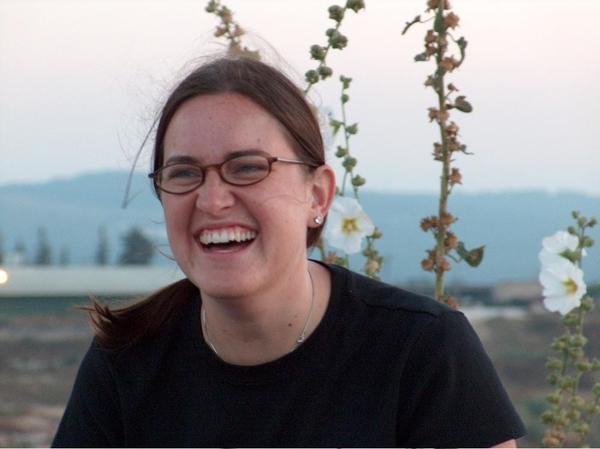
salem in israel in 2002

I’m nervous about wading even a little into the Israel-Palestine issue here, as it is, in the words of Rabbi Nevins, “unbelievably messy.” And I don’t really want to get it into it (more on that below), in no small part because it’s just not an issue I know that much about. I’m taking this risk, though, to explain the stakes and to make the point of how important it was that J Street addressed the issue. And it made me happy to see leaders of the schools I applied to at the conference. Whether or not you agree with J Street, they’re one of the few Jewish organizations that allows expression of a variety of viewpoints on Israel (as for example, when J Street noted that it disagreed with Peter Beinart but invited him to speak at the conference anyway). One of the things that I love about Judaism is that it values debate; but on Israel some believe that there are things we can’t say.

Also on the panel was Professor Steven Cohen of HUC-JIR, who had conducted a survey of JTS rabbinical students’ attitudes towards Israel in the wake of the article. All of the deans expressed disagreement with Gordis’s conclusions, and Cohen’s data seems to back them up. I suppose the deans’ remarks could be interpreted as merely defensive, but I’ve met and spoken with all three of them, and they are all thoughtful, responsible rabbis. Plus, they belong to the generation to which Gordis was drawing his contrast with current rabbinical students. But Cohen’s study did concur with the RJC staffer’s interpretation of Gordis’s article (if not his condemnation): Rabbinical students tend to agree with AIPAC less than with J Street or Rabbis for Human Rights — or the New Israel Fund, which was rated highest in political affiliation by students.

All of the deans acknowledged a shift in their students’ attitude towards Israel: “an evolution, not a revolution,” as Rabbi Altman characterized it. They agreed that rabbinical students do tend to hold more varied, diverse, and complex opinions about Israel than their predecessors. Gordis and his ilk attribute this to the fact that our generation didn’t grow up during the Six Day and Yom Kippur Wars, when existential threats to Israel were inescapable. But as Rabbi Nevins pointed up, our generation did grow up when bombs were exploding at pizza parlors and discos in Jerusalem, making Gordis’s point “more of truism than a deep truth.” Rabbinical students today — and indeed, young Jews in general — tend to prioritize different values in their support of Israel: human rights, say, versus the previous generation’s emphasis on loyalty. What most resonated with me was Rabbi Lehmann’s observation that Israel is now much less of a motivating factor to enter than rabbinate than it once was. Indeed, I remember thinking that it wouldn’t have even occurred to me that a North American Jew would become a rabbi because of Israel (I’ve certainly never heard anyone cite it).

Ultimately, the panel was an interesting glimpse into my future classmates and some of the issues I’ll be grappling with. I was reassured to hear about the diversity of opinion among my soon-to-be peers, and I’m looking forward to furthering my own Israel education.
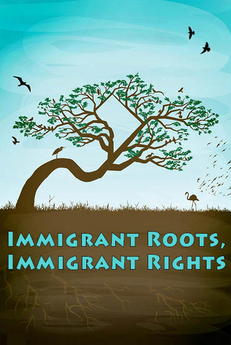
labor seder

Sunday night was Jews United for Justice’s (JUFJ) annual Labor Seder; for the two months prior, I led the program committee that wrote the haggadah. I was also honored with a reading and with leading the Shehecheyanu, one of my favorite prayers. As the graphic to the right alludes, the event this year focused on the issue of immigration in the D.C region.

As my reading, “Why a seder about immigration?,” stated,

In Hebrew, the word for immigration (“hagirah”) comes from the same root as the word “ger,” a word that can mean “stranger,” “foreigner,” or “other.” The word is used frequently in the Torah, most often in mandates to treat strangers living in our midst with respect and decency since we ourselves were once strangers in the Land of Egypt. Indeed, throughout history, the Jewish people have so often been in the position of the stranger, and much of Jewish history can be characterized as a history of constant migration, forced and voluntary relocation, and resettlement.

In short, the fact that all Jews at some point immigrated to our country obligates us to be concerned about the plight of all immigrants in our country. During the seder, we talked about the demographics of the immigrants in the D.C, their contributions to the region’s economy, and the struggles that they face, including paths to citizenship (for those who came here both legally and illegally). We largely focused on issues related to jobs — of which citizenship is obviously a huge part. D.C., Maryland, and Virginia have all recently been grappling with laws relating to immigrants, in particular the DREAM Act and the local reaction to the federal “Secure Communities” program.

Immigration issues have become a passion of mine since I studied their local implications as part of the Jeremiah Fellowship, a program that JUFJ runs to train “the next generation of Jewish social justice changemakers.” I learned a lot from the unit — and even more from writing the haggadah. I strongly believe in the kind of immigration reform advocated by the Hebrew Immigrant Aid Society (HIAS) — an ally of JUFJ and a co-sponsor of the seder — to wit, “. . . an effective immigration system guided by the rule of law, the national interest, fairness, and compassion.” There are specifics to this vision which I won’t get into here, for a variety of reasons. At this point I am so deeply enmeshed in this philosophy of immigration reform that it’s really hard for me to understand the ferocious opposition to any realistic — to say nothing of compassionate — action. It’s an issue that progressives don’t even agree on. However, if you seek vitriol, read the online comments on news articles that cover efforts other than the immediate deportation our country’s 12 million undocumented immigrants.

In addition to delving pretty deeply into immigration policy, I also began thinking about my own family’s immigration story. They aren’t Jewish, but they’re not Native Americans either — so they had to have arrived at some point. But it’s a story I hadn’t heard.

I decided to ask my dad. As I’ve mentioned before, I don’t have the kind of relationship with my father that facilitates these kinds of conversations. Or more precisely, I’m not sure he’d understand why I was asking in this context. Plus, my father is a lawyer, which for him means that he has to give precise answers at all times. It turned out that he had some genealogy, from my maternal grandfather, as well as his own family history. When I asked him about it at the beginning of February, he told me that he had loaned out his “big file” with all of that information to his brother and wouldn’t be able to get it back until mid-March. I told him that was fine, chuckling to myself that he didn’t give me any idea of that file’s contents; he never wants to misstate. A few days later, though, he got back to me with some details.

woody guthrie, apparently a relative

My maternal great-grandmother’s birth name was Guthrie, which family line can be traced back to John Guthrie in Edinburgh, Scotland. According to my grandfather’s notes, John Guthrie arrived in Jamestown in 1652. There was apparently a Guthrie Castle built in 1452, near Guthrie Hill, and that a Guthrie was dispatched to France in 1299 to get Sir William Wallace (“Braveheart”) to return to Scotland to oppose the English. It appears from my grandfather’s charts that the name was spelled “Guttery” until about 1854, when it became “Guthrie” again. My dad concludes this section: “Phil Kastelic [my uncle] may be able to tell you more about the recent Guthrie line: apparently Woody Guthrie is from the Guthrie family tree, and PMK is very proud of that connection.”

On his side of the family, my grandfather recorded Thomas Wilkes as his earliest known ancestor; he was born around 1630, location unknown. His son, Joseph Wilkes, is shown as having been born in New Kent, Va. in 1660. There are separate notes based on correspondence between my grandfather’s father and a Wilkes relative in Maryland that indicate that Thomas Wilkes arrived from England on February 25, 1653, at age 23, as an indentured servant. These notes also indicate that the birthplace of Joseph Wilkes was “just up the York River from Jamestown.”

So, not only did my grandparents’ ancestors both arrive at or near Jamestown in the 17th century — but they arrived within a year of one another! I was proud to tell this story at the seder on Sunday night, during the table discussion of attendees’ own family immigration stories. And I’m looking forward to hearing about my dad’s side of the family.

the women behind the missionaries

caleb's crossingI recently tore through both Caleb’s Crossing and The Poisonwood Bible. The first is Geraldine Brooks’ latest, published last year. I’ve read all of her fiction; her Pulitzer-prize-winning March is one of my favorite books.

The second is perhaps Barbara Kingsolver’s most well known work, which I’ve never picked up before. Last year I inherited my grandmother’s copy, which made the reading all the sweeter, knowing that she once enjoyed it. It’s a hardcover, so I assume she bought it shortly after it was published 15 years ago. One of her familiar address labels is affixed on the inside flap of the dust jacket.

I just happened to read them in succession (I’m trying to read more fiction), and they dovetail nicely. They’re both set against backgrounds of historical events, and the narrators of both are daughters of American clergymen bent on converting native cultures to Christianity (the Wampanoag on the island that would later become Martha’s Vineyard in Brooks’ novel, and the Congolese in Kingsolver’s). Sadly, though the settings are separated by 400 years, the Price sisters in the 1960s are offered just about as little opportunity as Bethia Mayfield in the 17th century: All of the girls hear a constant refrain about the uselessness of educating women. But in both tales, these women are much smarter, shrewder, braver, and more interesting than their naive missionary fathers.

Caleb’s Crossing is an ill-fitting name for Brooks’ work. Though it’s inspired by the life of the first Native American to graduate from Harvard College, the story belongs wholly to Bethia Mayfield, who achieves the book’s more lasting crossing: from the narrow realm of women’s chores to the limitless world of men’s education, from Puritanism to Wampanoag culture and back again, from her sister’s caretaker to scullery maid to wife and mother. She befriends the eponymous Caleb, the heir apparent to the Wampanoag who believes that being fully a part of the Mayfields’ white, Christian world represents the best chance for him to ensure the survival of his people. Caleb studies English, Latin, Greek, and Hebrew indefatigably (yes, I was jealous), gains admission to Harvard, and graduates with honors, doing better than many of his white counterparts. But the price he pays is extremely high, and the reader knows that all of his efforts ultimately will not save the Wampanoag. Through the plot’s twists, Bethia is able to accompany him to the mainland, and it is she who is more successfully changed for the experience.

One of the hardest things as a modern reader is to fathom the attitudes of those who believe themselves to be “civilizing” cultures, remaking others in their own image. I felt unspeakably sad reading about the changes Bethia describes that Caleb undergoes as he moves from robust hunter to sallow scholar. The same process in historical fiction such as this and other books of the genre (like Things Fall Apart) makes me, to be blunt, hate white people. The story of the Congolese in The Poisonwood Bible is made only slightly less painful by the fact that the village of Kilanga is largely immune to Reverend Price’s proselytizing.

It helps that Price is something of a ridiculous character (in contrast to Mayfield’s earnest and ethical attempts to engage the Wampanoag): His daughters note his mispronunciation of the Lingala word bangala, which, depending on how it’s said, can mean “dearly beloved” or “poisonwood tree,” leaving Price to preach week after week that Jesus is the local tree that can cause intense pain and even death. But Price is lucky to have this gaffe to humanize him, because he is otherwise a vile character. His cultural arrogance and condescension are insufferable, and his complete inflexibility, even in the face of danger because of the country’s unrest (the political turmoil of the post-colonial era), rips apart his family. I spent most of the book hoping for him a violent death. It’s his daughters, who take turns talking about their experience in Congo and afterwards, who charm and delight, even in the midst of their tragedies.

beit din

Yesterday, I got an email at 7:30 a.m. from the rabbi who married me and for whom I do clerical work once a week (she has a private practice). She needed a third for a beit din and a witness for the concomitant mikveh. I had a meeting that ended when the event was supposed to begin, but I agreed to duck out early, grab a cab, and race north to Adas Israel, the location of the community mikveh in D.C. It wasn’t what I was planning to do yesterday morning, but I am so happy that I did, for many reasons.

The event was a conversion for a 13-year-old boy who was marking his bar mitzvah in Israel in two weeks. Neither of his biological parents were Jewish. His father died when he was very young, and his Jewish step-father adopted him at a very young age (the boy even had the stepfather’s last name). His mother is still not Jewish, but she and her husband have raised the boy so.

A beit din (literally “house of judgment”) for conversion consists of three individuals — generally rabbis, but two can be educated Jews as long as one is an ordained rabbi who is an expert in the rules of conversion. I served along with two rabbis.

adas israel mikveh

I was really impressed with the young man. He was articulate about his desire to affirm his Judaism — and he was honest (saying, for example, that he didn’t like his Hebrew school — hee!). The beit din was mostly just a conversation among everyone. We then headed to the mikveh. The male rabbi and his father actually witnessed the three immersions, but the door to the mikveh was slightly ajar so that we could all hear him say the blessings, including the Shehecheyanu, one of my favorite blessings. We threw candy at him when he emerged from the room. Unfortunately, the rabbi had brought (kosher!) taffy, which he couldn’t have because he had just gotten braces; I was able to scrounge up a piece of hard candy in my purse for him. At the end of the ceremony, the father asked if he could make a donation to a charity I cared about to thank me for my participation, and I asked for a gift to the D.C. Rape Crisis Center, where I serve on the board.

This experience was so amazing — very special to me and incredibly holy. I was thrilled that I made the effort to be there. Plus, the rabbi on the beit din who I didn’t know has already been super helpful. He was very encouraging about my rabbinical school decision, and we’re already having a discussion about a possible fundraising job during school!

I got to sign the conversion certificate, the same template that I received two-and-a-half years ago. (Also, it turns out that I have as much trouble writing in cursive in Hebrew as I do in English. Must practice!) Before the family departed, the father thanked me for participating, noting that “you always remember these moments and those who were there.” I smiled and flashed back to my own beit din, knowing it was true.

a new spring

(probably not) cherry blossoms in scott circle; photo by salem pearce

Yesterday, Saturday, was a gorgeous day here in the nation’s capital. It was sunny and 70 degrees, and Shabbat was made sweeter by the fact that I had found out the day before that I was accepted at the third rabbinical school to which I applied. After morning services, I sat in Dupont Circle with my husband and felt like I could relax for the first time in at least six months. I read (Patti Smith’s Just Kids) and took a few photographs (right and below).

Yesterday felt like a new beginning in another way, as well: I led part of the Shabbat morning service for the first time! Sixth & I hosted a Learner’s Minyan in the morning, led by Rabbi Shira Stutman. The rabbi who is teaching my adult b’nai mitzvah class, Lauren Holtzblatt, arranged for the class to lead the parts of the service that we’re planning to in June during the official ceremony. I’ve volunteered for the second half of the Torah service (putting the scroll away) and for the mourner’s kaddish.

st. patrick’s day green grass at dupont circle; photo by salem pearce

Unfortunately, the past month of travel hasn’t left me any time to practice, so I had to beg off of the Torah service part. I decided to go ahead with the mourner’s kaddish, which I realized while I was leading is actually a little unnerving. The only people who are standing and reciting most of the prayer with the leader are the few in mourning or observing a yahrzeit (although I did ask those whose custom it is to stand to do so). Even so, I could only hear myself in the large sanctuary that was hardly filled, and saying the mourner’s kaddish by (what feels like just) myself is quite different than saying the hatzi kaddish with the whole congregation, when it doesn’t matter if I stumble over a word or two. I’ve got some practicing to do.

Despite my nerves, though, I was able to say to the congregation yesterday that I was leading and saying the mourner’s kaddish for the family of Trayvon Martin. This clear abrogation of justice has troubled me all week: I am proud and privileged to be an American, but I sometimes loathe my country’s institutions.

But the long road is coming to an end: I’ve gotten into (in alphabetical order) Hebrew College (in Boston), HUC-JIR (in New York), and Reconstructionist Rabbinical College (in Philadelphia). I am tentatively leaning towards one school, and I am pretty sure it will be a choice between two of them. But I’m not ready to make that intention more explicit at this point.

I now move on to the decision-making part of the process, which I hope to wrap up in the next few weeks. Stay tuned!

god vs. gay?

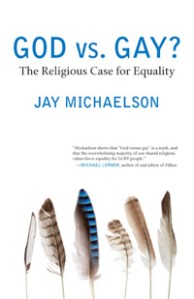
I was fortunate enough to be able to hear Jay Michaelson, author of God vs. Gay?: The Religious Case for Equality, speak at the Washington DCJCC in October, as part of the Hyman S. & Freda Bernstein Jewish Literary Festival. At the end of his excellent talk, a man in the audience stood up, ostensibly to ask a question. He announced, “Well, I wasn’t going to come to this event, but then I saw a picture of you.” We all laughed. A shallow disclosure perhaps, but Michaelson is indeed good-looking — and I think anything that gets people in the room is good. As many as possible need to hear what he what he has to say.

First and foremost, Michaelson is a scholar. He has a J.D., an M.F.A., an M.A., and he’s working on his Ph.D. — and all of these degrees are from Columbia, Sarah Lawrence, Yale, and Hebrew University. He’s also what I would probably call a Conservadox Jew. He makes learned, articulate, and persuasive arguments. This last fact is fortunate, because he covers in this book one of the more contentious issues of our time: what the Hebrew Bible and the New Testament say about homosexuality. And Michaelson doesn’t think those texts even come close to what every day we’re told they say.

Note: I am using the word “homosexuality” because it’s the word that Michaelson uses, and because many of the arguments that have been made against equality are based on verses that are concerned with “homosexuality” in the strictest sense (that is, same-sex sexual behavior), the Hebrew Bible and Christian scriptures having nothing to say about the social or cultural concepts of “being gay” or the same-sex relationships we’ve come to know in modern society. I do acknowledge, though, that the word can be clinical, distancing, and archaic.

Michaelson begins with the premise that while for him — and many others — the secular, constitutional argument for equality is sufficient, many religious people feel conflicted (at best) by the understood condemnation of homosexuality in scripture. He wants to meet these people where they are and address their concerns. “I sincerely believe that our shared religious values call upon us to support the equality, dignity, and full inclusion of sexual and gender minorities — that is, of lesbian, gay, bisexual, and transgender people.” It is said that only Nixon can go to China; similarly, only someone truly committed to the importance of religion could convincingly make this argument. And one of the things I like about this book is Michaelson’s willingness to take seriously the concerns of self-identified religious people. I don’t know that those of us who are absolutely committed to civil and legal equality for LGBT folks get anywhere by telling people their religious teachings don’t matter (and indeed, I would say we haven’t gotten anywhere).

I can see how some might feel that this endeavor is either a fool’s errand or completely irrelevant to the current debates about how our governments should treat LGBT folks. It might be both. Michaelson was preaching to the choir with this reader, so it’s hard for me to say objectively how convincing his arguments are, especially in the face of the constant drumbeat from places of worship of “Man shall not lie with another man as with a woman; it is an abomination!” As for relevancy: like it or not, religious beliefs inform opinions about secular issues; I think anything that addresses the motivations of prejudice is a good thing.

Michaelson divides the book into three parts: why our fundamental values support, rather than oppose, equality for sexual minorities; what the “bad verses” really say about homosexuality; and why inclusion of sexual minorities is good, not bad, for religious values. I found the first two more compelling than the third, and the second most of all. I am a fan of close textual readings, and it always amazes me when really important issues (like how we treat our fellow human beings) are decided on the basis of modern and often agenda-driven English translations of ancient texts. As Michaelson points out, only seven verses, out of more than 31,000 in the Hebrew Bible and New Testament, make reference to same-sex sexuality activity. So we don’t have much to go on — and we’d better make sure to get right the limited text that we do have. Indeed, the first part of Michaelson’s book is concerned with the values that should and must drive our understanding of LGBT folks in that absence. For instance, Jesus never made one recorded statement about homosexuality. Christians, then, are left with his teachings about love, compassion, mercy, tolerance, and justice for guidance about this issue.

I did have a few quibbles with Michaelson: More than once he mentions Eddie Long, who has been accusing of sexually abusing teenage boys, in the same sentence as other clergy condemning homosexuality found to be engaging in same-sex sexual behavior. But the problem with Eddie Long is that not that is he a closeted gay man or a hypocrite, as the others — it’s that he’s a perpetrator of child sexual abuse! Michaelson also uses the judgment-laden word “promiscuity” and similarly makes negative judgments about prostitution.

Overall, though, this book was excellent: persuasive and well researched. I picked it up because as a religious person, it’s important to me to know what my tradition says about homosexuality. I had assumed that mainstream interpretations were more or less accurate; I’d just dismissed them as archaic, as much use to me as the prohibition on wearing clothes made of linen and wool. Sadly, I’m not sure of the book’s chances of gaining a wider audience. But I can’t think of a book that our country needs more.

marriage

Today began and ended with my reflecting on marriage. It also began with sad tears and ended with happy ones.

I am sorry to say that this morning I had to go to D.C. police (MPD) headquarters. My husband had his wallet and phone stolen from a gym locker last month, and the police report on the incident was the last document I needed to complete our renter’s insurance claim. The insurance company had requested the report from MPD but naturally had not yet received it three weeks later. The complainant (or the complainant’s spouse) can request the report for free — but only in person! — so I headed to Judiciary Square after breakfast. I expected the process to be at least somewhat trying — as is almost all interaction with District bureaucracy.

It started with the metal detector. “You have cuticle clippers in your purse,” the guy running the x-ray machine tells me. “Where are you going?” When I tell him I need a copy of a police report, he non sequiturs, “Please take the clippers out of the building.” (I have no idea why he asked me what I was doing in the building, because it sure didn’t seem to make a difference to him.)

“I have to leave them outside?” I ask, confused. “I didn’t say that,” he responds. “You have to take them out of the building.”

Sighing, I take the offending object outside and place it on a concrete window ledge. I come back inside and repeat the security drill. This time (but why wasn’t it last time as well?) it’s a pair of tweezers. “Take them outside the building,” he repeats.

Lather, rinse, repeat. This time, it’s my coin purse. He tells me to just hold on to it as I walk through the metal detector, which of course goes off. I point out the coin purse in my hand to the other security person, who wands me anyway. The wand beeps near my jacket pocket: my office keys, which haven’t caused the metal detector to go off during the previous three times I’ve already been through it. “Why did you leave those in your pocket?” she demands. Flustered, I stammer that I must have forgotten about them. She motions me back again. I put the keys in the purse and try again. This time she wants to know why I’m holding my coin purse. “Because he told me to,” I almost scream in frustration.

All of this would merely be Kafkaesque, but I’m retelling it to underline the fact that I was in no mood for bullshit when I got to the Public Documents Unit. The trouble begins when the woman returns with copy of the report she’s retrieved. “I need to see your ID, because your name isn’t on the report.” I explain that I wasn’t involved in the incident and hand her my driver’s license. She hands it back to me: “I need to see something with your married name.”

Feeling the heat rising, I force myself to say calmly, “I don’t have a ‘married name.’ I didn’t change my name when I got married. I am telling you he’s my husband; the address on my license is the same as his on the report, and I am wearing a wedding ring.”

“Well, I’m wearing a wedding ring, and my husband’s dead.” (Yes. She actually said that.) She continues, “I can’t believe you don’t have something with his name.” We go back and forth in this vein until she finally thrusts the report at me and peevishly informs me, “You just got a free report.”

“Yes,” I reply. “The free report that I’m entitled to as the complainant’s spouse!” I’m so angry at this point I am shaking. “So you say,” she ends.

I’m crying before I’ve gotten on the elevator, kicking myself for letting her get to me and for not anticipating something like this. The thought did flash through my brain as I was looking online for how to get a police report: It’s free for a spouse . . . I wonder how that is verified? (There is absolutely nothing on that page about needing proof of marriage or what that would entail.) As far as I can tell, the Public Documents Unit at MPD is “verifying” marriage through last names.

Not only is this “policy” hopelessly old-fashioned (I can’t believe I’m the first spouse with a different last name to request a copy of a police report), it’s only going to become more problematic as same-sex married couples (who choose to take each other’s names even less than straight people do) become victims of crime. So MPD is either going to have to come up with a way to easily verify marriage, or they’re just going to have to take our word for it. The kicker to all of this is that the fee for police report for a third party is $3. The woman who works in this office gave me a hard time over three dollars.

I was surprised this hurt so much, and I don’t cry easily. In retrospect I know it bothered me because I have issues with one-size-fits-all corporate or bureaucratic policy. (And I choose these words in particular because my therapist has said exactly this to me: “Salem, you have issues with one-size-fits-all corporate or bureaucratic policy.”) And this is a one-size-fits-all bureaucratic policy par excellence. Usually I just get annoyed or frustrated with this type of stupid inflexibility, not hurt. But this felt like an attack on my personal choices — and on my commitment to my marriage. It devastated me that someone would doubt that I was married solely because my spouse and I don’t share a last name.

The day ended better than it began, though. From one of my least favorite D.C. institutions to one of my favorite: Sixth & I Historic Synagogue. I went to the 6th & the City Friday night services because my friend Julia would be there on her last night in D.C. before moving to L.A., and my friend Annie was celebrating her aufruf.

Kabbalat Shabbat services always make me feel better, and sitting in the pew — listening to Rabbi Shira bless Annie and Marc, singing siman tov and mazel tov, watching everyone dance around the sanctuary, and throwing candy — I was so grateful to be a part of tradition that celebrates marriage. There was no one in that crowded room who thought any less of my marriage because my husband and I have different last names (least of all the rabbi, who also does not share a name with her husband). My heart was full, and I was happy to be affirmed, happy for Annie and Marc, happy to be Jewish, back in the space where I got married. Hare ata mekudeshet li betaba’ at zo k’dat Moshe v’ Yisrael . . .

golda

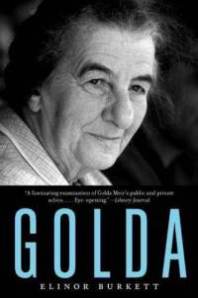
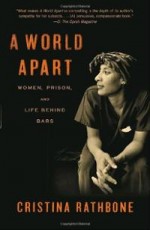
golda In her excellent biography Golda, Elinor Burkett gives her readers an entirely new definition of the word “tenacity.” Her subject, Golda Meir, the first female head of the state of Israel, achieved all that she did through sheer force of will. And she did so with little support from her family — father, mother, sister, husband, or children — and, for most of her career, in extremely poor health. Adored in America, she was reviled in Israel for her role in the Yom Kippur War, but it’s ultimately hard not to have sympathy for this woman from another time, doing the best she could in a modern world that had disappointed her.

Born Golda Mabovich in Kiev at the very end of the 19th century (she became Meyerson upon her marriage and Meir under pressure from David Ben-Gurion to Hebraicize her name), she was shaped by her first memories of pogroms in the Russian empire. As a young girl, she and her mother and two sisters followed her father to Milwaukee, where he had moved to find work. After 15 years in the United States, Golda made aliyah to then-British Mandate for Palestine, where she lived until her death in 1978.

Golda was heavily influenced by her older sister Sheyna, who introduced her to Labor Zionism, which informed Golda’s drive to establish and work for the state of Israel — and led her to try to join a kibbutz upon her arrival in Tel Aviv. But she and her husband’s first application was rejected, as was their second. Golda eventually managed to wrangle a place on the communal farm, but she and Morris were never fully accepted as kibbutz members, in part because of the perception of them, as a married couple, as hopelessly bourgeois Americans. Yet Golda persisted, thus establishing a pattern she would follow her entire life. Motivated by idealism, Golda tries to do something; Golda is rebuffed; and then Golda “bashes heads together” to get her way. Working her way up through pre-state quasi-governmental organizations and later the Israeli state apparatus, Golda would do it again and again.

Interestingly, Golda’s commitment to Israel was purely a matter of ensuring self-determination for Jews, so that they wouldn’t ever again have to rely on other countries for their survival. Her experiences of the pogroms of her youth and the Holocaust of her middle age solidified her militancy on this topic. It’s somewhat hard to imagine, given the influence that the ultra-religious now have on Israel, but its founders were largely completely secular. On erev Yom Kippur in 1973, as the war brewed, Burkett relates how Golda sat down to dinner with her family — on a holiday when even the least observant religious Jews generally fast.

As might be imagined, this ambition — as it could only somewhat accurately be described — didn’t leave much time for even a semblance of a personal life. Indeed, Golda was never as much wed to Morris as she was to her work. Although she did manage to make time as a younger woman for a few lovers (a fairly typical practice among the early, free-love Socialist Zionists, for whom divorce was equally rare), she and Morris gave up acting like married couple less than 10 years after emigrating. Morris died in 1951, and Golda never remarried — or it seems, ever had another intimate relationship. Golda’s children judged her especially harshly for her lifestyle, and while they were certainly justified in feeling so — and Golda admitted as much — Burkett doesn’t address their father’s abandonment, arguably as complete. Morris struggled with employment his entire life; he certainly had the time to step in for Golda. But in 1938, he moved to Persia, leaving their two children to her.

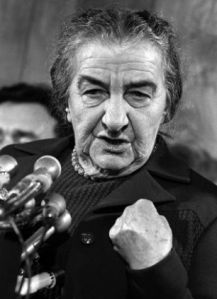
goldaSoftening her edges a bit was her famous wit. The stories are legion of her one-liners and quips, and the press hung on every one. On her 80th birthday, in the midst of peace process negotiations, she declared, “I wouldn’t want the West Bank even if it were given to me as a birthday present.” When Henry Kissinger, mediator after the Yom Kippur war, whined about her public coldness towards him (“When I reach Cairo, Sadat hugs and kisses me. But when I come here, everyone attacks me.”), Golda rejoined, “If I were an Egyptian, I would kiss you, too.”

But she couldn’t joke away her health problems, though she tried valiantly to ignore them until she was ordered into recuperation. She suffered from obesity; heart and circulatory problems; a twisted leg, and later phlebitis and blood clots; migraines; gallbladder attacks; kidney stones; a broken shoulder; and lymphoma. These weren’t helped by her three-pack-a-day cigarette habit. And as with everything else she deemed inconvenient, Golda barreled through her illnesses, often cutting short treatment to attend to a matter of state.

In the book, Burkett manages the near-impossible: building suspense in the story of the founding of Israel, an incredibly painful narrative. I actually found myself wondering whether the new state would be able to overcome its challenges. But I shouldn’t have, because Golda was always there, willing it into being behind the scenes.

what’s in a name?

A few weeks ago, I went to an event at Sixth & I hosted by “Not Your Bubbe’s Sisterhood” (a group that comes with the hilarious caveat, “For women in their 20s and 30s. And for the record, we love all bubbes everywhere.”)

The event was co-hosted by Lilith magazine: The cover article of its latest issues asks, “What’s in a Hyphen?” In it, the author explores “what’s lost, reclaimed, or reimagined when we’re hyphenates” (joining both parents’ surnames). In the salon-style event, we split up into small groups to talk about names and identities.

The discussion’s focus was a little too heterocentric for my comfort, but since name changing often happens when women marry men, and since I’ve struggled with this very issue, I’ll admit that I only tried to change the subject a couple of times.

I did not change my name when I got married. I always assumed that I wouldn’t, especially since I identify strongly as “Salem Pearce.” My husband wasn’t interested in changing his name, so any conversation that might have occurred ended there.

But I secretly struggled with the decision. I say secretly because it was hard for me to admit; I didn’t even tell my husband about my wavering until a few years after we were married.

“Pearce” is my father’s name, and my relationship with him is difficult, to put it mildly. When I visit him and my mother in Houston, we get along, but only when we stick to the safe topics of the weather, home improvement, and sports. My husband likes to tease that all I did by keeping my name was choose my father’s name over my husband’s, but I don’t think that’s the whole story. I got married when I was 31: By that time, “Pearce” was my name, too.

But there’s another layer. As a convert, I long for a readily identifiable Jewish name, and my marriage could have offered an easy path to this. “Pearce” is just about the WASP-iest name there is, but I’m not sure I can see myself as anything else.

As it turns out, this desire for a more Jewish name is not limited to converts! The rabbi who teaches my b’nai mitzvah class cited as her reason for taking her husband’s name the fact that her father isn’t Jewish: Thus, she opted for “Holtzblatt” over her birth name. And one of the participants in the salon arranges trips to Israel in her job and fears that the people she corresponds with assume she’s not Jewish because of her non-Jewish-sounding name.

Of course, a fair number of “Jewish” names — ones that we dub “Jewish sounding” and ones that we’ve come to think of as “Jewish” — have been changed from the originals: at Ellis Island, by immigrants themselves, by longtime Jewish residents who wanted to be less readily identifiably Jewish. My colleague Liz just told me last week that her grandfather changed his last name from Rosenblum to Ross, and it was her father who changed it again to its current form, Rose. My father’s family has been “Pearce” for centuries: So many recent changes boggle my mind.

If I’m being honest, another thing that boggles my mind is the fact that two women in the salon were ambivalent about changing their names at their upcoming marriages. Feeling strongly one way or another I understand, but not knowing how you feel? Harder to get. Another soon-to-be-wed (to-a-woman) woman said she wouldn’t even consider it. But the best story of the night belonged to a woman who had changed her name when she got married, for a year felt like a stranger to herself with a new name, and then changed it back to her birth name! She said that her husband was fine with both decisions, and the only reason she made the first one was that she thought she should do something that was expected for once in her life. Of course, that’s overrated.

interview the first

Optimized-HiRes.jpg

Earlier this week, I took a trip for my interview and testing at the first rabbinical school to which I applied. (As I’ve said before, it’s easy to figure out which school it is, but it’s not that important for this post.)

Joe came with me so that he could get a feel for the school and the surrounding area. We stayed with a new friend that I met on my visit to the school; he and his fiancée were nice enough to offer us their queen-sized guest bed. The home hospitality offered during all of these rabbinical school visits certainly has made the trips more affordable — not to mention has afforded the opportunity to get to know potential schoolmates and further perspectives on the schools.

The testing was a mixed bag. I can say with some confidence that the best thing about it was at the end, when I got up to turn in the last test and I fell out of my chair (in front of two other prospective students, I might add). In my concentration and/or fear, I hadn’t noticed that one of my legs had fallen asleep. It was very Liz Lemon.

The three hours of Hebrew wasn’t as bad as I expected; it was the one-hour “Jewish Traditions” exam that was heartbreaking. This reality was made worse by the fact that I really thought it was going to be the opposite. I was wholly unprepared for how badly I would feel at the end.

I think I did well enough on the basic modern and Biblical Hebrew sections and middling on the Rabbinic. I didn’t even attempt the advanced modern — or the composition. (I am sorely lacking in Hebrew writing skills. As I am in Hebrew conversational skills, a part of the test that I also bombed.) I did well reading aloud from the siddur and Torah — although I was chagrined at the feedback that I confused my sins and shins.

The “Jewish Traditions” exam made my heart sink into my stomach: two pages of Hebrew terms to define and explain the significance of, and I only knew about three at first glance. And with this kind of exam, further reflection doesn’t yield more answers. I either knew them or I didn’t — and I didn’t. So I spent the rest of the time writing the terms down, so that I could look them up and learn them later. (Joe said he thought this was as much evidence of my readiness for rabbinical school as actually knowing the terms. I hope he’s right. Either way, I won’t soon be forgetting what hatafat dam brit is.)

The next day, the interview went considerably better than the testing. Though I faced seven people, I’m generally good at interviews, so I wasn’t fazed. And they all asked thoughtful questions, which I really appreciate. That experience did much to buoy my spirits after the previous day.

Unsurprisingly, I was asked how I would decide which school to attend if I were accepted at all the ones I’ve applied to. I answered honestly: I’ve gathered all the information that I can, so I’m thinking that it’s going to come down to a feeling. Joe liked the school and the area, as do I, but I’m honestly not sure what my feeling about the school is.

I’ve been exhausted and starving since I returned. I think the combination of anticipation, stress, frustration, disappointment, enjoyment, and being around new people just ran me down. And I’ve got to do this at least twice more . . .