
down-ton abbey

Spoiler alert: I reference events in episodes that have aired in both the U.K. and the U.S., but I include the caveat for any readers who haven’t yet seen the series.

I’m an enthusiastic fan of “Downton Abbey,” the hugely successful British television drama set in the early twentieth century, the story revolving around the Crawley family and the servants of the eponymous estate in Yorkshire. The principle preoccupation of the family is the fact that Lord Grantham’s title, his estate, and his wife’s money — because of the ironclad English law of entail — all pass to a distant cousin upon the death of the previous heir and his son on the Titanic, which event opens the pilot. I love period drama, especially of the British late 19th/early 20th century variety. Indeed, I literally squealed with delight when I saw that Lady Mary Crawley references Tess of the D’Urbervilles in the upcoming episode.

There are so many wonderful things about this show: The accents. The fear of “new” technology (electricity! typewriters! telephones!). The gorgeous clothes (for the upstairs family, anyway, though the servants wear nicer things to wait on the Crawleys than most modern people ever do). The glimpse into a way of life that is so removed from a modern American audience. The well-developed characters: scheming Thomas and O’Brien, unflagging reformer Isobel Crawley, rebellious Sybil Crawley, the witty Dowager Countess — who it is universally acknowledged has the best lines of the series. (If you’re a fan and haven’t seen this video, you must. And you may appreciate it even if you’ve never seen the show.)

But — and I think with most mainstream entertainment, there is almost always a “but” — the latest episode to air in the U.S. gave me pause. Of course, there were issues all along. As one critic writes, somewhat contradictorily,

Even with its high-lather soap factor, no one would consider “Downton Abbey” a guilty pleasure — it’s “Masterpiece,” for heaven’s sake, the television equivalent of graduate school — though certainly creator Julian Fellowes makes it easy for an American audience to empathize with pampered members of the master class. . . . By conveniently blurring the class distinctions of the time with a lot of noblesse oblige and more than a dash of modern psychology, Fellowes and his writers allow their audience the benefits of a romantic period piece and none of the troubling drawbacks.

She then goes on to talk about the oppressive class system that bolsters the Crawley family — which I would certainly identify as a “troubling drawback” in even the most cursory critical examination of the show. For this reason, and others, I do consider “Downton Abbey” a guilty pleasure.

In “Episode Eight” of Series 2, which aired last Sunday, veteran Matthew regains his ability to walk after suffering severe spinal damage in the war. The ableism of this plotline — in service of giving viewers the long awaited, unblemished reunion of Matthew and Mary, whose on-again, off-again relationship drives a great deal of the show’s plot — is troubling.

We get a first glimpse in the pilot of the era’s anxiety around people with disabilities with the arrival of the new valet, who walks with a cane. The whole house is in a tizzy about whether Bates will be able to do his job, and he’s sacked towards the end of the episode — only to be saved, deus ex machina style by Lord Grantham, who seems to recognize the claims of an old friend more than the injustice of preemptorily firing a worker. And like magic in the next episode, all concerns about Bates’s performance are gone; they never come up again. It’s not clear if that’s because they were exaggerated, based on the prejudice of the times, or because accommodations were made for him. And since the villainous valet and lady’s maid find plenty of reason, besides his disability, to collude against him, one ultimately wonders why Bates was given this characteristic at all.

The issue returns in the latest episode, as Matthew (understandably) continues to struggle with the prospect of life in a wheelchair. I realize that these were different times and there were not the accommodations that now exist for people in his condition, but it struck me as extreme (and not a little sexist) when he sends his heretofore fiancee, Lavinia, back to London, citing his wish to keep her from a sexless, childless existence. But we aren’t afforded any view of the presumed obstacles that he must now face in an environment ill-equipped for his wheelchair. The very practical issues of how he gets around in a house full of stairs, of who is assisting him with bathing, dressing, and using the bathroom are not addressed. The heir presumptive must not be subject to these indignities, and the show acts as though it’s simply a matter of Bates — who in the pilot, we were told, wasn’t able to carry anything as might be required in the course of extra duties! — helping him move from wheelchair to bed. And when it becomes clear that Matthew will recover, though he’ll carry a bruise on his spine for the rest of his life, he quips, “But at least I’ll have a life” — which statement is at the very least hugely insulting to anyone in a wheelchair.

What’s more, the episode goes on to show that Matthew must be spared not only the wheelchair — only an able-bodied man is worthy to be the next Lord Grantham — but even the burden of having to appear ungentlemanly. In a truly horrifying development, as Lavinia lays dying of Spanish flu, having realized that he’s still in love with Mary, she manages to choke out, “Isn’t this better, really? You won’t have to make a hard decision . . .” So in the show’s really fucked up logic, it’s better that Lavinia die than Matthew have to do something selfish so that he and Mary can be together? This is the pinnacle of the show’s contortions to bring the protagonists to what I assume is coming: their marriage, securing Mary’s place in society and neatly resolving the problem that has propelled the series since the pilot. Hence my post title, “Down-ton Abbey,” as the show’s writers reach a new low in this episode.

I still plan to watch and enjoy “Downton Abbey” — if not just to delight in the swoon-worth Dan Stevens — but I’ll continue to do so carefully.

blue nights

I was drawn into Joan Didion’s latest memoir, Blue Nights, immediately. She begins by writing about a season changing from spring into summer into fall:

To the English it was “the gloaming.” The very word “gloaming” reverberates, echoes — the gloaming, the glimmer, the glitter, the glisten, the glamour — carrying in its consonants the images of houses shuttering, gardens darkening, grass-lined rivers slipping through the shadows. During the blue nights you think the day will never come. As the blue nights draw to a close (and they will, and they do) you experience an actual chill, an apprehension of illness, at the moment you first notice: the blue light is going, the days are already shortening, the summer is gone.

I’ve only read one other Didion book, The Year of Magical Thinking, the memoir that preceded Blue Nights. Tragically, the former is about the death of her husband in 2003; the latter, the death of her daughter two years later. It’s hard to escape the fact that few have unexpectedly suffered more than Didion.

In both books, the difficult subject matter is made easier by her beautiful writing. Her prose is positively poetic. I read The Year of Magical Thinking weeks after the death of my beloved grandfather, and it helped me immensely in dealing with his death. The book also touched on her daughter’s struggle, who was in a coma at the time of her father’s death (but managed to recover long enough to attend the funeral). When it was published, I was eager, as odd as it sounds, to read the second part of Didion’s saga. Her recent experience is heartbreaking, and accompanying her on her journey through grief is comforting.

But if Blue Nights drew me in right away, I had a hard time finishing it. In some ways, what Didion describes in both books is universal: With grief come questions. How did the illness actually cause death? Did the deceased anticipate the end? How did I fail my loved one? How could I have made the time we had left more meaningful? Why didn’t I . . .? And no one articulates these hard questions better than she.

In other ways, Didion mistakes her experience as universal. Toward the end of the book, she contemplates the suddenness of change: “One day we are absorbed by dressing well, following the news, keeping up, coping, what we might call staying alive; the next day we are not. One day we are turning the pages of whatever has arrived in the day’s mail with real enthusiasm — maybe it is Vogue, maybe it is Foreign Affairs, whatever it is we are intensely interested, pleased to have this handbook to keeping up, this key to staying alive — yet the next day we are walking uptown on Madison past Barney’s and Armani or on Park past the Council on Foreign Relations and we are not even glancing at their windows.” The general sentiment rings true, to be sure, but the details that are supposed to concretize her state of mind are alienating. Didion uses the word “we” — but her world isn’t one that I recognize.

Indeed, her two works that I’ve read are full of this kind of name and label dropping: Payard and Bouvier des Flandres, Bendel’s and The Bistro, Minton dinner plates and I. Magnin soap, Lilly Pulitzer shifts and Donald Brooks dresses, David Webb bracelets and Christian Louboutin shoes. I don’t even know what most of those words mean. And it goes on. Tasha (Natasha Richardson). Nick (Dominick Dunne). She spends two pages listing the (presumably very fancy) hotels that she and her daughter stayed in on her book tours. She even identifies something as banal as a kitchen implement: a “Craftsman knife.”

I probably would have dismissed these details had they gone unremarked. I’ve come to think of them as window-dressing, ornaments whose specificity probably connote something deeply meaningful for Didion (indeed, a photograph of Sophia Loren at a fashion show in 1968 prompts a lengthy ode to a past era in her life) but which for me are almost meaningless. I feel deeply for Didion’s losses, and these references, signifying wealth above all, give me hope. Whatever else she is — bereft, grieving, heartbroken, broken — she’s not poor. She has the resources to give herself the space to heal. It’s one of the benefits of privilege.

But Didion is angry about this label, and she breaks into a defensive address of the reader halfway through Blue Nights: “‘Privilege’ remains an area to which — when I think of what she endured, when I consider what came later — I will not easily cop.”

But she’s wrong. Just wrong. Wrong, full stop. It’s hard to imagine a more privileged type of person in the U.S. than a wealthy white Hollywood family. Didion’s daughter undoubtedly suffered terribly at the end of her life — and, to hear Didion tell, struggled with debilitating mental issues when she was alive. And she did so in a life of privilege. With all due respect to Didion’s experience, health problems, even fatal ones, don’t negate privilege.

I found this refusal to acknowledge her daughter’s — and by extension her own — privilege so troubling that I had to put the book down for several months. I was recently able to finish it, and I’m glad I did. Ultimately, I do recommend the book — how can I not love a book whose author describes a scene of her daughter’s walking to school as “beautiful as anything I’d ever seen”? — but I also recommend skipping chapter 15. Didion should have skipped it, too.

tu bishvat

“a carved tree in rock creek park”; photo by rachel tepper (first prize in Washington DCJCC’s “Every Person is a Tree” 2012 Tu Bishvat photography contest)

Today is the Jewish holiday called Tu Bishvat, literally the 15th of the month Shevat. It’s the new year for trees. (There are technically four “new years” in the Jewish calendar: The new year for kings, Rosh Hashanah; the calendar new year, Nisan (the first month); and the new year for tithing animals (the least well known one), Elul.) Originally a date to help farmers obey a Torah prohibition not to eat of a tree’s fruit until its fifth year, it’s come to be a minor festival. Today in Israel Tu Bishvat is celebrated with tree planting ceremonies, while in the Diaspora some give money to plant trees in Israel. There are also Tu Bishvat seders, as well as various ecological or environmental programs.

This is not a holiday that I’ve given much thought to in the past, but when I started this blog I committed myself to reading, reflecting, and writing about the Jewish holidays each year. Consulting several sources, I have learned more than I knew. I’ve attended at least one Tu Bishvat seder in the past, and we talked about the holiday last night at my b’nai mitzvah class, saying blessings over almonds, raisins, and olives). When I got home, I made almond mandelbrot.

But if I am being honest, I don’t feel much connection to this holiday right now. Lots of rabbis and other Jewish educators have said beautiful things this year and in the past about the meaning of Tu Bishvat and the Jewish people’s connection to trees, but I am just not there. I haven’t read or heard anything so far this year that has spoken to me. It’s probably best to just acknowledge that and see what happens next year, when, G-d willing, I’ll be in my first year of rabbinical school. How will things have changed by then?

Until then, I’ll join the ranks of at least two Tu Bishvat curmudgeons. In 2009 I began a weekly adult education class via the Florence Melton Adult Mini-School, offered by the local Partnership for Jewish Life and Learning. Over a year we covered both the “Rhythms of Jewish Living” and the “Purposes of Jewish Living” curricula; the former concerned the Jewish lifecycle. In late winter, one of the class instructors, the Hillel rabbi at an area university, shared his theory about Tu Bishvat. He felt that the rise in prominence of Tu Bishvat among Jewish holidays in modern observance was the Hebrew school cycle. Holiday-wise, there’s not much between Chanukah and Purim, so Tu Bishvat becomes more important just because of when it occurs in the Jewish calendar: Tu Bishvat as a glorified Jewish Earth Day. He was adamant about his interpretation of recent history — a point generally lost on us — and rather upset by it. Maybe I’ll be, too, after six years of rabbinical school? However, I don’t think that I’ll ever be as upset as my friend Ben over the spelling of this holiday. But I do appreciate his grammatical fervor.

To end on a high note, I do love this story about Theodore Herzl when he planted a tree near Jerusalem. It seems to prove his famous dictum: “If you will it, it is no dream.”

torah portion

parshat naso; art by siona benjamin

Since October, I’ve been taking an weekly young adult b’nai mitzvah class at Sixth & I, where I got married.

Isn’t that how the life cycle goes? Marriage, bat mitzvah two years later, followed shortly by rabbinical school? No?

My participation in the class is a little strange, since I am in a more than slightly different place than most of my classmates. (As far as I know, no one else is applying to rabbinical school.) And the experience of my classmates is pretty varied: Some are products of mixed marriages, so didn’t grow up Jewish, but are now connecting with their Judaism; others had a bar or bat mitzvah as a kid but didn’t feel like they got much out of it and want to learn more now. And still others grew up nominally Jewish and just didn’t have b’nai mitzvah. There is at least one other convert.

I’m in the class to learn the order of services, the prayers, and trope, and to have the experience of leading services and chanting Torah. To be sure, I’m getting that, even if the class occasionally veers a little too much into the “Introduction to Judaism” realm. Plus, I love the instructor, the beyond awesome Rabbi Lauren Holtzblatt of Adas Israel.

The ceremony will be this summer at Sixth & I, and our parshah is Naso, from the book of Numbers (the longest of the weekly Torah portions). The parshah addresses priestly duties, purifying the camp, the wife accused of unfaithfulness (sotah), the nazirite, the priestly blessing, and consecrating the Tabernacle. The four or so lines that I will be chanting (Numbers 4:28-5:2) are the end of census instructions and the beginning of those for camp cleaning.

We talked about the full parshah last week and began to work on our d’vrei Torah. Most of our discussion in class focused on the ritual of the sotah, because it’s just wacky. There’s really no other word for it, at least at first glance. It’s like a scene from Monty Python and the Holy Grail. We began discussing it more seriously than an initial reading would suggest it merits, but I don’t know that I’ve gained much insight into the passage yet.

And so, I leave you with this: “What also floats in water?” “Bread! Apples! Very small rocks!”

morning

File this under “things I worry about when I think about rabbinical school.” I imagine this post to be a first in a series. The issue today is prayer and exercise.

tefillin barbie by jen taylor friedman

I think about prayer a lot these days, more than I used to, which was generally on Friday nights and Saturday mornings. There are several reasons for this. My year-long b’nai mitzvah class at Sixth & I began by exploring some philosophy of prayer: We read Reuven Hammer’s Entering Jewish Prayer and Abraham Joshua Heschel’s Man’s Quest for God. We then moved on to learning the parts of the different services (Shacharit, Mincha, and Ma’ariv) — and talking about the differences between the services on weekdays and on Shabbat. We learned how to put on tallit and lay tefillin. And we’ve been encouraged by the rabbi to at least begin saying the Birchot HaShachar, the thirteen morning blessings — perhaps as practice towards expanded morning prayer.

And in the Talmud class I’ve been attending once a week, we’ve been reading the tractate Berakhot, which deals with the logistics and requirements of prayer, especially the Sh’ma and the Amidah.

Finally, my applications to rabbinical school have asked me to reflect on my relationship with G-d, of which prayer is certainly a part. And at every school that I visited, I had the chance to attend at least morning prayers. I’ve already realized that davening at rabbinical school is likely to be a unique experience: The minyan is most likely more committed than average, as you might expect from a roomful of aspiring rabbis, leading to perhaps a more spirited and spiritual experience. The students run the services and are oftentimes encouraged to experiment and innovate with the liturgy. Plus, in the institutions with cantorial schools, the services can make use of unbelievably beautiful music.

That’s prayer. On to exercise: It’s taken me a fair amount of my adult life to realize that consistent, almost daily exercise is key to my mental health. And for me, that exercise needs to happen first thing in the morning. It makes my whole day better. Plus, if I’m going to exercise, I’m more likely to do so in the morning: At the end of the day, I just don’t have energy to work out.

And the conflict: At all the schools I visited, Shacharit starts before 8:00 a.m., sometimes as early as 7:30 a.m. This doesn’t preclude morning exercise, but it certainly makes it trickier than it has been here in D.C., when I’ve started work at 9:00 a.m. or later. (Plus, my current morning commute is just 15 minutes of walking. My commute in school could be 30 minutes or more on public transportation, further shrinking the morning exercise window.)

I want to have a meaningful prayer life in rabbinical school and participate in communal prayer services. I also want to practice self care through morning exercise. So, I’ve got some thinking to do. And maybe some afternoon exercising to get used to.

metro minyan

Last night I went to Washington Hebrew Congregation‘s new Metro Minyan, a monthly Friday night Shabbat service and dinner hosted by the Reform synagogue’s 2239 group, for young professionals. My friend Alanna’s brother Aaron is the new assistant rabbi at Washington Hebrew, and she invited me and a group of our friends.

The idea behind this new initiative, the rabbi explained, is to meet young people where they are, literally. Indeed, most young professionals in D.C. live in metro-accessible locations (and very few of them have cars), but — and this is one of my pet peeves about synagogues in D.C. — most of the shuls are not. Of course, this fact made it all the more ironic when we couldn’t take the subway home because the orange line trains were suspended when the event ended.

The service was also an attempt to help young Jews connect to their Judaism, the rabbi said, some of them for the first time. That certainly doesn’t describe me — or any of the many people I knew at the service — and I’m not sure how else the others would have gotten there, unless they were at least somewhat plugged into the Jewish community. Indeed, the rabbi recognized a group of volunteers who had just returned from a community service trip, organized by the synagogue, to Birmingham to rebuild a house.

But engaging young Jews is the obsession of the Jewish community today. At the Union for Reform’s Judaism Biennial conference in December, for instance, a new Campaign for Youth Engagement was announced (which might have prompted this initiative by Washington Hebrew). And as I wrote in my rabbinical school applications, my generation is not connecting to the organized Jewish world in the same way as our parents. The way we as Jews are handling intermarriage isn’t helping either.

eastern market’s north hall; photo by susana raab

The service was held in the North Hall of Eastern Market, D.C.’s oldest continually operated fresh food public market (according to its website). Renovated by the D.C. government in 2009, the North Hall is a community space in the Capitol Hill market.

The service lasted about an hour and was (I gather) a fairly typical Reform Friday night service. I didn’t grow up affiliated, but most of my experience has been in more traditional services. I love the Kabbalat Shabbat service and was sad that it was over with perhaps three songs. And since I was sitting in the back, I couldn’t hear the rabbi that well in the cavernous space; the people around me weren’t singing very much (I could really only hear my friend Julia behind me). I wish there had been a piece of learning or a d’var Torah. However, since I am applying to the Reform seminary, I knew I needed to get myself to a Reform service or two. Update (1/25): I should have noted that I was very happy that we sang Debbie Friedman’s “Mi Shebeirach,” which I love and I don’t get to sing that often at services.

Dinner was great: The food was from New Course Catering, a non-profit that provides chronically unemployed D.C. residents with marketable restaurant training. The proceeds from the night went back to it. As the event website noted, it was “a meal and a mitzvah!” And I discovered a new challah option. I’ve always thought that KosherMart made the best challah in the area, but my friend Jordy (apparently) swears by the one from Great Harvest Bread Co. I may have been converted. Naturally, there is no location in D.C. proper. I guess the bakery isn’t worried about engaging young Jews!

asking for help

Ben Zoma says: Who is wise? One who learns from all people. (Pirkei Avot 4:1)

In the process of applying to rabbinical school, I did something I almost never do: I asked for help.

My mom says that I came out of the womb saying, “I can do it myself!” (An old copy of that I Can Do It Myself Bert and Ernie book was a present one year from my parents.) Indeed, I’ve always been an independent person, preferring to work alone rather than in a group. I don’t think I even had anyone even look at the applications I wrote for college admission. This instinct is in some ways positive: I have a great deal of confidence in my own abilities, and I rarely doubt whether I am up to the task. But it’s also a little ridiculous: Simply put, I don’t know how to do everything that I set out to do, and clearly whatever I am doing would be improved by asking for a little help.
There’s a deeper element to this tendency, though: I have a hard time opening up to people. I am hesitant to make myself vulnerable. I’m scared that those I choose to share with will see my flaws and weaknesses — and won’t like me because of them — and, somewhat obviously, that I do need help. And I’m scared that if I ask for help, I’ll get criticism that I won’t be able to handle.

These truths do make my choice to start a blog somewhat mystifying. What am I doing in this space but bearing my soul? But I started this blog more for myself (writing is cheap therapy!), and I don’t expect to gain any kind of sizeable readership. Plus, I feel less exposed just sending my thoughts into the internets.

I don’t know what exactly made me decide to do things differently this time around. Maybe it was my first school visit, when an admissions officer said, “We’re here to help you through the admissions process.” I remember thinking that this was a bit of a revelation, although I’m not sure why I assumed the process would be adversarial. But I did decide to seek help.

So far I’ve visited four schools, met with 11 D.C.-area rabbis (and have appointments with three more), and spoken with at least a dozen current students, as well as admissions deans at all four schools. All of that went well — and has been helpful to boot. Meeting with rabbis helped me to work on my “why I want to be a rabbi” speech, and I got to hear what they liked and what they didn’t like about their alma maters, as well as what they wish they had known before starting rabbinical school and a career in the rabbinate. (Though, I recently realized, with some amazement, that I haven’t asked anyone I’ve met with, “Why did you become a rabbi?” I should probably start doing so.)

A little tougher for me has been sharing my personal statement with others. But I did it. So far I’ve asked seven people to look at it, and I’ve been gratified by the responses. Of course, I have to admit that it’s been easier since the feedback has been universally positive. But everyone has had suggestions for improvement, and my essay is definitely the better for them.

This experience has been an exercise in humility, which is undoubtedly good for me. Continued practice in this area will be good for me in my rabbinate, and in life.

visions of freedom and justice

Tonight was the eighth annual MLK Shabbat at Sixth & I. (I didn’t know it had been going on that long; I thought I had gone to one of the first, in 2006.) Held in conjunction with the Turner Memorial AME Church, this is, hands down, my favorite Shabbat service each year.

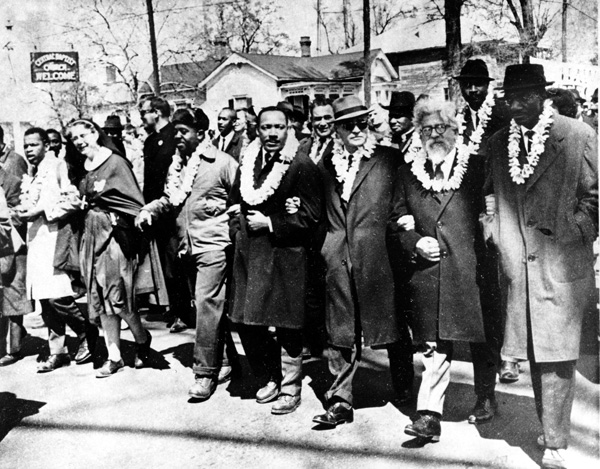
Dr. King and Rabbi Heschel march in Selma.

The service commemorates both the federal holiday dedicated to the Reverend Dr. Martin Luther King Jr. and the yahrzeit of Rabbi Abraham Joshua Heschel. One of the most influential Jewish theologians of the 20th century, Heschel marched with King in Alabama in March 1965. He famously wrote, “When I marched in Selma, my feet were praying.”

Every Jewish social justice activist knows this story. We are taught about Heschel as much as young black kids are taught about King. We aspire to be like Heschel the way they want to be like King. We know Heschel’s words about Selma as well as they know King’s “I Have a Dream” speech.

And, I imagine, we ask ourselves, “Can I be as brave as Rabbi Heschel?” as much as they ask themselves, “Can I be the next Dr. King?”

The service is a mix of a traditional Jewish Friday evening service with pieces of African Methodist Episcopal worship: The Howard Gospel Choir sings; the Agape Liturgical Dancers perform; the Senior Pastor preaches. And in between we say Shehecheyanu, the Sh’ma, and the V’Ahavta.

I can’t adequately describe the power of this service. I alternate between goosebumps and tears — and I feel like my feet are praying as I walk home. I love the traditional Kabbalat Shabbat service: It is real and spirited and inspiring and beautiful. But I wish I could go every week to a Shabbat service with the Howard Gospel Choir. And communal prayer should always end with “We Shall Overcome.”

Tonight Pastor William H. Lamar IV spoke. My mouth was literally agape by the end. (My friend Bert asked afterwards if I had taken notes during his talk: “You have to learn how to do that when you’re a rabbi!”) A self-professed “King-ophile,” Pastor Lamar talked about his desire to remember the living, breathing legacy of Dr. King, instead of the ossified version enshrined in the memorial on the mall. He cited Cornel West’s warning not to “Santa Clausify” the civil rights leader: We have, in other words, turned him into a cartoon — one that teaches us to ignore much of what he stood for, because what he stood for remains such a threat to the political establishment in this conservative country. Dr. King was not afraid to speak truth to power, and he sometimes focused on issues that his community thought didn’t pertain to it (the war in Vietnam, for example). But as we all know, Dr. King believed that “injustice anywhere is a threat to justice everywhere.” Pastor Lamar noted that being a leader sometimes means betraying your tradition and your people — to move them away from prescriptive views.

I love this service because it represents the best of what Judaism can be: pluralistic, visionary, radical, inspiring, and insistent on our obligations to one another as human beings. In the words of Rabbi Heschel:

Above all, the prophets remind us of the moral state of a people: Few are guilty, but all are responsible.

the fourth school

jeremiah

the prophet jeremiah, from fall rabbinical school tour; photo by salem pearce (via instagram)

In the fall I visited four rabbinical schools. There are only a handful non-Orthodox institutions (that is, ones that accept women) in the U.S. I ruled out two online/commuter schools, as well as the ones not on the East Coast (per my husband’s request). In early to mid-December, I decided to apply to just three of the schools I had visited — and I began to make plans accordingly: asking for letters of recommendation, sending transcripts, organizing essays, completing forms, etc.

When I took the GRE on December 9, I had to choose the schools to which to send scores, and I included school #4 on that list. I think I just wasn’t quite ready to rule it out. (Plus, I got to send four reports for free, so I thought, “Why not?”)

Five days later, the admissions director at school #4 called to check in. Surprised at his call, I wasn’t ready to have the conversation about why I had decided not to apply, so I only mentioned one reason. But I didn’t feel great about how poorly I had articulated my concerns about the school, so I sent a follow-up email. In it, I explained that I had come to the conclusion that school #4 was just not a good fit for me, for various reasons. I’m not going to be a productive member of the matriculating class — and the school shouldn’t want me — if that’s the case. I didn’t hear back.

Sidebar: I’m not trying to hide the identity of the school in question: In fact, it’s probably easy to figure it out. But I don’t think it’s all that important to this narrative.

Then last week, I did get an email, after he had received my GRE scores; he hoped for an opening to start the conversation again. This unexpected development shook me up probably more than it should have. I started spiraling into a tizzy of questions: Why is he doing this? As a new admissions director, does he just want robust application numbers? Am I letting flattery cloud my judgment? Are the concerns I raised about the school actually not accurate? Is this school actually my destiny?

The last is a bit of an exaggeration. But I did wonder, much to my husband’s chagrin, whether this was a sign from the universe. I’m willing to believe that things happen for a reason. And I think having grown up with an evangelical Christian father makes me more susceptible to doubt in the face of someone else’s certainty. (It could also be reasonably inferred that I am also an over-thinker and an over-worrier.)

I agreed that we should have another conversation; it happened yesterday, and it went really well. I was able to go through with him a list of my concerns. None of them were fully alleviated, which is not what I was expecting anyway. But next I’ll speak with the associate dean, as well as a current student. (Both are women, which may hint at the nature of some of my concerns.) And after a conversation with a rabbi I trust, an alumna of school #4, I’m going to go ahead and apply. What’s one more application, right? I don’t want to close that door quite yet.

the dovekeepers

Trigger warning: The book and this post, albeit briefly, explore the subject of sexual violence, which may be upsetting to survivors.

On New Year’s Eve I finished Alice Hoffman’s The Dovekeepers, my first by her. I picked it up because it’s the next book of a Jewish Reads book club I just started getting emails from (not sure yet if I will go to a discussion).

The book is the about the settlement at Masada, where Jewish rebels in 70 C.E. resisted the Roman army for months before killing themselves in a mass suicide when their destruction was inevitable. The story is told in four parts, each by a woman who took a different path to arrive at the mountain in the Judean desert.

Yael begins the story. Her father is one of the Sicarii, assassins who kill Jews complying with Romans bent on the destruction of the Temple. It’s in this environment of civil war and anti-Semitism that Yael’s brother, also an assassin, and eventually Yael and her father, are forced to flee Jerusalem. On the way across the desert, Yael and one of her traveling companions become lovers, but he and his family don’t survive the journey. She arrives pregnant at Masada and begins to work in the dovecotes with three other women.

One of them, Revka, picks up the thread of the story. A baker’s wife in Shiloh, she leaves with her daughter, scholar son-in-law, and their two sons after her husband is killed by the Romans. En route to Masada, on Yom Kippur, they are set upon by Roman army deserters, who brutally gang rape her daughter. Her son-in-law returns from prayers to find his wife and her attackers dead. They arrive at Masada, her grandsons rendered mute by the trauma and her son-in-law, a brutal warrior with a death wish.

Aziza speaks next. Raised as a boy in the land of Moab, across the Dead Sea, she becomes a skilled warrior. She arrives at Masada, along with her half-brother and beloved half-sister, after being sent for by her mother’s lover.

Her mother, Shirah, the last of the dovekeepers, finishes the story proper. Born in Alexandria, she is raised by her mother to practice magic. But when her mother falls out of favor with the Jewish community, Shirah is sent to her mother’s family in Jerusalem. Unmarried, she is banished after she gives birth to Aziza but is rescued by a Moabite, who takes her to his homeland. She arrives at Masada from Moab, with Aziza and two other children, to reunite with her Jerusalem lover.

The historian Josephus, the main source of the siege of Masada, reports that the only survivors were two women and five children. The Dovekeepers is Alice Hoffman’s imaging of how a settlement of nine hundred got winnowed to seven. But it doesn’t just seek to humanize those who in modern times would be considered akin to the Branch Davidians or the Peoples Temple. It is a story of women in the society of ancient Israel that is constructed by and for men. As Hoffman notes in the acknowledgements, “[T]he stories of women have gone unwritten . . . It is my hope that . . . I can give voice to those who have remained silent for so long.”

Hoffman immediately sets up the dichotomy between the world of men and the world of women when Yael seeks out the kephashim for a protection charm for her brother as he begins to kill as part of the Sicarii. She notes,

In the Temple there was the magic of the priests, holy men who were anointed by prayer, chosen to give sacrifices and attempt miracles and perform exorcisms, driving out the evil that can often possess men. In the streets there was the magic of the minim, who were looked down upon by the priests, called charlatans and imposters by some, yet who were still respected by many. Houses of keshaphim, however, were considered to engage in the foulest sort of magic, women’s work, evil, vengeful, practiced by those who were denounced as witches.

But in the book, kephashim magic runs the world. Indeed, the conventional wisdom, explained by Yael at the outset, is tuned on its head as the reader is left with the clear feeling that women’s magic, over and over again, sets right the world that is continually destroyed by men. It is not the women who want a civil war, or to fight the Romans (they are used to doing that they need to do in secret), or, least of all, to make a stand at Masada. And that is probably why only women (and children, their wards) survive. Though the men of Masada are fierce warriors, it is the women of Masada who have the real strength.

I am sorry to say that I don’t know how accurate the portrayal of ancient Israel is, although it has been reported that Hoffman researched the book for five years. She explains how moved she was by a visit to Masada — and how her story is built around the remains that were found in the archeological excavation of the site. To the extent that it’s true to life, it did help me understand, at least a little, the motivations of the Jewish rebels. When I visited Masada, in contrast to Hoffman, I was struck by the fact that we might be lionizing crazy people.

In the world of ancient Israel, men set the rules — and time and time again, women break them. And that world is better because of it. In Hoffman’s beautiful and haunting narrative, each of the women gets to tell her story and how she became who she is against the backdrop of impending disaster.