the buffyverse talmud

For a creative writing assignment for my Talmud class last semester, I was asked to write a mishnah and accompanying sugya. A mishnah refers to the smallest unit of the Mishnah, redacted in 200 CE, a part of the Talmud, and therefore in this case to a few, generally unattributed, rabbinic statements on a particular topic.

The other part of the Talmud is the gemara, the debates of the generations of rabbis subsequent to the Mishnah; the Talmud was redacted between 350 and 500 CE (depending on the edition). A sugya is a building block of gemara, a proof-based elucidation of an aspect of the mishnah.

As readers of this blog well know, I am a huge Joss Whedon fan. So for this assignment I chose Buffy the Vampire Slayer as my source text. I wrote a mishnah about the power of words in hevruta (the paired learning that takes place in the beit midrash), and then I used episodes of Buffy to write the gemara to explain that mishnah.

After I mentioned the project on Facebook, several people asked to read the finished product. So here it is. (It’s a PDF because of the formatting, which mimics a page of Talmud.)

I will note that the document will likely be nearly incomprehensible unless you know a great deal about both Buffy and Talmud. (And since I know more about Buffy than I do about Talmud, I’ll admit that Talmud studiers might find that aspect incomprehensible as well.)

For those only mildly curious, here’s the mishnah — with Hebrew “signal words” in parentheses — which contains a quote from Buffy. Who can name the episode and speaker (without Google)?

original mishnah about the power of words and hevruta study, to be elucidated by buffy the vampire slayer


original mishnah about the power of words and hevruta study, to be elucidated by buffy the vampire slayer

summer!

Well, I’ve been gone so long that in my absence WordPress updated its blogger interface! The change is nice, by the way.

Since I last posted at the beginning of May, I have done the following:

finished my first year of rabbinical school (passing all of my courses!);

end-of-year "mekorot" class cake (First years got "R"; second years, "Ra", etc. Those graduating got "Rabbi".); photo by salem pearce via instagram

end-of-year “mekorot” class cake (first years got “R”; second years, “Ra”, etc. those graduating got “Rabbi”.); photo by salem pearce via instagram

moved from Brookline to Jamaica Plain (the balcony alone in our new place made the pain of moving worth it);

new home; photo by salem pearce via instagram

new home; photo by salem pearce via instagram

read two books (and half of two others);

went to D.C. for 24 hours for Elissa Froman‘s memorial service (you can see the video here);

popsicle stick craft project at froman's memorial: write a word, phrase, or design that reminds you of Elissa; photo by salem pearce via instagram

popsicle stick craft project at froman’s memorial: write a word, phrase, or design that reminds you of elissa; photo by salem pearce via instagram

began studying Torah three days a week with one classmate and Psalms two days a week with another;

had visits from both my husband’s parents and my parents, as well as two friends from D.C.;

mike's canolli: the best reason for out-of-town visitors; photo by salem pearce via instagram

mike’s cannoli: the best reason for out-of-town visitors; photo by salem pearce via instagram

started a volunteer position with the National Havurah Institute as its fundraising coordinator;

practiced leyning Torah (I’ve read on Shabbat twice and on Thursday morning five times);

these color-coded torah portion sheets have been my constant companions; photo by salem pearce via instagram

these color-coded torah portion sheets have been my constant companions; photo by salem pearce via instagram

and gotten lost running in Franklin Park, the green space near our new home, three times.

asking g-d

In my Talmud class we’re reading a section from Baba Metzia called the “gold chapter”; it deals first with honesty in business exchanges and then moves on to honesty in personal interactions, or ona’at devarim, “oppression with words.” As is typical of gemara, the rabbis discuss the nature of the issue at hand and use Biblical passages and stories to back up their arguments. In an extreme moment, one of the rabbis notes that if someone embarrasses a friend, it is as if that person has spilled blood. They are especially concerned with ona’at devarim because, they say, the gates of prayer are always open to tears; that is, G-d always hears the petitions of those who have been oppressed by words.

rabban gamliel's alleged grave in yavneh

rabban gamliel’s alleged grave in yavneh (photograph used under wikipedia creative commons license)

They tell the story of Rabbi Eliezer, the head of the yeshiva, who was excommunicated for his unpopular opinions. When Rabbi Akiva tells Eliezer of the decision, his anguish causes everything he looks upon to be burned up. It happens that at that time Rabban Gamliel, who took over the yeshiva, is on a ship, and the sea begins storm. Gamliel knows immediately that his safety is threatened because of Eliezer. It also turns out that Rabbi Eliezer’s wife is Gamliel’s sister, and she is worried for Gamliel’s life. In perhaps not the most effective method, she begins to watch Eliezer constantly to keep him from praying tachanun, a supplicatory prayer. (Elsewhere in the Talmud, tachanun is called “a time of divine goodwill,” during which supplication is more likely to be received.) On Rosh Hodesh (the first day of a Jewish month, determined by a new moon), tachanun is not recited. One day Eliezer’s wife gets confused, erroneously thinks it’s Rosh Hodesh, and abandons her vigilant watch over Eliezer. In her absence, he prays tachanun, and Rabban Gamliel dies.

It’s a bizarre story, but certainly one that gives some insight into how powerful the rabbis consider both words to others and words to G-d.

More than a month ago in my tefila group, we were looking at the amidah, often just referred to as “the prayer.” It consists of 18 (well, really 19, but I don’t need to get into that here) blessings, several of which are called bakashot, or prayers of asking. The person who led davennen that morning first asked us to think about why we struggle with petitionary prayer. Not if — but why. The assumption was that we all did, and indeed, we all did. Among those in my group, someone cited a lack of a conception of a personal g-d; another, the association with the common Christian practice of ad hoc prayer; a third, a doubt that G-d does (or even should) intervene in our lives. Added someone else, “G-d wouldn’t bother with me. My needs are too small. I am too small.” Our prayer leader said, and I can still hear her saying it, so powerful was it,

“Where did the idea of G-d as a scant resource come from?”

Yes: Any divine being I want to believe in would be able to handle everything, the small stuff as well as the big stuff. Why not ask?

At the Rabbis Without Borders retreat that I attended a few weeks ago, one of the facilitators asked us to share a time when “prayer worked for us,” as a way of opening a conversation about how to make prayer services work for our congregants. Many shared stories of times of distress, of getting on their knees and begging for intervention or answers from G-d.

I haven’t had that experience. So I thought about the efficacy of prayer a little differently. My beloved cousin, who I grew up with and who is like a sister to me, is expecting a child in the fall, a child she has been wanting for a very long time. When she called to tell me her good news, I immediately thought, I want to pray for a healthy pregnancy and a healthy child. And I then almost immediately thought, That’s ridiculous. Pregnancy is a scientific process of cell growth, not subject to divine intervention: If I pray and something goes wrong, would that mean my prayer was somehow deficient? If I pray and everything goes well, would that mean that I had reached G-d? What would that mean for other folks whose pregnancies or children had not fared well?

hannah victors

hannah giving her son samuel to the priest, by jan victors (photograph used under wikipedia creative commons license)

I have a hard time with petitionary prayer for all the reasons above — and because I have a hard time asking for help, admitting that I need something, acknowledging that I want what is out of my control. And there’s certainly a perceived resistance to the prayer of asking in Judaism: On Yom Kippur, the holiest day of the year, we don’t petition G-d. The implication is then that asking is somehow not holy. But the rabbis also saw the value in petitionary prayer: On Rosh Hashanah, another holy day, we read the story of Hannah. Bitter and distraught at her childlessness, she goes up to the temple and prays — her lips moving but with no sounds — and weeps, and promises any child she will have to the service of G-d. Hannah is the first to call G-d “the Lord of Hosts” (יהוה צבאות), and the rabbis say that Hannah’s silent prayer should be a model for for our own. (It should be noted that Hannah’s request proves highly effective, as a short time later she has Samuel.)

One of the wisest things I ever read about prayer was in the book The Unlikely Disciple. Nonbeliever Kevin Roose enrolls at Liberty University, the erstwhile institution of Dr. Jerry Fallwell, and goes about doing all that is required of him, including prayer. He notes that in spite of his lack of belief, his daily prayer becomes meaningful. It changes him. As I noted in my post about the book, “[H]e begins by articulating his hopes for his family and friends, and he comes to find that — non-belief in G-d notwithstanding — he actually enjoys the opportunity for reflection.” A friend from Hebrew College writes something similar in this thoughtful piece about praying as an atheist.

So I decided to pray for my cousin’s child. And to me, that means prayer has “worked.”

mechitza

I spent this weekend at a Rabbis Without Borders rabbinical student retreat on “Spirituality, Social Justice, and the Rabbinate.” Students from several different schools gathered at the Pearlstone Center in Reisterstown, Md.: Besides Hebrew College, there were contingents from the Reconstructionist Rabbinical School, HUC Los Angeles and Cincinnati campuses, Jewish Theological Seminary, Zeigler School of Rabbinic Studies, Academy of Jewish Religion, and Yeshivat Chovevei Torah. (Update: I very unfortunately forgot to note the fabulous representation from ALEPH – Alliance for Jewish Renewal – Smicha Program *and* International Institute for Secular Humanistic Judaism — which I regret. It was an unintentional mechitza.)

One of these things is not like the other.

YCT is a new-ish school training men to become Modern Orthodox rabbis “who are open, non-judgmental, knowledgeable, empathetic, and eager to transform Orthodoxy into a movement that meaningfully and respectfully interacts with all Jews, regardless of affiliation, commitment, or background.” The idea is to change Orthodoxy from the inside, as one of the students explained.

The impact of their participation that I felt the most was in the davennen. Their school policy requires, in accordance with Orthodox principles, that the YCT students not daven alongside women. The way this is generally achieved in the Orthodox world is via a mechitza, a partition to separate those participating in tefila.

This presented a challenge for the prayer services, since all of the other schools practice egalitarianism, not least in that they admit both women and men. The tefila committee, which met before the retreat (and of which I was not a part), decided on separation via what was dubbed a “tri-chitza“: spaces reserved for men, for women, and for mixed seating. The configuration was used for four of the five services we davenned together; the fifth, lead by the YCT students, was set up in a more traditional way, with seating for men and seating for women.

pearlstone center in reisterstown, md.

the farm at the pearlstone center in reisterstown, md.; photo by salem pearce (via instagram)

As one of the retreat faculty members (who is a huge fan of mechitza) explained, the idea developed as a result of an evening of joyful, raucous, downright Dionysian prayer, after which the rabbis reflected that if women had been present, it might have turned into an orgy. Thenceforth, women and men prayed separately.

On a visceral level, I find mechitza loathsome. Historically it has been a tool for silencing and disempowering women by marginalizing their prayer and limiting their participation: Women are not counted as part of the minyan (the quorum of 10 adults needed for prayer). In many spaces, women are also not allowed to lead tefila, to read Torah, to have aliyot. What’s more, the service often only takes place in front of the men’s side. In extreme cases, women are relegated to a balcony where it might be difficult to see or hear anything at all.

In the Modern Orthodox world, these latter elements are generally not found, but the purpose of a mechitza is still to ensure that people daven with those of the same gender. Which is problematic. It’s heteronormative; it’s based on the false assumption of a gender binary; it creates potentially unsafe situations for genderqueer folks. Ultimately, it is a space created entirely on the terms of and for the needs of cisgendered men.

I go to a pluralistic school, so I am used to experiencing all different kinds of davennen. Hebrew College was founded to challenge the conventional wisdom that the Jewish world can be pluralistic in all settings except for prayer. And we still struggle with community tefila — which, to be honest, usually means that no one is completely satisfied with services. But egalitarianism is our bright line. Everything else goes. This weekend was meant to be about pluralism, too. It is so important, especially for movement-based students, to talk to one another, learn from our differences, and experience other ways of doing Judaism. This weekend suggested that my pluralism might have limits.

To be fair, everyone was pushed out of their comfort zones this weekend. When I walked into the prayer space on Friday morning, I thought, “What? You call this a mechitza?” It was just a table with chairs on either side. Mechitzot can take many forms, to be sure, but they are usually solid partitions, or at least a line of person-high potted plants (as in the case of a Chabad minyan I went to a few times when I was in D.C.). The point is to obscure the sides from one another. This mechitza did not in any way do that, so it was largely symbolic. And I am not denigrating it by so calling it, as much of what is important in Judaism is symbolic, or might seem within the mere letter of the law and not the spirit. Indeed, the symbolic nature of the mechitza made it hurt more, as it seemed to be separation just for separation’s sake. I think that it was probably not the mechitza to which the YCT students are accustomed. Nor was the davennen. For me, the pain stemmed from the fact that because of the mechitza, the space felt like it belonged to just one contingent. I became an outsider, praying on their terms. Most uncomfortable of all, I felt like I was condoning the mechitza with my presence.

But I don’t consider my discomfort and the potential discomfort of the YCT guys to be morally equivalent. Their discomfort is because of an incursion on their male privilege; mine is the result of oppression.

I do feel that it is important to point out that my painful experience had to do with the issue of mechitza and not with YCT students themselves. Their hands are tied, to a certain extent: a condition of their continued enrollment is adherence to the tents of Orthodoxy as laid out by their school. And these are good guys, and I think they are fully aware of the difficulty mechitza presents. But their project is to struggle within Orthodoxy, and that is not my fight.

my favorite (problematic) cloth bag; photo by salem pearce (via instagram)

(Sidebar: The first time I encountered YCT was in Washington, D.C., in 2009, at the Jewish Federation’s annual General Assembly, where the institution had a booth. I was just beginning to think about rabbinical school and hadn’t heard of this one. I stopped and spoke with them for at least 20 minutes before they told me that, unfortunately, I was not able to attend their school. “But we hold women in high regard and believe that there is a special place for women in Judaism!” Completely annoyed, I left abruptly, but not without the tote bag they had given me. But as much as I feel a twinge of irritation every time I see it, I continue to own it because it is, hands down, the best cloth bag I’ve ever used. Roomy, more square than rectangular, sturdy, and with wide shoulder straps. It asks, “The Rabbinate. Is it in you?” To which I answer, “Yes! Just not with you.”)

I’ll admit that I took a perverse pleasure in the fact that the men’s section was small, at the edge of the room, and not in front of the tefila leaders or Torah readers. In other words, their experience approximated that of women in Orthodox settings (with the important difference that the separation had been effected at their own request). But I hated that I thought that. And it didn’t alleviate my own hurt. And none of these feelings were conducive to my being in a prayerful space.

I would love to see Orthodox Judaism become a more welcoming space for all Jews. And I don’t know whether I can be any part of it.

a day of mourning

Today is Yom HaZikaron in Israel, the day of remembrance for fallen soldiers and victims of terrorism. In addition to the national memorial services that take place, the day opens (the preceding evening, since Jewish days begin at sunset) with a country-wide siren during which everyone and everything stops for a minute of silence.

It’s also Patriots’ Day here in Boston, a local holiday ostensibly commemorating the battles of Lexington and Concord — also known as the day the Boston Marathon is run. There’s also always a Red Sox home game.

As I drove to school this morning, I thought about how the Jewish calendar and the secular calendar are often at complete odds with one another. This morning’s tefila was soulful and somber. My Bible teacher, who raised her children in Israel, read a piece she had written when one of her son’s fellow soldiers was killed near the Golan Heights. The mother of the slain soldier had asked my teacher to take care of her own son (the one who had survived), that he might not be forever haunted by his friend’s death. It was heartbreaking.

As I drove to school this morning, I thought about how so many of my friends would be running the race, or watching the race, or watching the baseball game. One of my classmates, who has lived in Boston for several years now, said that it was too bad that those of us new to Boston wouldn’t get the chance today to enjoy Patriots’ Day the way it should be celebrated: by drinking lots of beer and watching the race. We talked about going down to Commonwealth Avenue, near the infamous Heartbreak Hill, during lunch. (Homework called instead.)

As I drove to school this morning, I thought about how I wished I were running the race today. It’s been my dream since college to one day qualify for the Boston Marathon. I wondered if I would be able to get fast enough to do so during my five years here.

As I sat in Hebrew class this afternoon, my husband texted me that bombs had exploded near the marathon finish line. As of this writing, two people are dead and dozens are wounded. (Everyone I knew running or watching the race is fine.) We began a frantic checking in via Facebook, Twitter, text message, and phone call.

And just like that, the days synched.

dayeinu

At seder on Monday and Tuesday nights, we sang “Dayeinu,” the Passover song that thanks G-d for the many, many things that G-d has done for us. It’s a review of everything that happened to get us out of slavery in Egypt and into Israel where the temple was built. (Good for G-d, the song ends before those pesky temple destructions.) Dayeinu means, approximately, “it would have sufficed!” The verses take the form of, “If G-d had just done X and not Y, dayeinu!”

So we sing, “If G-d had split the sea for us and not led us through on dry land, dayeinu!” “If G-d had led us to Mount Sinai and not given us the Torah, dayeinu!”

But these are absurd things to say. It would have been enough for G-d to create an escape route from the Egyptians but not actually vouchsafed it to us? It would have been enough for G-d point the way to a random mountain in the desert . . . for no reason at all? Many have offered feasible explanations for each of these statements. On Tuesday, for instance, my seder host shared what she had heard from a rabbi: The arrival of the Israelites at Mount Sinai marks the first time “Israel” is referred to the singular, as a collective. So Sinai represents the beginning of peoplehood, even without the Torah. But I’m not so sure we’re supposed to take the song so literally. It seems to me that we might be simply expressing awe for each of the things G-d did for us, in a series of things that ultimately led to our freedom. But each one is actually not enough.

On Tuesday the U.S. Supreme Court heard arguments in the Prop. 8 case, the referendum that Californians passed in 2008 that outlawed marriage for same-sex couples. On Wednesday, the Court heard arguments in the challenge to DOMA, the federal Defense of Marriage Act, which restricts federal marriage benefits from same-sex couples (insurance benefits for government employees, Social Security survivors’ benefits, immigration, the filing of joint tax returns, etc.), and requires interstate marriage recognition only for opposite-sex marriages.

marriage equalityOn Tuesday my Facebook feed turned red. Most of my friends changed their profile pictures to the Human Rights Campaign’s logo, colors changed for this historic occasion. Then the variations started: Yoda, Bert and Ernie, and an angry cat were added. The equal signs became penises, mustaches, animals, band-aids, matzah. I was over it even before the inevitable appearance of bacon. (The internet abhors a meme without bacon.)

I support marriage equality. And I didn’t change my profile pic. I put little stock in so-called clicktivism. One of my friends did post about how much it would mean to her if all her friends, especially straight ones, changed their profile pics as a sign of allyship: That partially melted my cold heart. And I did see a few people asking about its significance in comments on Facebook’s notification of changed profile pics. Which I imagine might be construed as “raising awareness,” quite possibly my least favorite phrase in the English language.

But my concern about this issue is deeper than my fear that people are substituting social media for real action. Many, many of my D.C. friends actually did actually go to the Supreme Court rallies to show support for marriage equality.

I worry that these cases, in the words of a good friend of mine, are “a gamble and a huge risk.” Marriage is a civil right — if perhaps not a strategy to achieve structural change — and there’s a chance it won’t be affirmed by the Court.

I came out in, and lived through, the post-Bowers v. Hardwick world, and it was an ugly time. The people who brought that case thought their odds were good too, but the result of their good intentions was a long period of time [Bowers was overturned in 2003 with the ruling in Lawrence v. Texas] when employers, governments, and courts (among others) could consider gay people de facto criminals in many states with the blessing of the Supreme Court. If we lose, and the high court decides that there is no fundamental right for gay people to marry our partners, I fear it could set back the fight for marriage equality in a huge way.

I worry that the online activism around these cases give rise to arguments that are not good for anybody’s liberation. I’m thinking in particular about the Louis CK quote [NSFW, natch] on marriage equality, which begins with “It doesn’t have any effect on your life.” Is this really how we want to garner support for this cause? So you are free to oppose issues if they inconvenience you? I’m also thinking of the argument that gay people are just like straight people. Just gay. Again, is this really how we want to garner support for this cause? So minorities should have rights as long as they are just aspiring to imitate the majority? Equal protection goes to the non-threatening? I am also thinking of the implication that marriage is a panacea for ensuring rights. Shouldn’t everyone, regardless of marital status, be entitled to the benefits denied because of DOMA? So you’re just out of luck if for some reason marriage isn’t in your plans?

I worry that, as I’ve written about before, marriage equality is the priority of only a small, privileged group of queer folks, mostly well-off white people (just look at the plaintiffs in both cases, or the sea of white that was the supporting faction in the rallies). On a current events program on my local NPR affiliate this week, the host marveled at how quickly marriage equality has gained support (contrasting it with, say, the relative torpidity of the civil rights movement). As far as I can see, the difference is that the former has had a lot of money and power behind it.

I worry that money and power thus directed limits the same towards issues that feel a lot more pressing and a lot more damaging, particularly for poor people of color. (I recognize that it is easy for me — a straight, white, married woman — to say this with the privilege of marriage already in hand.) On Thursday I visited the inmate that I am mentoring — a queer woman of color — as she finishes her college degree as part of Boston University’s College Behind Bars program. I use the word “mentoring” because that is the formal term for our relationship, as defined by the program we participate in, but she hardly needs help with her studies. I’m basically a cheerleader, a listener, and a contact from the outside world.

She’s taking a class on race and incarceration, so we’re reading a lot of the same books. As we talked about the drug war and hyperincarceration and the dehumanizing prison system, I couldn’t help but wish for the day when all of my white friends would support drug policy and prison reforms and would proudly make those known and would go to rallies in support of court cases before the Supreme Court. As useless as I find social media “activism,” a sea of profile pics demanding an end to the racist institution of the death penalty, or protesting the “virtual ‘drug exception’ [that] now exists to the Bill of Rights” (Michelle Alexander, The New Jim Crow), or decrying the dehumanizing for-profit prison industry would at least mean that the issues had gained mainstream currency.

This was a hard post to write. Tuesday’s Facebook activity ultimately left me very sad and unable to organize my thoughts. (It didn’t help that I was getting sick and mourning the death of a friend.) And changing one’s profile pic is not a wrong thing to do. And one of my best friends works for a prominent gay rights organization in this fight. And many of my gay friends consider marriage equality very important.

Our collective liberation today depends on many, many steps — as did our march to freedom through the desert. And even when we think we’ve gotten there and the song ends, the temple can be destroyed. Twice.

Marriage equality is something to regard with awe. And it is in no way enough.

a visit from the goon squad

a visit from the goon squadJennifer Egan’s A Visit from the Goon Squad is the first work of fiction I’ve read since June — and it’s as good as everyone has said it is. I tore through it in about a weekend, and I feel like I can’t say enough good things about it. Read it!

Parts of the book were first written as short stories for various publications (Harper’s, Granta, The New Yorker, etc.), and indeed each chapter could be a stand-alone tale, with minor characters in one story becoming the protagonists of the next. The title is a reference to an observation made by an aged and ailing musician, overruling objections to his idea for a tour to promote his final album: “This is reality, right? You don’t look good anymore twenty years later, especially when you’ve had half your guts removed. Time’s a goon, right? Isn’t that the expression?”

That is expressed in this Pulitzer-Prize-winning novel, about a cast of the characters wondering how they got from point A to point B. (The two parts of the book are in fact “A” and “B,” and the last album of the aforementioned musician is “A to B.”) Amazingly, even while they make, in some cases, horrifying choices, Egan is able to make these characters incredibly sympathetic and compelling. (I will note a trigger warning: There is a short scene of sexual assault, unfortunately told from the perspective of the perpetrator, which survivors may find upsetting.)

The stories center around Bennie Salazar, a washed up former musician and record executive, and his assistant, Sasha Grady. As the setting moves back and forth through time, between the 1960s and the 2020s, we also meet Sasha’s uncle Tim; Alex, a man she dates only once but who will later become one of Bennie’s employees, long after Sasha’s been fired; and Sasha’s college friends, one of whom will eventually become her husband, with whom she’ll have two kids. Then there’s Bennie’s high school friends, one of whom introduces him to Lou Kline, a music mogul who will become Bennie’s mentor; Lou’s many wives and kids; and Bennie’s first wife — and her boss and her brother, whose lives intersect via a has-been (though still young) movie star. In one of the more obscure links, the young Samburu warrior that one of Lou’s kids meets on safari in Kenya grows up to marry Bennie’s ex-wife’s boss’s daughter, who also becomes Bennie’s assistant after he fires Sasha. But the characters can’t see all of these connections, much as they are unable to see their own paths between A and B.

As I began thinking of making this next point, I almost started with: “The novel feels timeless until the last two chapters,” which take place in the 2020s. But that seems patently silly, as the stories, told in a non-linear way and from different perspectives, of necessity are grounded in very specific points in time for the reader’s understanding. I think I was responding to the jarring feeling the chapters in the future inspire. Egan is clearly doing her own connection from point A (2010, when the novel was published) to Point B (2021 and beyond, when the novel’s storyline ends). As with many of the other stories, we as readers are able to see how the characters get there (in this case, to a dystopian future), since that path is based on current events in the post-9/11 world and the security and surveillance state.

But technology predictions always make me stifle a giggle, as they’re hardly ever accurate. (Flying cars are just two years away, according to Back to the Future Part II!) Luckily, Egan’s strong writing and character development carries the day, so even as readers stumble through the completely phonetic language of her future’s quasi-text messages, we can see the significance of the academic work of that same future, where, as one character explains to another, the “ethically perfect state . . . doesn’t exist and never existed”:

Her new book was on the phenomenon of word casing, a term she’d invented for words that no longer had meaning outside quotation marks. English was full of these empty words — “friend” and “real” and “story” and “change” — words that had been sucked of their meanings and reduced to husks.

Despite the assessment that we all go the way of these words, the novel nevertheless ends on a hopeful note. Introduced as a young naïf at the beginning of the book, at its end Alex watches a younger version of himself, also new to New York, fumble with the keys to her apartment.

The goon squad visits us all in time, but in the meantime, we live.

the implosion conspiracy

2216003For some reason I’ve been really interested in Julius and Ethel Rosenberg for quite a long time, and I’ve been wanting to read a book about their trial. But unlike a lot of subjects, I was finding it hard to find the definitive work on this topic. So one day when I emailed the rabbinical school list about something unrelated, I also asked if anyone had recommendations. One of my classmates responded extremely enthusiastically with an endorsement of Louis Nizer’s The Implosion Conspiracy, which he read decades ago and still remembered vividly. It must be out of print now, because I was only able to find a copy on Amazon Marketplace (but for $0.78!).

To be honest, the book wasn’t exactly what I was looking for. However, it was a great read, and I definitely recommend it to the fellow Rosenberg-obsessed. Nizer was a lawyer, and he approaches his subject via an in-depth look at the trial itself. His perspective is that the truth can be found in the record.

He writes (somewhat pompously), “My objective was to know every inch of the thousands of pages of the records, as if I were going to write the briefs; and every word and authority in the briefs, as if I were going to argue the appeals; and every word of the many judicial opinions, as if I were going to write a critique for a law review; and every book I could find for or against the verdict, as if I were going to review each one for the Sunday Times; and every newspaper reference I could find, as if I were an editor preparing an editorial; and every person I could find who touched their lives or deaths, as if I were a reporter on a Pulitzer-Prize mission.” Indeed, his account, published in 1973, is incredibly thorough.

Nizer acknowledges in his introduction the “strong feelings” that the case engendered. In 1951, the Rosenbergs were convicted of passing information about the atomic bomb, being built under the auspices of the Manhattan Project in Los Alamos, N.M., to the Soviet Union. Just after the war, there was a certain amount of camaraderie (pun intended) in the United States with the Russians, who had been just about pulverized in their defeat of the Nazis on the eastern front. But by the time the Rosenberg case went to trial, the cold war had started, and communists (which the couple indisputably was) were viewed with considerable suspicion. Sen. Joe McCarthy would begin his infamous hearings just two years later, right about the time the Rosenbergs were executed for their espionage. Add to this opposition to the death penalty; horror at the fact that the chief government witnesses were Ethel’s brother and sister-in-law, whose damning testimony allowed them to escape more serious prosecution; and the possible role of anti-Semitism, fairly common in the mid-20th century — and one might think that the case would have hinged on some less quantifiable factors than Nizer claims. During sentencing, the judge himself made the following extreme statement:

I believe your conduct in putting into the hands of the Russians the A-Bomb years before our best scientists predicted Russia would perfect the bomb has already caused, in my opinion, the Communist aggression in Korea, with the resultant casualties exceeding 50,000 and who knows but that millions more of innocent people may pay the price of your treason. Indeed, by your betrayal you undoubtedly have altered the course of history to the disadvantage of our country.

Pres. Eisenhower cited a similar concern when he denied clemency a few months before their execution.

But this account provides almost none of that context or how it might have influenced the outcome. However, I now feel as though I lived through the trial and the appeals. In fact, I probably now know more than what most of the public did at the time, given how much of the testimony was embargoed because of national security concerns. In one of the few moments of levity in the book, the judge asks the public to leave, only allowing press to stay, because of the evidence about the atomic bomb about to be presented; I think today the press would be just about the last group allowed to hear such privileged testimony.

the rosenbergs in a rare embrace, but one so characteristic of their deep love for each other

the rosenbergs in a rare embrace, but one so characteristic of their deep love for each other

I finished the book over two Shabbatot, during one of which I was sick, so I just stayed in bed all day reading. Even though I knew the outcome, I cried at the end. The Rosenbergs were executed just over two years after their conviction, lightening speed when compared to today’s process. Through a practical deus ex machina, the legal team was able to get a stay of execution ordered by one U.S. Supreme Court judge, William Douglas, on the day after the Court’s summer recess. It initially seemed that the Rosenbergs would gain months of their lives while the appeal based on the stay made its way through the lower courts. However, exhilaration turned into shock and despair when, in a completely unprecedented move, the Court was called back for a special session and vacated the stay. The Rosenbergs were executed by electric chair a day later — on Shabbat, despite the pleas of their lawyer for respect for their Jewish heritage. Even more horrifying, Ethel had to be electrocuted three times after it was discovered she was still alive after the first course.

Since I’ve practically read the trial transcript, I’ll weigh in on the verdict. From the book’s account of the trial, it certainly seemed like Julius Rosenberg was involved in espionage activities. However, the government’s case was pretty weak, based on circumstantial evidence and verbal testimony (and absolutely no physical ties). As a juror, I think I would have had trouble concluding that the government had made its case beyond a reasonable doubt. Indeed, based on evidence released decades after the trial, it is clear that he was indeed a spy for the Soviet Union, but it is not at all clear whether what he passed on helped the Russians in their quest for the bomb, or whether he even passed on anything at all about the bomb.

Ethel’s involvement was always dubious, and the government had even less of case against her. In the years since the trial, her role has pretty much been completely debunked (her brother having admitted in 2001 that he gave false testimony about her involvement). She almost certainly knew of her husband’s activities but did not participate in them in any substantive way.

Ages 10 and 7 when their parents died, the Rosenberg sons were adopted by their foster family, the Meerepols. The father Abel was a poet and song-writer who wrote under the pseudonym Lewis Allen; his most well-known work was the anti-lynching poem “Strange Fruit,” made famous by Billie Holiday.

The affair would ultimately claim another life. Upon hearing the Supreme Court’s decision to vacate Justice Douglas’s stay, the Rosenbergs’ lawyer, Emmanuel Bloch, called the warden at Sing Sing: “Please tell Julie and Ethel I did the best I could for them. Tell them I will take care of the children. Tell them I love them. Tell them . . . ” and then collapsed into a chair sobbing. He died of a heart attack, at the age of 52, six months later.

a world apart

This week I was assigned Cristina Rathbone’s A World Apart: Women, Prison, and Life Behind Bars as part of my Foundations of Prison Ministry class. I was only required to read parts, but I ended up tearing through the whole thing. It helped that I had a snow day on Tuesday.

The book hits close to home (it looks like I’m calling Boston home now!) because the author lives in Jamaica Plain, a neighborhood just a few miles away from mine. Plus, the subjects of the book are women incarcerated at nearby MCI-Framingham, a women’s prison, where I mentor an inmate who is in Boston University’s College Behind Bars program. I visit her as part of an interfaith initiative between Hebrew College and Andover Newton Theological Seminary, the CIRCLE Prison Justice and Ministry Program.

Rathbone’s relationships with the five women whose stories constitute the majority of the book developed over five years — and were only the result of years of initial litigation for access to the prison. As she notes at the outset, she has just about only been in MCI-Framingham’s visiting room. But despite the considerable efforts of the powerful Massachusetts Department of Corrections to keep her out, Rathbone presents a comprehensive picture of life on the inside (in so far as any outsider can tell, I suppose).

The importance of the book lies in the fact that, Rathbone notes, “women behind bars are startlingly unlike their more violent male counterparts. Predominantly incarcerated for nonviolent, drug-related offenses, they are frequently mere accessories to their crimes: girlfriends, wives, or lovers of drug dealers, even leaseholders of apartments in which drugs are stashed. Almost all have serious drug problems themselves, and about half are victims of domestic abuse.” It stands to reason that life inside a women’s prison would be different, too.

If the stereotypical male experience in prison is working out, illegal procurement of weapons and drugs, physical violence, and trying to escape, the stereotypical female experience is eating junk food, illegal procurement of underwear and personal hygiene products, gossiping, and trying to see children. But sex is the great unifier: It turns out that almost everyone, in both environments, sleeps with a fellow inmate or a guard.

The book alternates between the stories of a handful of women and the history of women’s incarceration in the U.S. I found the latter only of passing interest, in part because how little effect the past has had on the trajectory of how women now fare in the criminal justice system. The first women’s prison, Mount Pleasant, opened in 1838 on the grounds of the infamous Sing Sing prison, and it was closed in 1850. MCI-Framingham, which opened in 1877, is the oldest running women’s prison in the U.S., so its history could be instructive. But it falls into a depressingly rhythmic pattern: A reform-minded woman takes over and institutes changes aimed at true rehabilitation, and then a (usually male) higher-up decides that the programs and practices are self-indulgent and replaces the reformer with a traditionalist. And then a reform-minded woman takes over again . . . The regularity of the ups and downs made me wonder whether a permanent revolution will ever be possible.

rug hooking class at MCI-Framingham, 1948; photo via Framingham Public Library

rug hooking class at MCI-Framingham, 1948; photo via Framingham Public Library

In Rathbone’s account, MCI-Framingham, probably like many prisons in the era of government budget shortfalls, has very little in the way of programming. She writes: “Its website indicates a long list of programs available to the women of Framingham . . . but when you take into account the diversity and breadth of its population, it remains a fact that each women at MCI-Framingham has access to fewer programs, and therefore to fewer privileges and less prison-earned ‘good time,’ than most male prisoners in the state.” Indeed, Rathbone’s analysis is that the sexism of our society is reflected in the prison system: Men get disproportionate resources. But women in prison have disproportionate need, in part because of past abuse, drug addiction, mental illness, and their responsibility for children.

Sidebar: For what it’s worth, I should note a criticism of this analysis: Our class discussion on the book was led (in the absence of my professor) by Rev. Joyce Penfield, executive director of The Blessing Way, a Rhode Island institution that provides “spiritual guidance for reentry & recovery.” She argued that per capita, women get vastly more resources than men: There are more programs in men’s prisons, but they constitute 94% of the country’s prison population. I’m not sure that this changes the experience of scant resources that the women in Framingham report, but I feel compelled to mention this disagreement. And Penfield even went further, suggesting that her experience in the Rhode Island penal system is one of plenty where women are concerned.

Most compelling, as is so often the case, are the stories Rathbone tells. These are women you want to root for: None of them ever had much to begin with, were given pretty short shrift in life, and are now facing just about the steepest uphill climbs you can imagine. Most heartbreaking were the struggles with child-rearing. As women are most often the primary caregivers in our society, so too are they in prison. And they seemed to spend most of their energy behind bars monitoring the often insecure living situations of their kids. Unlike the majority of incarcerated men, each woman could not rely on her children’s other parent to do the care-taking in her absence.

Somewhat mystifying was Rathbone’s treatment of sexual relationships at the prison. She devotes a number of pages to the prevalence of these illicit affairs (physical touch between inmates and just about anyone is forbidden), both between prisoners and between prisoners and guards. Such contact is commonplace, even rampant, for all the same reasons that it is on the outside: One of the women in the book, who resists such affairs for most of her time in prison, even witheringly notes that her fellow inmates just replicate on the inside the same problematic relationships they had on the outside. Her cellmate hooks up with almost every officer that is interested, while another woman is involved in an abusive relationship with a fellow prisoner. And these relationships, like everything else in jail, are commodities. What’s lacking, to my mind, is a discussion of the question of whether carceral relationships can ever be truly consensual, particularly between inmates and guards. Rathbone only talks very briefly about allegations of rape in that institutional context — but devotes an entire chapter to a now-defunct web site that seeks to connect men to incarcerated women (ultimately called “Jail Babes” but originally and unfortunately dubbed “Jail Bait”). Maybe that says something important: As Rathbone begins her book, “Life in a women’s prison was full of surprises.”

steubenville

Trigger warning: This post alludes to a graphic sexual assault that may be upsetting to survivors.

For better or worse, the name of this Ohio town, which used to be associated with the high school football team that was its pride and glory, will likely become synonymous with “teenage gang rape,” much as Abu Ghraib has become synonymous with “torture and prisoner abuse.” Ironically, in Steubenville the former — a cult of football player worship that is all too common in the United States — played a huge role in the latter — an atmosphere in which multiple athletes assaulted a classmate too drunk to consent.

Today the two boys who committed the assault, a six-hour ordeal of which the survivor has no memory but which was extensively documented on social media, were convicted of rape. The 17-year-old will serve at least two years in the state juvenile system; the 16-year-old, at least one year. It’s possible that they will be incarcerated until they are 24 and 21, respectively. Extension of the sentences is at the discretion of the state’s Department of Youth Services.

I felt relief when I heard about the conviction. From the event all the way through the trial, it seemed — at least from my limited vantage point, through local and national media — that the town was generally rallying around “their boys” and were blaming the victim, as people are so wont to do. Indeed, many of their classmates hurriedly deleted videos of and text messages about the assault when the boys realized that, wow, people are kind of upset about this and we might have done something wrong. Two of the victim’s former friends testified that she is often intoxicated at parties and “lies about things.” There was much hand-wringing over the boys’ futures, football and otherwise. I feared that the circling of the wagons around the perpetrators would be successful.

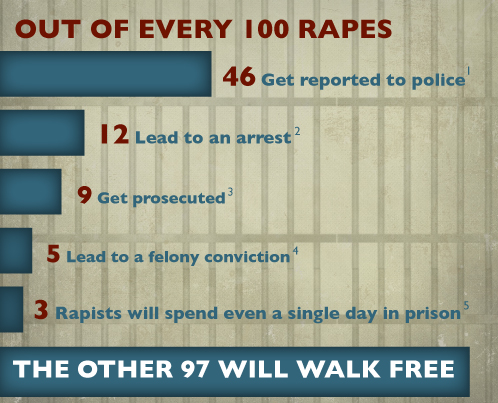
jailed rapists

jailed rapists (source: RAINN)

I also felt that the punishments were at least to some extent appropriate, though I can’t help but hope that the punishments end up on the longer end of the possibilities (more on that below). I may be in the minority in this sentiment, judging by a (highly unscientific) review of today’s Facebook posts about the verdict. A friend of a friend expressed surprised outrage that rape is not punishable by 25 years to life. To which I want to burst out laughing.

According to the Rape, Abuse & Incest National Network (RAINN), accounting for unreported rapes, only about 3% of rapists ever spend time in jail. And according to the U.S. Department of Justice, as of 1992, the average sentence for rapists was just shy of 12 years, with average actual time served about five-and-a-half years. (The current arrest rate for rape, about 25%, has remained unchanged since the 1970s, so there’s little reason to believe that sentences have changed either.) To say that rape is rarely punished via the criminal justice system is an understatement.

I spent seven years in D.C. volunteering at the local rape crisis center. I have little sympathy for rapists.

I also spent the same amount of time working and volunteering for drug policy reform organizations. I have little confidence in the criminal justice system.

And indeed, my experience working with survivors of sexual assault taught me the same lesson: The criminal justice system simply doesn’t do what we hope it does.

This semester I’m taking “Foundations of Prison Ministry” at Boston College School of Theology and Ministry. To whatever small extent I wasn’t before, I am now thoroughly horrified at our criminal justice system. I can’t condone caging human beings for inordinate amounts of time. I have no trust that we are putting away the “right” people. And I am certain that we’re not rehabilitating anyone.

Sidebar: I just wrote 10 pages for my class midterm about why the criminal justice system is abominable — and I barely scratched the surface in so doing — so I am obviously not able to do it justice (heh) in this post. For a good primer, read Michelle Alexander’s The New Jim Crow. And don’t tell me you don’t have time to read a whole book. As a citizen of this nation, you don’t have time not to read it! /rant

Ultimately, what I am saying is that I am divided. I don’t think we should be locking kids up for long periods of time (and never for life). And the criminals in this case are kids. Stupid, self-entitled, shameless, sadistic scum. But kids nonetheless. (The New York Times reported that the boy sentenced to at least one year told his lawyer upon hearing the decision, “My life is over.” To my mind there’s no clearer indication of the immaturity at work here. And I still want to scream at him about the life of the girl he assaulted.) These kids merit punishment. So in our very limited criminal justice system arsenal, I am forced to admit that some jail time seems like the best option.

But I concede this knowing that whatever good these boys will learn over the next year, two years, or five years, they will find in spite of their incarceration, and not because of it. More than likely, they’ll come out more desensitized than they went in. They’re for damn sure not going to learn in juvenile how to be men in a way different from that which rape culture promotes. And shouldn’t that be our goal?