metro minyan

Last night I went to Washington Hebrew Congregation‘s new Metro Minyan, a monthly Friday night Shabbat service and dinner hosted by the Reform synagogue’s 2239 group, for young professionals. My friend Alanna’s brother Aaron is the new assistant rabbi at Washington Hebrew, and she invited me and a group of our friends.

The idea behind this new initiative, the rabbi explained, is to meet young people where they are, literally. Indeed, most young professionals in D.C. live in metro-accessible locations (and very few of them have cars), but — and this is one of my pet peeves about synagogues in D.C. — most of the shuls are not. Of course, this fact made it all the more ironic when we couldn’t take the subway home because the orange line trains were suspended when the event ended.

The service was also an attempt to help young Jews connect to their Judaism, the rabbi said, some of them for the first time. That certainly doesn’t describe me — or any of the many people I knew at the service — and I’m not sure how else the others would have gotten there, unless they were at least somewhat plugged into the Jewish community. Indeed, the rabbi recognized a group of volunteers who had just returned from a community service trip, organized by the synagogue, to Birmingham to rebuild a house.

But engaging young Jews is the obsession of the Jewish community today. At the Union for Reform’s Judaism Biennial conference in December, for instance, a new Campaign for Youth Engagement was announced (which might have prompted this initiative by Washington Hebrew). And as I wrote in my rabbinical school applications, my generation is not connecting to the organized Jewish world in the same way as our parents. The way we as Jews are handling intermarriage isn’t helping either.
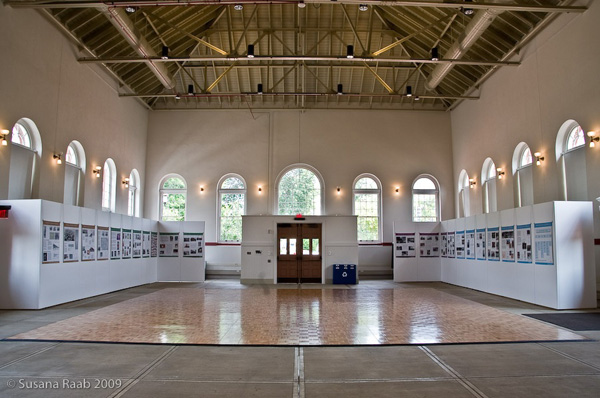
eastern market’s north hall; photo by susana raab

The service was held in the North Hall of Eastern Market, D.C.’s oldest continually operated fresh food public market (according to its website). Renovated by the D.C. government in 2009, the North Hall is a community space in the Capitol Hill market.

The service lasted about an hour and was (I gather) a fairly typical Reform Friday night service. I didn’t grow up affiliated, but most of my experience has been in more traditional services. I love the Kabbalat Shabbat service and was sad that it was over with perhaps three songs. And since I was sitting in the back, I couldn’t hear the rabbi that well in the cavernous space; the people around me weren’t singing very much (I could really only hear my friend Julia behind me). I wish there had been a piece of learning or a d’var Torah. However, since I am applying to the Reform seminary, I knew I needed to get myself to a Reform service or two. Update (1/25): I should have noted that I was very happy that we sang Debbie Friedman’s “Mi Shebeirach,” which I love and I don’t get to sing that often at services.

Dinner was great: The food was from New Course Catering, a non-profit that provides chronically unemployed D.C. residents with marketable restaurant training. The proceeds from the night went back to it. As the event website noted, it was “a meal and a mitzvah!” And I discovered a new challah option. I’ve always thought that KosherMart made the best challah in the area, but my friend Jordy (apparently) swears by the one from Great Harvest Bread Co. I may have been converted. Naturally, there is no location in D.C. proper. I guess the bakery isn’t worried about engaging young Jews!

visions of freedom and justice

Tonight was the eighth annual MLK Shabbat at Sixth & I. (I didn’t know it had been going on that long; I thought I had gone to one of the first, in 2006.) Held in conjunction with the Turner Memorial AME Church, this is, hands down, my favorite Shabbat service each year.

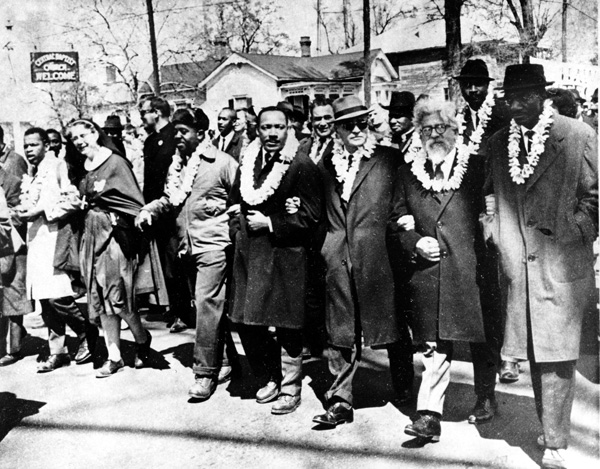
Dr. King and Rabbi Heschel march in Selma.

The service commemorates both the federal holiday dedicated to the Reverend Dr. Martin Luther King Jr. and the yahrzeit of Rabbi Abraham Joshua Heschel. One of the most influential Jewish theologians of the 20th century, Heschel marched with King in Alabama in March 1965. He famously wrote, “When I marched in Selma, my feet were praying.”

Every Jewish social justice activist knows this story. We are taught about Heschel as much as young black kids are taught about King. We aspire to be like Heschel the way they want to be like King. We know Heschel’s words about Selma as well as they know King’s “I Have a Dream” speech.

And, I imagine, we ask ourselves, “Can I be as brave as Rabbi Heschel?” as much as they ask themselves, “Can I be the next Dr. King?”

The service is a mix of a traditional Jewish Friday evening service with pieces of African Methodist Episcopal worship: The Howard Gospel Choir sings; the Agape Liturgical Dancers perform; the Senior Pastor preaches. And in between we say Shehecheyanu, the Sh’ma, and the V’Ahavta.

I can’t adequately describe the power of this service. I alternate between goosebumps and tears — and I feel like my feet are praying as I walk home. I love the traditional Kabbalat Shabbat service: It is real and spirited and inspiring and beautiful. But I wish I could go every week to a Shabbat service with the Howard Gospel Choir. And communal prayer should always end with “We Shall Overcome.”

Tonight Pastor William H. Lamar IV spoke. My mouth was literally agape by the end. (My friend Bert asked afterwards if I had taken notes during his talk: “You have to learn how to do that when you’re a rabbi!”) A self-professed “King-ophile,” Pastor Lamar talked about his desire to remember the living, breathing legacy of Dr. King, instead of the ossified version enshrined in the memorial on the mall. He cited Cornel West’s warning not to “Santa Clausify” the civil rights leader: We have, in other words, turned him into a cartoon — one that teaches us to ignore much of what he stood for, because what he stood for remains such a threat to the political establishment in this conservative country. Dr. King was not afraid to speak truth to power, and he sometimes focused on issues that his community thought didn’t pertain to it (the war in Vietnam, for example). But as we all know, Dr. King believed that “injustice anywhere is a threat to justice everywhere.” Pastor Lamar noted that being a leader sometimes means betraying your tradition and your people — to move them away from prescriptive views.

I love this service because it represents the best of what Judaism can be: pluralistic, visionary, radical, inspiring, and insistent on our obligations to one another as human beings. In the words of Rabbi Heschel:

Above all, the prophets remind us of the moral state of a people: Few are guilty, but all are responsible.

the test

I walk to an office building in downtown D.C. early on a weekend morning. I take the elevator to the second floor and enter a room where lots of other people are sitting on chairs, waiting. I show my ID to check in; the man at the desk scrutinizes both me and and the picture on my driver’s license, literally squinting and looking between both several times.

what my cursive looks like

Then he hands me a confidentiality agreement I’m meant to sign — but not before I write, in cursive, the three-sentence statement at the bottom of the page. I haven’t written in script since third grade, so I anticipate that this may be the most challenging part of my day. I began the laborious task of writing with loops and linking letters together; I can’t even get the sentences to fit in the space prescribed, and I am barely halfway through when he asks if I’m ready to move to the next step.

When I finally finish what cannot seem like an adult’s rendering of the statement, I’m directed first to put all of my belongings into a locker and then to proceed to the next room with only my ID and the key to the locker. I sit down in front of another man, who again checks my ID — and then asks me to stand up so he can wand me. He directs me to lift up my shirt so that he can see my waistline, then to pull out all of my pockets — why did I choose to wear cargo pants today? — so that he can verify that they are empty. He warns me not to make any unusual movements once I’m in the next room, and not to take off my sweatshirt. I begin to worry about whether it’s going to be hot in the next room.

He hands me back my ID, points to the line on the paper to sign in, and hands me approved pencil and paper. I enter the next room and am led to my seat by yet another staff member. I leave the room three times and return twice during my four-and-a-half hours inside, and each time I go through the same process of ID check, signing in and out, wanding, and pocket inspection. I’m also reminded that accessing my cell phone during these breaks will lead to my being kicked out of the facility. Finally, while I’m sitting in my cubicle, the innermost room staff periodically walks by to adjust the angle of the camera that is trained on various parts of the room.

And this is how you take the Graduate Record Examination (GRE) in the U.S. today.

Obviously I am terribly naive, because this shocks me. It beggars my belief that anyone would cheat on an admissions test, even as I question its value as a predictor of success in graduate school. But apparently all of this rigamarole is the logical response to past scam attempts, so I have to concede that it’s necessary.

You may be asking, “What relevance do analyses of your writing, verbal reasoning, and high-school math abilities have to do with rabbinical schools, especially since applications to those institutions are compromised principally of multiple essays?” And the answer clearly is, “Very little if at all.” Two of the schools I’m applying to require the GRE, but one does not; the fellowship I’d like to get only requires it if the school does. I don’t know what accounts for the difference between otherwise fairly similar schools.

I prepared for the exam in the simplest and cheapest way possible: I worked my way through the official GRE book published by the Education Testing Service. I’m guessing that the decision to admit or not admit me to rabbinical school will not hinge on my GRE scores; it seems most likely to me that it’s some kind of idiot check, which is still odd because it’s not like these schools haven’t already met everyone who is applying. I’ve certainly talked at length with the admissions directors of all three schools.

But I am a neurotic student, and I hate taking tests that I can’t fully prepare for. I found myself disagreeing with the “correct” answers of more than one “verbal reasoning” question and was annoyed that I won’t be given the chance to argue my point.

what quantitative reasoning looks like

The math drove me even crazier. I actually like math, and in high school, I was pretty good at it: I got a 5 on the AB Calculus exam. In college, I considered double majoring in math and Classics. So I was frustrated by my complete inability to figure out how to proceed on many “quantitative reasoning” problems. The book takes what in my mind is a puzzling attitude to this. First, I was never able to discern a pattern for the questions — but the book’s explanations were always of the sort, “Of course, it’s clear that you should do x  approach (and obvious from first glance that y approach is not going to work).” And there was no big-picture guidance whatsoever about how to recognize which approach — solving the equation, plugging in numbers, estimating, etc. — would be best. Maybe there are students who just get math — in the way I just get verbal reasoning — for whom this is not a problem. Ultimately, all I was able to do was to tell myself that it simply wasn’t worth the time it would take to get really good at the math section. Math, I’m guessing, is not going to be a large part of my rabbinate.

crying to the walls

Note: I updated this post on 12/21/11 with a photo that better illustrates it.

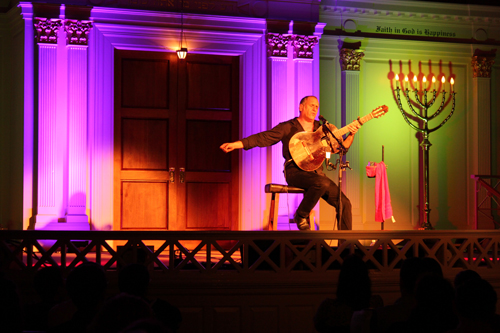
On Thursday night I went with my friend Noah to see singer-songwriter David Broza at Sixth & I Synagogue. It was an awesome night, not least because, since the concert was sponsored by the America-Israel Cultural Foundation and the Israeli Embassy, it was free! Noah first introduced me to Broza years ago, with the song “Crying to the Walls.”

As with most concerts at Sixth & I, Broza played in the sanctuary, on the bimah. Noah and I were in the balcony, looking down on the “stage.” I followed the lights that were coloring the wall behind Broza to the ark. Two nights ago, I had stood in front of the ark with the members of my adult b’nai mitzvah class while the rabbi explained the significance of its architecture.

david broza at sixth & i; photo courtesy of embassy of israel

And then I had a moment that made sound fade away and time slow down: I realized I was looking at a scene that perfectly expressed the confluence of the past, present, and future of Judaism. Thinking back, it seems so simple; I feel like this should have occurred to me before, at previous events. But of course, I’ve been thinking a lot about this topic recently.

The ark at Sixth & I holds four sefer Torahs, each of which had been hand-lettered by a scribe’s quill on pieces of animal skin that were stitched together into scrolls — as they have been created for generations. The features of the ark itself — the parokhet (curtain), ner tamid (eternal flame), menorot (candelabras), and ten commandments’ tablet — all have their roots in the first temple.

An Israeli, Broza himself presumably led to the search of attendees before the concert — byzantine security measures that have come to characterize any event in the United States having to do with the modern state of Israel. And he sang that night to a crowd of diaspora American Jews in Hebrew before the Israeli ambassador addressed the crowd.

Sixth & I is an unique space: a synagogue, turned church, almost turned nightclub, turned non-membership, non-traditional, non-denominational synagogue. It’s where young Jews connect to their Judaism in often non-religious ways. (I saw Ani diFranco in the same place six weeks earlier.) Attendance at its events continues to increase even while synagogue membership is down.

The ancient, the contemporary, and the world to come, all swirled together in a mix of rainbow lights and guitar strums and stained glass. I looked at the salmon-colored walls of the building and thought, “Remember this.”

Crying to the Walls

meridian hill park

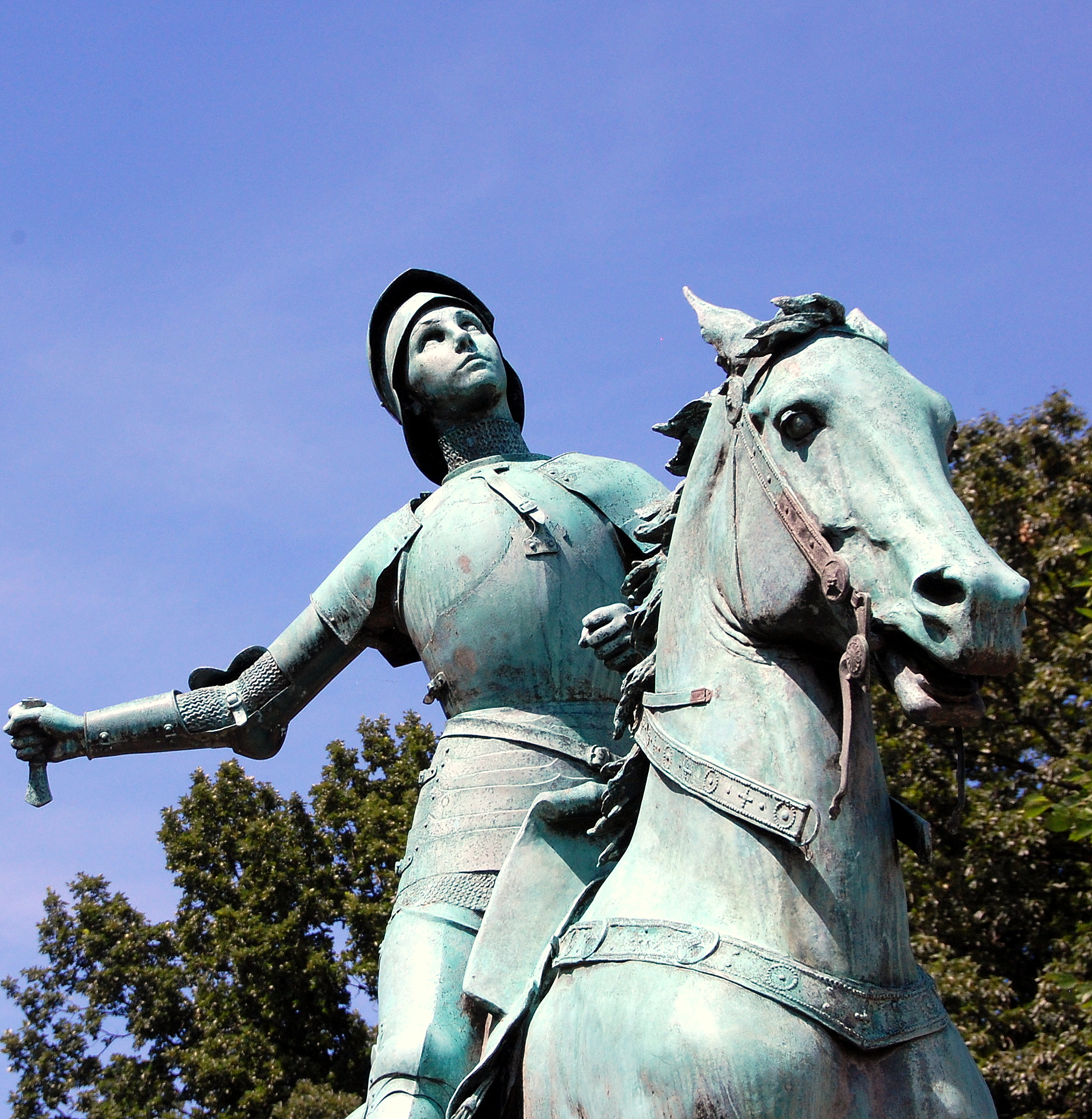
joan of arc in meridian hill park; photo by salem pearce

I took the day off from work today and decided to take photos en route to my massage appointment at Mint (yeah, my life is tough, I know). Since “Mint Dupont” is actually in Adams Morgan, I choose Meridian Hill Park, where I’ve only been once before, and that was really early in the morning during boot camp. Under those conditions, it was hard to appreciate the design and flora.

I find Meridian Hill Park a little wacky. First of all, the park reminds me of both of Morningside Park in New York and of the gardens around the Villa Borghese in Rome. I’m not wrong about the latter: Apparently the architect meant to design a “grand urban park modeled on parks found in European capitals.”

Secondly, its name is rather abstruse. The National Park Service website explains that John Porter built a mansion on the hill and so named it “because it was on the exact longitude of the original District of Columbia milestone marker.” This line is apparently one of the “Washington meridians” — but three pages into Wikipedia, and I still don’t really know what those are, except that there are markers for them all over the district.

Next, its nickname is Malcolm X Park . . . for no reason. That’s just what people call it. And the statues are no help: They consist of a U.S. president, an Italian poet, a French warrior, and a bare-breasted representation of “Serenity” — the whitest statue in the world.

Finally, the building material, concrete aggregrate, experimental (and groundbreaking?) for the early 20th century, doesn’t really stand the test of time. The material is now employed almost exclusively for utilitarian, not decorative, projects. Basically, it looks like design by sidewalk.

With all of those caveats, I do find the park charming and relaxing — despite the disturbing number of people running stairs there in the middle of a summer day. It’s certainly an under-appreciated part of D.C.

the jazz baroness

On Sunday I attended a screening of the documentary “The Jazz Baroness” at the Washington D.C. Jewish Community Center, the kickoff event of the Washington Jewish Music Festival.

I can’t really remember what motivated me to buy a ticket: I’m not a music person, so I generally don’t even skim the program listings for this annual event. But something must have intrigued me about this documentary.

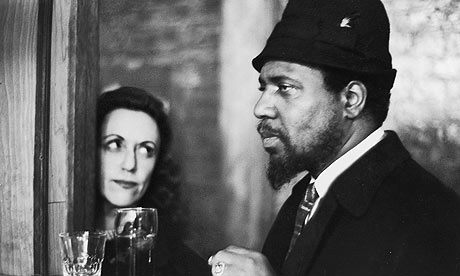
The film was written, directed, edited, and produced by Hannah Rothschild, whose great-aunt Pannonica, known to everyone as “Nica,” had a long friendship with Thelonious Monk, from when they met in Paris in 1954 until his death (at her house in Weehawken) in 1982.

By all accounts, they were not lovers, although Monk’s son tells the filmmaker that he believes Nica to have been “in love” with his dad. Indeed, both Nica and Monk were married when they met; Nica’s husband, Baron Jules de Koenigswarter, divorced her in 1956, at least in part because of her carrying on with New York jazz musicians.

The relationship seems to have been more one of patronage and caregiving on the part of Nica, who simply adored Monk’s music. In the film, she (voiced by the incomparable Helen Mirren) tells the story of the first time she heard it. In 1951, she stopped by a friend’s apartment in New York on the way to the airport to catch a flight to Mexico, where she was living at the time with de Koenigswarter and her children. He played for her “‘Round Midnight,” and she was completely captivated. She’d never heard anything like it, and she made her friend play the record over and over again. She missed her flight back to Mexico, and shortly thereafter, she moved to New York.

For his part, Monk was a musical genius but suffered from fairly severe mental health issues (undiagnosed in his lifetime, but later speculated to be manic despression, bipolar disorder, and/or schizophrenia). Several friends and his long-time manager also testified to his use of marijuana and heroin. Another friend explained that Nica, together with Monk’s wife, Nellie, shouldered the burden of caring for Monk, as his behavior was too much for one person to manage. Nica even took the rap for Monk when they were arrested for marijuana possession on the way to a gig in Delaware.

Overall, I liked the film. I certainly learned a lot, and I *loved* that Monk’s music played all throughout the film. You really can’t go wrong with his bebop. A few small items distracted me: Hannah Rothschild’s voice sounds remarkably like Helen Mirren’s, so at times during voiceovers it was hard to tell whose experience was being narrated. And a few of the interviewees were only identified during their first appearance in the film, leaving me to wonder in later scenes on what authority they were speaking. (Compounding this problem is that many of the Rothchilds interviewed were old, wrinkly, and therefore practically indistinguishable, women.)

My other complaint concerned the filmmaker’s attempt to show parallels between Nica’s and Monk’s lives. I don’t think that her search was in vain, but when she likened Monk’s upbringing — the son of a sharecropper in rural North Carolina — to Nica’s childhood — a member of one of Europe’s most prominent dynasties — she strained my credulity.

Mostly, though, I very much enjoyed the story of this “beautiful friendship.”

first person

Yesterday I heard a Holocaust survivor speak in-person for the first time in my life. A few weeks ago, after finishing Refuge in Hell, with its many survivor interviews, I realized that I hadn’t ever heard a survivor speak about his/her experience firsthand, save the film that runs at the end of the permanent exhibit “The Holocaust” at the United States Holocaust Memorial Museum.

I went to the museum for the first time in the spring of 1995, right after it opened, and I haven’t been back since (except for a quick visit to the gift shop — for classroom supplies with my mom — last July). But I’ve been thinking about the site a lot recently since Stephen Johns was murdered one year ago today.

On June 10, 2009, a man dressed in a confederate coat walked up to the museum’s entrance. Johns, a security guard at the museum, saw him and moved to open the door for the 88-year-old man, who then opened fire on the museum with the rifle hidden in his coat. Johns died at GWU Hospital, where my friend Rabbi Tamara Miller, as the Director of Spiritual Care, was called to minister to the Johns family — a job which later played a role in the hospital’s firing her in July. I’ve been working for Rabbi Miller for the past six months, helping her to build her new private practice in the wake of her dismissal.

This is how I found myself, a little before 1:00 p.m., making my way to the museum to hear Inge Katzenstein (née Berg) as part of its “First Person” series.

I was already thinking about senseless loss of life as I walked up to the building. And my sadness only increased as I navigated to the Rubenstein auditorium. The architecture of the museum is purposefully inescapable. Imposing. You can’t pretend that you’re anywhere except a memorial to the genocide of 6 million people, even if you just want to hear a nice Jewish lady tell about her family’s escape from Germany to Kenya, and then to the United States.

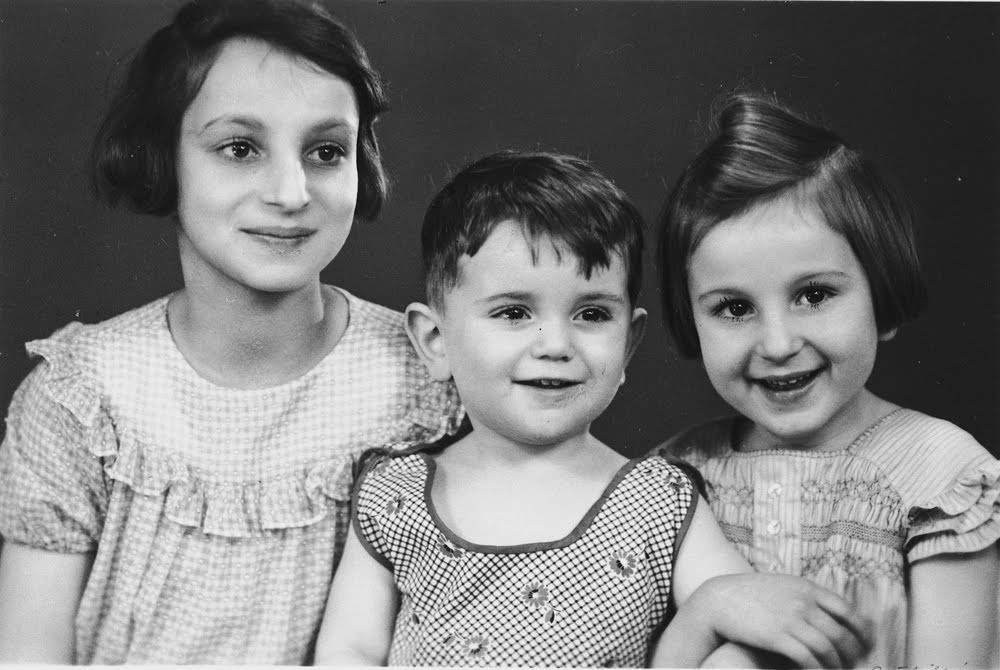
After a brief introduction by (the rather unfortunately named) Bill Benson — an introduction which included several pictures of the Berg family, including the one above of Inge, her sister, and her cousin — Inge sat down with Bill for an informal interview.

A member of an observant Jewish family, Inge lived in a small village outside of Cologne. Kristallnacht was the breaking point for her parents, who had been trying to leave Germany since 1933, but had been denied entry to the United States. (Inge recalled that they had a quota number, but it was so high, she quipped, “I doubt it would have even come up by today.”) Her father illegally left Germany for Holland right after Kristallnacht, and through a cousin who was a lawyer in the then British colony, 17 of her family members obtained visas for entry into Kenya.

Inge’s mother was left alone to manage the clean-up of the family’s house — which had been ransacked, and all items within damaged or destroyed, during Kristallnacht — as well as the orchestration of the family’s move to Africa. In May 1939, Inge, her mother, and her sister left Cologne for good; they made their way first to Switzerland and later to Genoa, Italy, where they caught a German boat to Mombasa. (At that point, the Germans were apparently happy to help Jews leave Europe.) And the boat even provided kosher meals!

Inge, her mother, and her sister lived in Nairobi while her father, his parents, and an uncle and a cousin ran the farm in the highlands. Eventually though, the political climate in Kenya became uncomfortable for the Bergs, who were considered to be Germans by the British and by the Kenyans, and in 1947, they immigrated to the United States.

I especially loved hearing all of the little details in Inge’s story. Her observant family managed to keep kosher even after such customs were outlawed in Germany through a cousin who had been a kosher butcher; after the Nuremburg Laws were passed, his business continued to slaughter animals but fired a shot afterwards, so that anyone listening wouldn’t suspect a ritual killing.

Inge recalled being driven with her grandparents out of her village to the relative safety of the countryside after the day after Kristallnacht. Her grandmother’s leg was in a cast, and Inga related how her grandmother used the cast to keep her on the floor of the car, so she and her sister couldn’t see what had happened to the village.

My favorite story was one that illustrated Inge’s self-described “rebellious” nature. A boy called her “a dirty Jew,” and Inge, tired of such insults, gave him a bloody nose. “And then I ran,” she grinned.

merry strasmas!

First, a hat tip to the Washington Post for that bon mot.

Last night, my husband and I ventured out to Nationals Park to see the much-hyped debut of the Nationals’ new 21-year-old ace, Stephen Strasburg (versus the Pittsburgh Pirates). He didn’t disappoint.

Joe and I left our apartment near downtown D.C. around 5:00 for the 7:05 p.m. start, and the train was still packed by the time we got to Navy Yard. The excitement in the air inside the stadium was palpable, a feeling not at all fitting for a match-up between two sub-.500 teams.

Even the elements conspired in Strasburg’s favor. It was absolutely perfect ballpark weather: 68 degrees, and not a cloud in the sky. Joe and I found our seats in the infield gallery, along the third baseline, in section 306. Among the sold-out crowd (pictured here in a photo taken by Joe on his iPhone), practically every other person wore a “37” red or white T-shirt.

Ken Burns (“not local,” Joe informs me, after checking his iPhone) threw out the ceremonial first pitch, and then the crowd was on its feet as Strasburg calmly jogged to the mound. There were so many camera flashes during his first pitch that I’m amazed the umpire was able to make out the tiny white speck in their midst. But he apparently did, calling . . . a ball.

But Strasburg doesn’t throw balls!

After a rocky start (it took him eight pitches to throw two strikes), Strasburg got the first two batters to line out and ground out, respectively. And when he fanned Lastings Milledge (a former Nat) for his first strikeout of the game, the crowd erupted into pandemonium.

Strasburg ended up striking out 14 over seven innings, including the last seven batters he faced. He walked none. By about the sixth inning, the crowd was again on its feet, cheering every pitch — and booing the home plate umpire when he dared to call a ball.

And the Nats gave their new ace uncustomary run support. Ryan Zimmerman hit a solo homerun in the bottom of the first, reminiscent of his walk-off homer during the park’s inaugural game in March 2008, the last time I saw Nationals Park so packed. Adam Dunn hit a two-run shot in the sixth, which Josh Willingham immediately followed with a solo shot of his own. That turned out to be enough, but Zimmerman managed to score again in the eighth.

The only part of the night that was a disappointment was the Presidents Race. Usually (rather insultingly) billed as “the main event” during the fourth inning, the promotional gimmick pits the four U.S. presidents on Mt. Rushmore in a foot race around the edge of the field from the Nats’ bullpen to home plate. Perennial loser “Teddy” is a favorite of mine, and the internets had been buzzing about whether the powers that be would finally let him win, in honor of the new era for the franchise that Strasburg was said to be ushering in. But alas, while Strasburg walked away from the game with his first “W,” Teddy just racked up another “L.”

Earlier in the day, the Nationals said that they had credentialed more than 200 members of the press for the game. The D.C. Sports Bog reported that Willie Harris, upon seeing the media crowd, remarked, “Damn, is this the World Series?”

Jesus of Nats-areth (h/t Steve Fox), indeed.

mikveh

On Wednesday night, I took in a performance of “Mikveh” at Theater J at the Washington DC Jewish Community Center. (And thanks to my friend Rabbi Tamara Miller, who led an interfaith panel on “Water and Ritual” afterwards, my ticket was comped! Free stuff = good.)

The two-hour piece takes place exclusively in a mikveh in an Ultra-Orthodox neighborhood in Israel; all of its characters are female (although the male characters — the husbands — play important roles in the action off-stage). A mikveh, or a bath used for the purpose of ritual immersion, is the way in which these women regain ritual purity after menstruation. Ostensibly, the women come to the mikveh each month for the same reason, but it becomes clear during the course of the play that things are not as they seem with the mikveh’s regular visitors.

One of the most serious secrets that is revealed to the two mikveh attendants, who supervise immersions to ensure that they are completed according to halacha, or Jewish law, is the physical abuse suffered by one of the women, Chedva, at the hands of her very powerful — and purportedly very religious — husband. Ultimately, the women who end up at the mikveh together each month band together to help this “battered wife,” as well as to comfort each other in their respective problems.

I didn’t love the way that the domestic violence was handled on stage. For one, the new mikveh attendant, Shira, a community outsider and the subject of much speculation and gossip, is set up as Chedva’s savior. New on the scene, she tricks Chedva into accepting a DV helpline number, is insistent that Chedva leave her husband, and then offstage, after a particular bad beating (we assume), makes the decision to remove Chedva from her home and hide her and her daughter.

As my friend Alicia notes in her blog post on battering in public places,

often, survivors would say that they didn’t want people to get involved because it only made it far more dangerous for them- they know their abusers best, and how to survive just enough. they know their partner’s moods, schedules, patterns. they have had to. they are surviving. they are incredibly resourceful and resilient. other folks coming in to “save” them only makes abusers mad (and leaves the survivors feeling more disempowered). and those abusers very rarely take it out on the strangers. they take it out on their partner.

It was great to see the very different women in the play come together to buck the patriarchal world of Jewish Ultra-Orthodoxy, but I couldn’t help but feel that the narrative was a little insulting to those women. Were they not capable of seeing the abuse and devising an organic solution, one specific to their community? Wasn’t Chedva herself capable of deciding if and when she left her abusive husband? Plus, the scene in which Shira is trying to get the other women in the mikveh on board with her solution suffers from being an unfortunately strained, melodramatic moment on stage.

I was also concerned that the literature around the play didn’t contain any trigger warnings, which it really should, dealing as it does with the traumatic issues of domestic violence and rape. (The website and program do contain the spoiler that the play contains nudity (gasp!), which seems both kind of obvious and not really a big deal at all.) Indeed, it was really hard for me to be unexpectedly faced with fairly graphic representations of these issues. One of the women (spoiler alert) commits suicide over, in part, the non-consensual sex that she has with her husband. It’s not pretty.

I did enjoy the variety of women’s experiences that were presented in the play: All of the characters were seeking something slightly different from her mikveh experience. Unfortunately, the presentation was on the heavy-handed side.