
rabbinical students on israel

j street's "fill to the green line" shot glass; photo by salem pearce via  instagram

j street’s “fill to the green line” shot glass; photo by salem pearce via instagram

Last Sunday, I managed to walk the five blocks from my apartment to the convention center to attend a session at J Street’s annual conference. I say “managed” because Sunday was a busy day for D.C.-area Jewish organizations. I ran Sixth & I’s Exodus 5K in Rock Park in the morning and went to JUFJ’s Labor Seder in the evening. Among the events I couldn’t squeeze in were Federation’s “Good Deeds Day” and a lecture by Anat Hoffman. (I think it’s possible that the Jews need to coordinate their events a little more.)

I’m really glad I took the time to attend the panel, called “The Changing Attitudes of Rabbinical Students on Israel: Perspectives from the Deans.” The deans in question were HUC-JIR’s Renni Altman; JTS’s Danny Nevins; and Hebrew College’s Daniel Lehmann (who I’m pretty sure is actually the president of Hebrew College, but no matter).

The creation of the panel was prompted by an article by Daniel Gordis published last year in Commentary: “Are Young Rabbis Turning on Israel?” The response was of special interest to me as an enrolling rabbinical student — but also because part of what prompted Gordis’s article was the commemoration of Yom Hazikaron at Hebrew College (where I’ve decided to enroll). The article caused quite a bit of uproar when it was first published: I happened to get an earful about it in October when I ended up sitting next to a man from the Republican Jewish Coalition on a trolley in Arlington Cemetery on the way to the dedication of the Jewish Chaplains Monument. When he found out I was applying to rabbinical school, he immediately brought up his horror about the article (published some five months earlier). His interpretation? Rabbinical students today more closely align themselves with the philosophy of J Street than with that of AIPAC.

For those not in the know, the reason this is so upsetting to some is that J Street engenders a lot of suspicion — if not downright hatred — among a large (or possibly the most outspoken) part of the American Jewish community. As for example: In November 2010, I attended a Federation lunch event that featured a debate between a conservative and a progressive about the meaning of the mid-term elections, particularly for the Jews. (The conservative viewpoint was represented by Bill Kristol, with whom I almost never agree, but who was miles more articulate than the progressive, who was unfortunately ridiculous — and whose name I can’t remember.) They argued for an hour, disagreeing about everything.

Until someone asked their opinions of J Street. Kristol responded that he thought the organization was a front for a pro-Palestinian agenda. The progressive: “I agree.” The room exploded in laughter.

This is not an uncommon view. J Street’s slogan is “Pro-Israel. Pro-Peace.” — but its opponents generally don’t believe any of its stated positions. It is routinely labeled “anti-Israel.” Recently I witnessed a Facebook exchange between an acquaintance of mine and an acquaintance of his about the BDS controversy at the Park Slope Co-op. (And if you haven’t seen “The Daily Show’s take on this vote, you must.) The person I didn’t know crowed about the failed boycott, adding the comment, “Take that, J Street.” When my friend pointed out that a) the BDS movement precedes the founding of J Street by several years, and b) that J Street opposes the BDS movement (and has position papers on its website to this effect), the former was unswayed. And he remained unswayed even when a VP at J Street weighed in on the feed that she has spoken on numerous occasions about J Street’s opposition to BDS. And so it went.
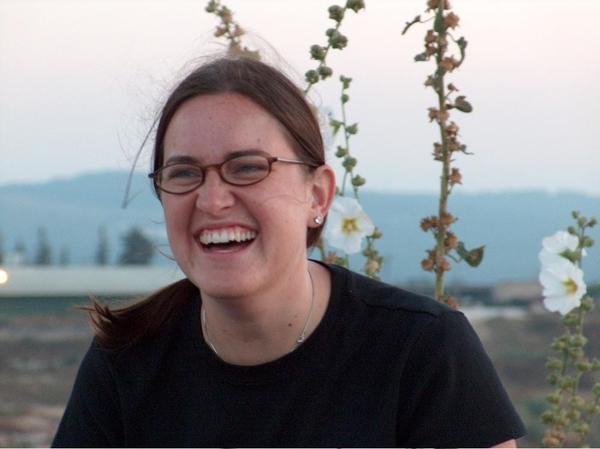
salem in israel in 2002

I’m nervous about wading even a little into the Israel-Palestine issue here, as it is, in the words of Rabbi Nevins, “unbelievably messy.” And I don’t really want to get it into it (more on that below), in no small part because it’s just not an issue I know that much about. I’m taking this risk, though, to explain the stakes and to make the point of how important it was that J Street addressed the issue. And it made me happy to see leaders of the schools I applied to at the conference. Whether or not you agree with J Street, they’re one of the few Jewish organizations that allows expression of a variety of viewpoints on Israel (as for example, when J Street noted that it disagreed with Peter Beinart but invited him to speak at the conference anyway). One of the things that I love about Judaism is that it values debate; but on Israel some believe that there are things we can’t say.

Also on the panel was Professor Steven Cohen of HUC-JIR, who had conducted a survey of JTS rabbinical students’ attitudes towards Israel in the wake of the article. All of the deans expressed disagreement with Gordis’s conclusions, and Cohen’s data seems to back them up. I suppose the deans’ remarks could be interpreted as merely defensive, but I’ve met and spoken with all three of them, and they are all thoughtful, responsible rabbis. Plus, they belong to the generation to which Gordis was drawing his contrast with current rabbinical students. But Cohen’s study did concur with the RJC staffer’s interpretation of Gordis’s article (if not his condemnation): Rabbinical students tend to agree with AIPAC less than with J Street or Rabbis for Human Rights — or the New Israel Fund, which was rated highest in political affiliation by students.

All of the deans acknowledged a shift in their students’ attitude towards Israel: “an evolution, not a revolution,” as Rabbi Altman characterized it. They agreed that rabbinical students do tend to hold more varied, diverse, and complex opinions about Israel than their predecessors. Gordis and his ilk attribute this to the fact that our generation didn’t grow up during the Six Day and Yom Kippur Wars, when existential threats to Israel were inescapable. But as Rabbi Nevins pointed up, our generation did grow up when bombs were exploding at pizza parlors and discos in Jerusalem, making Gordis’s point “more of truism than a deep truth.” Rabbinical students today — and indeed, young Jews in general — tend to prioritize different values in their support of Israel: human rights, say, versus the previous generation’s emphasis on loyalty. What most resonated with me was Rabbi Lehmann’s observation that Israel is now much less of a motivating factor to enter than rabbinate than it once was. Indeed, I remember thinking that it wouldn’t have even occurred to me that a North American Jew would become a rabbi because of Israel (I’ve certainly never heard anyone cite it).

Ultimately, the panel was an interesting glimpse into my future classmates and some of the issues I’ll be grappling with. I was reassured to hear about the diversity of opinion among my soon-to-be peers, and I’m looking forward to furthering my own Israel education.


a new spring

(probably not) cherry blossoms in scott circle; photo by salem pearce

Yesterday, Saturday, was a gorgeous day here in the nation’s capital. It was sunny and 70 degrees, and Shabbat was made sweeter by the fact that I had found out the day before that I was accepted at the third rabbinical school to which I applied. After morning services, I sat in Dupont Circle with my husband and felt like I could relax for the first time in at least six months. I read (Patti Smith’s Just Kids) and took a few photographs (right and below).

Yesterday felt like a new beginning in another way, as well: I led part of the Shabbat morning service for the first time! Sixth & I hosted a Learner’s Minyan in the morning, led by Rabbi Shira Stutman. The rabbi who is teaching my adult b’nai mitzvah class, Lauren Holtzblatt, arranged for the class to lead the parts of the service that we’re planning to in June during the official ceremony. I’ve volunteered for the second half of the Torah service (putting the scroll away) and for the mourner’s kaddish.

st. patrick’s day green grass at dupont circle; photo by salem pearce

Unfortunately, the past month of travel hasn’t left me any time to practice, so I had to beg off of the Torah service part. I decided to go ahead with the mourner’s kaddish, which I realized while I was leading is actually a little unnerving. The only people who are standing and reciting most of the prayer with the leader are the few in mourning or observing a yahrzeit (although I did ask those whose custom it is to stand to do so). Even so, I could only hear myself in the large sanctuary that was hardly filled, and saying the mourner’s kaddish by (what feels like just) myself is quite different than saying the hatzi kaddish with the whole congregation, when it doesn’t matter if I stumble over a word or two. I’ve got some practicing to do.

Despite my nerves, though, I was able to say to the congregation yesterday that I was leading and saying the mourner’s kaddish for the family of Trayvon Martin. This clear abrogation of justice has troubled me all week: I am proud and privileged to be an American, but I sometimes loathe my country’s institutions.

But the long road is coming to an end: I’ve gotten into (in alphabetical order) Hebrew College (in Boston), HUC-JIR (in New York), and Reconstructionist Rabbinical College (in Philadelphia). I am tentatively leaning towards one school, and I am pretty sure it will be a choice between two of them. But I’m not ready to make that intention more explicit at this point.

I now move on to the decision-making part of the process, which I hope to wrap up in the next few weeks. Stay tuned!

interview the first

Optimized-HiRes.jpg

Earlier this week, I took a trip for my interview and testing at the first rabbinical school to which I applied. (As I’ve said before, it’s easy to figure out which school it is, but it’s not that important for this post.)

Joe came with me so that he could get a feel for the school and the surrounding area. We stayed with a new friend that I met on my visit to the school; he and his fiancée were nice enough to offer us their queen-sized guest bed. The home hospitality offered during all of these rabbinical school visits certainly has made the trips more affordable — not to mention has afforded the opportunity to get to know potential schoolmates and further perspectives on the schools.

The testing was a mixed bag. I can say with some confidence that the best thing about it was at the end, when I got up to turn in the last test and I fell out of my chair (in front of two other prospective students, I might add). In my concentration and/or fear, I hadn’t noticed that one of my legs had fallen asleep. It was very Liz Lemon.

The three hours of Hebrew wasn’t as bad as I expected; it was the one-hour “Jewish Traditions” exam that was heartbreaking. This reality was made worse by the fact that I really thought it was going to be the opposite. I was wholly unprepared for how badly I would feel at the end.

I think I did well enough on the basic modern and Biblical Hebrew sections and middling on the Rabbinic. I didn’t even attempt the advanced modern — or the composition. (I am sorely lacking in Hebrew writing skills. As I am in Hebrew conversational skills, a part of the test that I also bombed.) I did well reading aloud from the siddur and Torah — although I was chagrined at the feedback that I confused my sins and shins.

The “Jewish Traditions” exam made my heart sink into my stomach: two pages of Hebrew terms to define and explain the significance of, and I only knew about three at first glance. And with this kind of exam, further reflection doesn’t yield more answers. I either knew them or I didn’t — and I didn’t. So I spent the rest of the time writing the terms down, so that I could look them up and learn them later. (Joe said he thought this was as much evidence of my readiness for rabbinical school as actually knowing the terms. I hope he’s right. Either way, I won’t soon be forgetting what hatafat dam brit is.)

The next day, the interview went considerably better than the testing. Though I faced seven people, I’m generally good at interviews, so I wasn’t fazed. And they all asked thoughtful questions, which I really appreciate. That experience did much to buoy my spirits after the previous day.

Unsurprisingly, I was asked how I would decide which school to attend if I were accepted at all the ones I’ve applied to. I answered honestly: I’ve gathered all the information that I can, so I’m thinking that it’s going to come down to a feeling. Joe liked the school and the area, as do I, but I’m honestly not sure what my feeling about the school is.

I’ve been exhausted and starving since I returned. I think the combination of anticipation, stress, frustration, disappointment, enjoyment, and being around new people just ran me down. And I’ve got to do this at least twice more . . .

morning

File this under “things I worry about when I think about rabbinical school.” I imagine this post to be a first in a series. The issue today is prayer and exercise.

tefillin barbie by jen taylor friedman

I think about prayer a lot these days, more than I used to, which was generally on Friday nights and Saturday mornings. There are several reasons for this. My year-long b’nai mitzvah class at Sixth & I began by exploring some philosophy of prayer: We read Reuven Hammer’s Entering Jewish Prayer and Abraham Joshua Heschel’s Man’s Quest for God. We then moved on to learning the parts of the different services (Shacharit, Mincha, and Ma’ariv) — and talking about the differences between the services on weekdays and on Shabbat. We learned how to put on tallit and lay tefillin. And we’ve been encouraged by the rabbi to at least begin saying the Birchot HaShachar, the thirteen morning blessings — perhaps as practice towards expanded morning prayer.

And in the Talmud class I’ve been attending once a week, we’ve been reading the tractate Berakhot, which deals with the logistics and requirements of prayer, especially the Sh’ma and the Amidah.

Finally, my applications to rabbinical school have asked me to reflect on my relationship with G-d, of which prayer is certainly a part. And at every school that I visited, I had the chance to attend at least morning prayers. I’ve already realized that davening at rabbinical school is likely to be a unique experience: The minyan is most likely more committed than average, as you might expect from a roomful of aspiring rabbis, leading to perhaps a more spirited and spiritual experience. The students run the services and are oftentimes encouraged to experiment and innovate with the liturgy. Plus, in the institutions with cantorial schools, the services can make use of unbelievably beautiful music.

That’s prayer. On to exercise: It’s taken me a fair amount of my adult life to realize that consistent, almost daily exercise is key to my mental health. And for me, that exercise needs to happen first thing in the morning. It makes my whole day better. Plus, if I’m going to exercise, I’m more likely to do so in the morning: At the end of the day, I just don’t have energy to work out.

And the conflict: At all the schools I visited, Shacharit starts before 8:00 a.m., sometimes as early as 7:30 a.m. This doesn’t preclude morning exercise, but it certainly makes it trickier than it has been here in D.C., when I’ve started work at 9:00 a.m. or later. (Plus, my current morning commute is just 15 minutes of walking. My commute in school could be 30 minutes or more on public transportation, further shrinking the morning exercise window.)

I want to have a meaningful prayer life in rabbinical school and participate in communal prayer services. I also want to practice self care through morning exercise. So, I’ve got some thinking to do. And maybe some afternoon exercising to get used to.

asking for help

Ben Zoma says: Who is wise? One who learns from all people. (Pirkei Avot 4:1)

In the process of applying to rabbinical school, I did something I almost never do: I asked for help.

My mom says that I came out of the womb saying, “I can do it myself!” (An old copy of that I Can Do It Myself Bert and Ernie book was a present one year from my parents.) Indeed, I’ve always been an independent person, preferring to work alone rather than in a group. I don’t think I even had anyone even look at the applications I wrote for college admission. This instinct is in some ways positive: I have a great deal of confidence in my own abilities, and I rarely doubt whether I am up to the task. But it’s also a little ridiculous: Simply put, I don’t know how to do everything that I set out to do, and clearly whatever I am doing would be improved by asking for a little help.

There’s a deeper element to this tendency, though: I have a hard time opening up to people. I am hesitant to make myself vulnerable. I’m scared that those I choose to share with will see my flaws and weaknesses — and won’t like me because of them — and, somewhat obviously, that I do need help. And I’m scared that if I ask for help, I’ll get criticism that I won’t be able to handle.

These truths do make my choice to start a blog somewhat mystifying. What am I doing in this space but bearing my soul? But I started this blog more for myself (writing is cheap therapy!), and I don’t expect to gain any kind of sizeable readership. Plus, I feel less exposed just sending my thoughts into the internets.

I don’t know what exactly made me decide to do things differently this time around. Maybe it was my first school visit, when an admissions officer said, “We’re here to help you through the admissions process.” I remember thinking that this was a bit of a revelation, although I’m not sure why I assumed the process would be adversarial. But I did decide to seek help.

So far I’ve visited four schools, met with 11 D.C.-area rabbis (and have appointments with three more), and spoken with at least a dozen current students, as well as admissions deans at all four schools. All of that went well — and has been helpful to boot. Meeting with rabbis helped me to work on my “why I want to be a rabbi” speech, and I got to hear what they liked and what they didn’t like about their alma maters, as well as what they wish they had known before starting rabbinical school and a career in the rabbinate. (Though, I recently realized, with some amazement, that I haven’t asked anyone I’ve met with, “Why did you become a rabbi?” I should probably start doing so.)

A little tougher for me has been sharing my personal statement with others. But I did it. So far I’ve asked seven people to look at it, and I’ve been gratified by the responses. Of course, I have to admit that it’s been easier since the feedback has been universally positive. But everyone has had suggestions for improvement, and my essay is definitely the better for them.

This experience has been an exercise in humility, which is undoubtedly good for me. Continued practice in this area will be good for me in my rabbinate, and in life.

the fourth school

jeremiah

the prophet jeremiah, from fall rabbinical school tour; photo by salem pearce (via instagram)

In the fall I visited four rabbinical schools. There are only a handful non-Orthodox institutions (that is, ones that accept women) in the U.S. I ruled out two online/commuter schools, as well as the ones not on the East Coast (per my husband’s request). In early to mid-December, I decided to apply to just three of the schools I had visited — and I began to make plans accordingly: asking for letters of recommendation, sending transcripts, organizing essays, completing forms, etc.

When I took the GRE on December 9, I had to choose the schools to which to send scores, and I included school #4 on that list. I think I just wasn’t quite ready to rule it out. (Plus, I got to send four reports for free, so I thought, “Why not?”)

Five days later, the admissions director at school #4 called to check in. Surprised at his call, I wasn’t ready to have the conversation about why I had decided not to apply, so I only mentioned one reason. But I didn’t feel great about how poorly I had articulated my concerns about the school, so I sent a follow-up email. In it, I explained that I had come to the conclusion that school #4 was just not a good fit for me, for various reasons. I’m not going to be a productive member of the matriculating class — and the school shouldn’t want me — if that’s the case. I didn’t hear back.

Sidebar: I’m not trying to hide the identity of the school in question: In fact, it’s probably easy to figure it out. But I don’t think it’s all that important to this narrative.

Then last week, I did get an email, after he had received my GRE scores; he hoped for an opening to start the conversation again. This unexpected development shook me up probably more than it should have. I started spiraling into a tizzy of questions: Why is he doing this? As a new admissions director, does he just want robust application numbers? Am I letting flattery cloud my judgment? Are the concerns I raised about the school actually not accurate? Is this school actually my destiny?

The last is a bit of an exaggeration. But I did wonder, much to my husband’s chagrin, whether this was a sign from the universe. I’m willing to believe that things happen for a reason. And I think having grown up with an evangelical Christian father makes me more susceptible to doubt in the face of someone else’s certainty. (It could also be reasonably inferred that I am also an over-thinker and an over-worrier.)

I agreed that we should have another conversation; it happened yesterday, and it went really well. I was able to go through with him a list of my concerns. None of them were fully alleviated, which is not what I was expecting anyway. But next I’ll speak with the associate dean, as well as a current student. (Both are women, which may hint at the nature of some of my concerns.) And after a conversation with a rabbi I trust, an alumna of school #4, I’m going to go ahead and apply. What’s one more application, right? I don’t want to close that door quite yet.