tefillin

tefillin bag; photo by salem pearce (via instagram)

tefillin bag; photo by salem pearce (via instagram)

Earlier this semester I took on mitzvat tefillin, the mitzvah of tefillin, or “phylacteries” as they are often referred to in English. (I am not sure why the latter word is any clearer than the former, but some have heard the Greek word rather than the Hebrew.)

Tefillin are the set of black boxes with leather straps that are worn on the head and on the arm during weekday morning prayers. They are the Talmudic solution to the exhortations in the Torah (in several places) to “bind them [these words] as a sign upon your arm, and they shall be as totafot between your eyes” (Deuteronomy 6:8). The meaning of “totafot” is not entirely clear; it is often translated as “frontlets” (which, in some possibly circular logic, is defined by Merriam-Webster as “a band or phylactery worn on the forehead”). And tefillin is a rabbinic word; it’s not found in the Tanakh.

The rabbis interpreted “them” (which refers back to “these words” from an earlier verse) to mean the verses in which totafot are mentioned in the Torah; thus, each set of tefillin contains the four verses from Exodus and Deuteronomy written on parchment scrolls.

At the beginning of last semester, I borrowed a set of tefillin from the Women’s Tefillin Gemach, a free loan society (“gemach”) that, as you might guess, lends tefillin to women. Many people — including lots of my classmates — inherit tefillin from their grandparents (or maybe even parents). Obviously that is not an option for me, but the gemach exists as well for women who were born Jewish; some might have been passed over, in favor of a brother or other male relative, for inheritance of a set. Unlike wearing tallit, laying tefillin is still not all that common among women. Even among my classmates, I would estimate that less than half of the women wear tefillin, while most of the men do.

I borrowed a set of tefillin from the gemach in August, tried them on once, and then let them languish in my tallit bag. There was enough going on already during my first semester of rabbinical school, and I just wasn’t able to take on one more new thing. So I prayed last semester just in my tallit (which itself was a new practice).

still life with tefillin; photo by salem pearce (via instagram)

still life with tefillin (with metal casings for the boxes); photo by salem pearce (via instagram)

During our winter seminar on feminist theology and practice, I started thinking about tefillin again, especially as we talked about changing prayer and other ritual to make it more accessible for those for whom it was not originally created. And then I came across an abridged prayerbook with blessings in all feminine G-d language. I decided that I would start to wear tefillin — and that I would learn the blessings from this book (and deliberately not learn the traditional blessings). So I say the traditional blessing when putting on my tallit — and something a little different when putting on my tefillin. It’s a way of making my own a practice that still feels very . . . male.

I also say an alternative passage from the Tanakh as I finish putting tefillin on my hand. Traditionally, one recites Hosea 2:21-22: “And I will betroth you to myself forever; I will betroth you to myself in righteousness, and in justice, and in lovingkindness, and in compassion. And I will betroth you to myself in faithfulness; and you shall know the Lord.” This is certainly a lovely sentiment. However, the prayerbook I found suggested an alternative, which resonated much more with me. The passage I say is from Ruth 1:16, her devotional words to her mother-in-law, Naomi: “For where you go, I will go, and where you lodge, I will lodge. Your people will be my people, and your G-d, my G-d.” Indeed, the words of a fervent convert are certainly more appealing to me than the problematic metaphor of marriage between G-d and Israel.

I learned the blessings and the passage from the Tanakh one night while working at the front desk at school (which I do two nights a week). And that same night I learned also how to wrap tefillin . . . by watching a video on YouTube! (All of the many how-to videos of course all feature older men — or IDF soldiers — so I may have found an eventual project!) That evening I just put on the tefillin and took them off, over and over and over again, until I was able to do it fairly quickly (it’s a complicated process).

tefillin barbie by jen taylor friedman

tefillin barbie by jen taylor friedman

Worn, tefillin look weird. Full stop. It’s possible that since I didn’t grow up seeing them, I find them a little more jarring than most Jews, but I think it’s more probable that they’re just odd. I say this because the first time I was shown how to put on tefillin, by my bat mitzvah rabbi, she said, “Don’t they look funny?” — and I loved her for that. However, wearing tefillin while praying has felt completely natural. It just seems right. I am so excited to continue the practice and to observe what effect it has on my prayer.

This is not to say I haven’t had my frustrations. My first barrier to overcome was my fear (or fear of my annoyance) that it would take too long to put them on. That evening spent practicing got me to an acceptable speed (and yes, I timed myself!).

What I’m having trouble getting past is the fact that tefillin are meant to be laid against the skin, and the wrapping starts at the upper arm. Tefillin were not designed with women in mind — nor for that matter were women’s clothes designed with tefillin in mind. Most men’s upper-body garments are conducive to being pushed up or aside to expose the upper arm; the same is generally not true of a lot of women’s clothes. So in the dead of New England winter, I’ve been doing one of two things: I’ll wear a short-sleeved or sleeveless shirt (with, say, a cardigan). Or I’ll wear a camisole under a more form-fitting sweater or turtleneck and wriggle halfway out of it during davenning. Both of these options make me feel considerably less modest than I’d like, especially during prayer. (Thank goodness for tallit!) And both mean that every morning I have to think, “Can I lay tefillin in what I’m wearing?” I know mitzvot aren’t supposed to be effortless — but I’m pretty sure that the men at my school aren’t thinking about this.

I’ve written this post from my perspective as a cis-gendered, female-identified student (and have admittedly used a gender binary throughout): I am also interested in the experiences of others with this practice.

What would tefillin look like if a pluralistic community, of Jews of all types, were designing them today? How would we understand words of Torah “for a sign for you upon your hand, and for a memorial between your eyes” (Exodus 13:9)?


the wrath of the whatever from high atop the thing

Seven days ago this happened.tempting fate
And one day ago this happened.fate tempted

I know the two are not connected. I know this. <Pause.> Mostly. My rationalist husband, who is not at all conflicted as I am, has derived great pleasure from repeating my taunt above and then watching my face as it crumbles in guilt. Lots of other people who I know for sure don’t believe there is a connection are also teasing me.

I’m a baseball fan. I know that you don’t talk to a pitcher on the way to a no-hitter. You don’t declare a game over until it’s actually over. You don’t step on baselines to and from the field. You grow a beard during playoffs. You don’t change anything during a winning streak. Simply put, I’m superstitious.

And it’s hard to put aside completely the thought — laughable as I know it is — that as a rabbinical student I might have a connection to The Powers that Be.

So I actually debated with myself whether to write what I did on Facebook. And I remember concluding, “Ah, do it. What could possibly happen?” This was my first mistake: If you’re asking yourself that question, you shouldn’t do whatever it is that you’re contemplating the consequences of.

Putting aside the absurdity of naming a historic blizzard (so far the fifth worst in Boston history) after a cartoon fish, I am still excited about this big snow (even as I am not looking forward to shoveling out the car). I got a day off from school on Friday, and the snow is absolutely beautiful. We still have power, heat, and, most importantly, internet. But my friend Stacey lost power — along with another quarter of a million people. And as of Saturday evening it was still snowing in Maine, where our friend Jackie lives; the snow drifts there are taller than her 18-month-old daughter. And one day of Ta Sh’ma, the school’s prospective student open house, has been cancelled.

The rabbis lived by the truism that words have power. In a section of the Mishnah about when fasting is prescribed, drought is cited; in desperation, the rabbis once went further.

They said said to Choni the Circle-maker, “Pray that rain may fall.” . . . He prayed, but the rain did not fall. What did he do? He drew a circle and stood within it and said before G-d, “O Lord of the world, your children have turned their faces to me, for that I am like a son of the house before you. I swear by your great name that I will not stir hence until you have pity on your children.” Rain began falling drop by drop. He said, “Not for such rain have I prayed, but for rain that will fill the cisterns, pits, and caverns.” It began to rain with violence. He said, “Not for such rain have I prayed, but for rain of goodwill, blessing, and graciousness.” Then it rained in moderation . . . – Masechet Ta’anit

The rabbis were horrified by what they and Choni had done, but they didn’t respond because they recognized the special nature of Choni’s relationship with G-d, “like a son that importunes his father, and the father performs his will.” Obviously I didn’t do exactly what Choni did. But is prayer other than articulation of desire?

Really, though, I should have been looking not to Jewish tradition but to the West Wing, the source of all wisdom, to make my decision:

“You want to tempt the wrath of the whatever from high atop the thing?”

she who has a why

[S]he who has a why can bear almost any how. -Frederick Nietzsche

The second week in January I took an interfaith seminar called “Experiencing Islam” in conjunction with Andover Newton Theological Seminary (ANTS), which shares the hill with Hebrew College. I had lunch on one day with an ANTS student, and I told her (a short version of) the story of my journey to the rabbinate. One of the weird things I find about being a new rabbinical student is that, after months of talking about nothing else, I am no longer regularly asked — and I don’t ask any of my classmates of themselves — why I want to be a rabbi.

In talking with my future colleague, I found myself thinking back to the high holidays in October of 2011, almost a year-and-a-half ago. I went to Sixth & I’s Yom Kippur services at Calvary Baptist Church, which Rabbi Shira Stutman led. During the service, Elissa Froman gave a talk. In her introduction, Shira noted that Elissa was planning to start HUC-JIR Rabbinical School the next summer. And I remember having a twinge of jealousy and wanting that (or some version of that, with perhaps another rabbinical school substituted) to be said about me. This wasn’t the beginning of my decision to apply to rabbinical school, as I had already been thinking seriously about it (as much as two or three years before), but Elissa was certainly motivation to really get going.

I don’t know Elissa well, although I should. We have similar interests, are involved in some of the same organizations, and have many mutual friends. Unfortunately, what I know most about Elissa is that she is sick (which is of course not the sum of her identity).

Elissa was diagnosed with Hodgkin’s lymphoma more than six years ago and has had two relapses, as well as a bone marrow transplant, and she’s been in the hospital for the past year dealing with complications from treatment. (This is information that she, her family, and others authorized by her family have shared publicly.) Elissa didn’t go to rabbinical school last summer, as she had planned. And that plan was a deferment from the year before. And I’m guessing that it’s probably not in the cards this summer, either (although, who knows?). It does seem like she has yet a struggle ahead of her.

In October, a friend of Elissa’s started a fundraising page for her and her family, as her stay in the hospital stretched into its eighth month. My friend Eve sent an email to our Jeremiah cohort about the effort, encouraging everyone to give: “Maybe some of you know her better than I, but, ever since meeting her back in the early 2000s, her work and life have been an inspiration.” (If you want to donate to this effort, you can do so here.) The page and its success are certainly a testament to the impact that Elissa has had on so many people. As the page’s creator wrote in the introduction:

If you are here, it is because you know and love Elissa Froman. You know the impact she has had on the people lucky enough to surround her, you are those people. Or maybe you know of her. You know of her advocacy work, her commitment to community, social justice, civil rights, and making the world a better place.

The morning that Eve sent her email, my classmate Lisa (also a former D.C.-er and friend of Elissa) led the Torah service at school. I also happened to be at the front of the room because I had an aliyah (the honor of saying the blessings before and after the Torah reading). As we sang mi sheberiach (the prayer for healing that is usually said in the middle of the Torah service), we shared with each other later that we had both been thinking about Elissa. All of this is to say that her presence is far-reaching.

And if you need even more evidence of Elissa’s awesomeness, watch this video that her friends made for her 29th birthday.

A year before Eve sent her email, to the day, Elissa wrote the last post that appears on her blog, where she’s chronicled her battle with cancer and her plans to go to rabbinical school. (By the way, you should read all of her blog. It is touching and heartbreaking and funny and honest and all the things that make a blog worth reading.) That last post was also written mere days after she spoke on Yom Kippur. In it, Elissa reflects on the five years since her diagnosis and expresses hope for the next five years, during which she was to finish her rabbinical school education.

It’s obviously painful to read in retrospect. I met with Elissa shortly after she wrote the post. We had coffee in the middle of the day, and I excitedly told her about my first visit to a rabbinical school and my plans for more visits and applications. And she shared with me her hopes for her rabbinate. We talked about how great it would be to one day be colleagues with similar interests, working as rabbis for social justice organizations.

Elissa’s been on my mind recently, and not just because I told the story of my journey to the rabbinate. Elissa’s sister recently sent an update on her progress — as she does regularly — to friends of Froman. And as many of you know, last semester (my first in rabbinical school) was very challenging for me, emotionally and spiritually. While I don’t think I’ve ever treated this experience flippantly, I always want to remember that first and foremost I am able to have this experience. This is a blessing and a privilege.

So Elissa, I’ll go to rabbinical school for both of us — until you join me.

UPDATE: Elissa Froman passed away on Friday, March 22, 2013 (11 Nisan 5773). May her memory be always for a blessing.

You can make a gift in her honor to the National Council of Jewish Women, her longtime employer.

things i ate in texas that i loved

migas

migas from Goode Company Taqueria; photo by salem pearce (via instagram)

When I go back to Texas, which I am usually able to do about three times a year, I have two priorities: seeing my family (parents; brother, sister-in-law, and nephew; cousin and her husband; aunt and uncle; and grandmother) and eating Tex-Mex — which is often just called “Mexican food” by locals. Inspired by Mexican food, Tex-Mex is actually not Mexican food proper but its own type of cuisine.

I haven’t lived in Texas in more than 10 years, and there is no good Tex-Mex anywhere on the East Coast — and anyone who says differently is (a) wrong or (b) selling something. Even the restaurants that look promising aren’t: When my husband and I first arrived in Boston, we found a Tex-Mex joint run by a man from Houston: It was awful.

butter crunch blue bell ice cream; photo by salem pearce (via instagram)

butter crunch blue bell ice cream; photo by salem pearce (via instagram)

So when I’m in Texas, I make my family eat Tex-Mex at just about every meal. During my most successful trip, I managed to eat at Pappasito’s, Chuy’s, Ninfa’s, Lupe’s, Berryhill, and Goode Company Taqueria (my favorites). My New Jersey-native husband usually cries uncle after about two days, and of course my own family doesn’t normally eat that much. (They often refrain for a few weeks before I arrive to prepare themselves.) I’m like a Tex-Mex chipmunk: I have to store it all away until my next visit.

frozen

frozen margarita with salt from Pappasito’s; photo by salem pearce (via instagram)

My favorite breakfast is migas (without chorizo) from Goode Company Taqueria (above), which come with refried beans, rice, and flour tortillas. I ate them three times last week. The breakfast menu is extensive, and I’m told other items on the menu are also great. On our last day my husband got huevos con napolitos (eggs with cactus), a favorite of my brother’s. This trip my mom did manage to convince me one morning to try breakfast tacos from Maria’s Tacos near their house in the Heights: They were indeed excellent.

shipley's chocolate iced nut and cinnamon sugar donuts; photo by salem pearce (via instagram)

shipley’s chocolate iced nut and cinnamon sugar do-nuts; photo by salem pearce (via instagram)

For dinners, we did Chuy’s and Ninfa’s on Navigation, at the latter of which we saw a family whose daughters went to school with me and my brother. The oldest daughter also lives in Boston with her husband and two daughters and during her visit was also doing the Tex-Mex tour of Houston. (See, I’m not the only one!) And I had Pappasito’s at Hobby airport on the way out of town.

This trip I also managed to work in a few non-Tex-Mex local Texas food. One afternoon we got stuck in some traffic on what should have been a quick detour to get a doughnut at Shipley; my husband griped that it had better be worth it — and he later confirmed that it was. I ate Blue Bell (new-to-me flavor Butter Crunch) in Brenham, Texas, the home of the Texas-made ice cream. My parents and brother and sister-in-law and I drove there one day to meet my aunt, uncle, and grandmother, since the town is about halfway between Houston and Austin, where the latter live. We ate lunch at the Brenham institution Must Be Heaven, known for its homemade pies (I had a slice of the peach praline).

Now we’re back in Boston, and my husband has declared that he needs to fast for the next five days to make up for the excess of Texas. I, on the other hand, could eat more Tex-Mex.

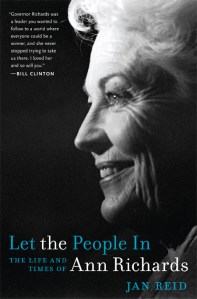
let the people in

final-let-the-people-in

When asked what she would have done differently if she’d known she was to be only a one-term governor, Ann Richards grinned and said, “I would probably have raised more hell.”

While I was at the ashram, I read Jan Reid’s Let the People In: The Life and Times of Ann Richards. I laughed with delight at the introductory chapter, and I cried with despair at the ending — at both endings. There was the end of her rather short political career in 1994, and then there was her death in 2006 from cancer.

My introduction to this bawdy, loud, wonderful lady was during her second and failed race for governor. As I wrote for my introduction when I was asked to speak during the feminist fishbowl, “Salem has identified as a feminist since 1994, when as an impressionable 16-year-old she watched Ann Richards lose her re-election bid for governor of Texas to one George W. Bush.” I remember feeling like the world was going to end that fall — and then being sure of it six years later in the fall of 2000. But here we all are.

And thank goodness for that, because the world that I live in is one that Ann Richards helped to create. As Reid notes,

Her greatest accomplishment was to bring to positions of responsibility and power in Texas the women, African Americans, Latinos, Asian Americans, gay men, lesbians, and disabled persons who had been so long denied. Because of that, state government centered in Austin will never be the same. Whatever party wins the elections and controls the appointed boards that keep the bureaucratic agencies and institutions of higher education running, democracy in Texas is better because she won.

Ann Richards was born near Waco, Texas, at the end of 1933, and she was almost immediately ill suited to her time. She was a wife (to David Richards), mother (to Cecile, Daniel, Clark, and Ellen), and teacher because that’s what women did; she was honest even in her lifetime about how those roles made her just about go out of her mind with boredom. Even when she served as chief of staff for Sarah Weddington (before the latter went to D.C. to argue Roe v. Wade before the Supreme Court), Richards had to negotiate a special arrangement with her boss to leave work early be able to cook dinner for her family. On the one hand, we should all be able to so organize our lives to spend more time with our families. On the other hand, of course Richards’ demanding job did not excuse her from her unpaid work, as it did her husband. Indeed, even as she began to field requests for appearances all over the country, Richards answered a phone call from Midge Costanza, the highest ranking woman in the Carter administration, with the breezy, “Hi, Midge, what do you want? I’m cooking David’s supper.”

ann richards at the 1988 democratic national convention

ann richards at the 1988 democratic national convention

Richards rose through Texas politics as a campaign volunteer, political staffer, county commissioner, state treasurer, and then governor. (Her career is a good reminder that it wasn’t so long ago that Texas was not the monolithically Republican state that it’s now considered to be.) Her spunk brought her to the attention of the national scene even when she was just a local politician, but she became a star during the 1988 Democratic National Convention in Atlanta, where she gave the keynote address. She “talked Texas” and delivered the now well-known zinger about the Republic presidential candidate: “Poor George, he can’t help it. He was born with a silver foot in his mouth.”

In 1990, Richards’s first race for governor, against millionaire businessman and good ole boy Claytie Williams, is one of the most amusingly horrifying tales in Texas history — and is chronicled brilliantly in Molly Ivins’ book Molly Ivins Can’t Say That, Can She?, a collection of the columnist’s political coverage, from which Reid draws liberally (no pun intended). Richards became the first female governor of Texas since 1924, when the wife of a former governor was elected. (They are still the only two women to have held that office.)

As Reid tells it, Richards tried to do too much: Her inauguration speech included 15 massive projects as top priorities. She made progressive headway in many, but ultimately, she would preside over the largest expansion of the criminal justice system in the country, doubling the number of incarcerated persons in Texas. In so doing, she did pioneer a revolutionary model of drug and alcohol treatment for non-violent offenders (she herself was a recovering alcoholic and drug user). And in her defense, she inherited a state prison crisis that had been broiling since the early 1970s, when an inmate brought a federal case against the state for violation of the Eighth and Fourteenth Amendments. Adding pressure to the impetus for change were several high profile killings, most notably the Luby’s massacre in Killeen in 1991 and the siege on the Branch Davidians in Waco in 1993. But the number of executions on her watch reached 48, and her only acts of clemency in four years were two 30-day stays. It is an indelible stain on her legacy that by the year 2000, Texas had the largest prison population of any Western democracy.

The book suffered slightly, not from its subject, but from its writing, which swung between not enough repetition and too much. The text was full of awkward segues that didn’t properly introduce new characters, and recurring characters were not given enough context to remind the reader of his or her significance. But as the author touched on a subject and later returned to it, entire passages (as for example, on the history of prison reform in Texas) would be repeated almost verbatim.

But Reid was a friend of Richards (and his wife was in her employ for more than a decade). The reader can’t help but feel his affection for her. Oddly enough, he refers to her as “Ann” throughout; it’s hard to tell whether this is simply familiarity, but it is certainly not customary in biography.

It is indeed easy to root for Ann Richards, who said on her inauguration: “Today we have a vision of a Texas where opportunity knows no race, no gender, no color — a glimpse of what can happen in government if we simply open the doors and let the people in.”

homelessness

One morning in D.C. I met a friend at Caribou Coffee, and I grabbed the restroom key off the bar as soon as I walked in. The barista glanced at me but said nothing. I walked back to the restroom, which was clearly marked: “For Caribou customers ONLY.” A homeless man sat at the table closest to the restroom, sipping his cup of coffee, alternately watching me and his shopping cart of belongings just outside the door.

“If I did that, they’d make me buy something before used the restroom.”

I didn’t know what to say. I muttered that I was going to buy something; I just really had to use the bathroom. But I knew that he was right. My privilege as an upper middle-class white woman (even one dressed in her stinky running clothes) had given me that pass. I look like someone who is going to buy something. Or someone who isn’t going to bathe in the bathroom. Or both.

I don’t see homeless folks where I live in Boston. I know they exist, even in the affluent suburbs where I live and go to school. But besides running or a quick trip to the drug store, I drive everywhere. It’s hard to see anyone from the bubble of my car.

Before I left D.C., the plight of homelessness weighed on me heavily. I walked everywhere, including to and from my office downtown, where there are homeless people on almost every street. In the months before I moved away, I struggled every day with how best to treat these people with humanity. My general policy is to give money — change — to whomever asks, but I feel deeply the inadequacy of that response.

image

tzedakah box: tiempo israelitico synagogue; photo by salem pearce (via instagram)

As I was packing, I decided I didn’t need to schlep a full tzedakah box, which my husband and I had been adding to since we moved to our apartment four years earlier, to Boston. I put the coins in a plastic bag and began doling it out. There was a lot of change, and I began to go out of my way to give it away. I’ll be honest: This increased interaction with some of the most vulnerable residents became a source of stress, as I found myself feeling increasingly helpless in the face of such a daunting social issue. I didn’t know if what I was doing was ultimately helping or hurting, and I don’t know what a better alternative is.

But when a person is asking something from me — a person who my tradition teaches me was created b’tzelem Elohim, “in the image of G-d” — I can’t decline a request for change, something that literally costs me very little to give. Because of this, I am unconcerned, as many are, about how the requesting party will use that money; that is simply not a factor in my thinking about this issue. As often as I can, I look the person in the eye, I smile, and I give.

I arrived at this decision about how to respond to these requests after a text study during a fellowship I participated in. The Jeremiah Fellowship, run by the local D.C. organization Jews United for Justice, was a 10-month program to train the next generation of Jewish social justice changemakers. The text study, “Can You Spare a Dime? Jewish Perspectives on Spontaneous Tzedakah,” which focused specifically on these kinds of street requests, was in three parts: To give or not to give? What about people who aren’t really in need? Are there alternatives to giving money?

We’re told in Vayikra Rabbah 32:2:

Rabbi Pinchas says in the name of Rabbi Re’uven: To anyone who gives a small coin to a poor person, the Holy Blessed One will give many small coins. But is the giver really just giving the poor person a coin? Isn’t she really giving him his life? How so?

If a loaf of bread costs ten coins and a poor person is standing in the market and only has nine, and someone comes along and gives him one [more] coin so that he buys the loaf of bread and eats it and his soul is returned to him [i.e., he is saved from starving to death]. The Holy Blessed One says to the giver, “In your case, too, when your own soul threatens to break loose from your body [i.e., when you’re on the verge of death], I will return it to you.”

The text study (several more pieces besides the one above) had a profound effect on me. I like that the Talmud acknowledges that not everyone who asks is in need (or, by extension, will use the money for the professed need) and suggests non-monetary ways to help those in need — while still affirming our obligation to give even just a little, and to do so with compassion.

sign near occupy dc on k st nw

sign near occupy dc at vermont & k sts nw; photo by salem pearce (via instagram)

I know that not everyone agrees with my approach — including some of my fellow Jeremiahs, who looked at the same texts I did. While I lived in D.C. I also made a (small) annual donation to an organization that worked with the local homeless population. Each week my husband bought a copy of Street Sense — a publication by and about those experiencing homelessness — from a vendor near his office. And I spent many a Christmas day repainting various buildings of the Community for Creative Nonviolence, a downtown D.C. shelter.

All of this is to say that I loved being in back in D.C., where homeless folks are visible, even if they are a painful reminder of how short our society falls in an important test. In the words of Mahatma Gandhi, “A nation’s greatness is measured by how it treats its weakest members.”

up close and personal

Knowing I was going to be in D.C. last week, I made an appointment with my friend Emily, non-profit account manager by day, photographer by night, and all-around awesome person. I was inspired by her post “Headshot How-To.” As she notes, “there is something SO empowering about having a set of (professional) photos of yourself that you feel really good about.” So I decided to take the plunge: I’ve been surprised by how often in the past year I’ve been asked for a headshot.

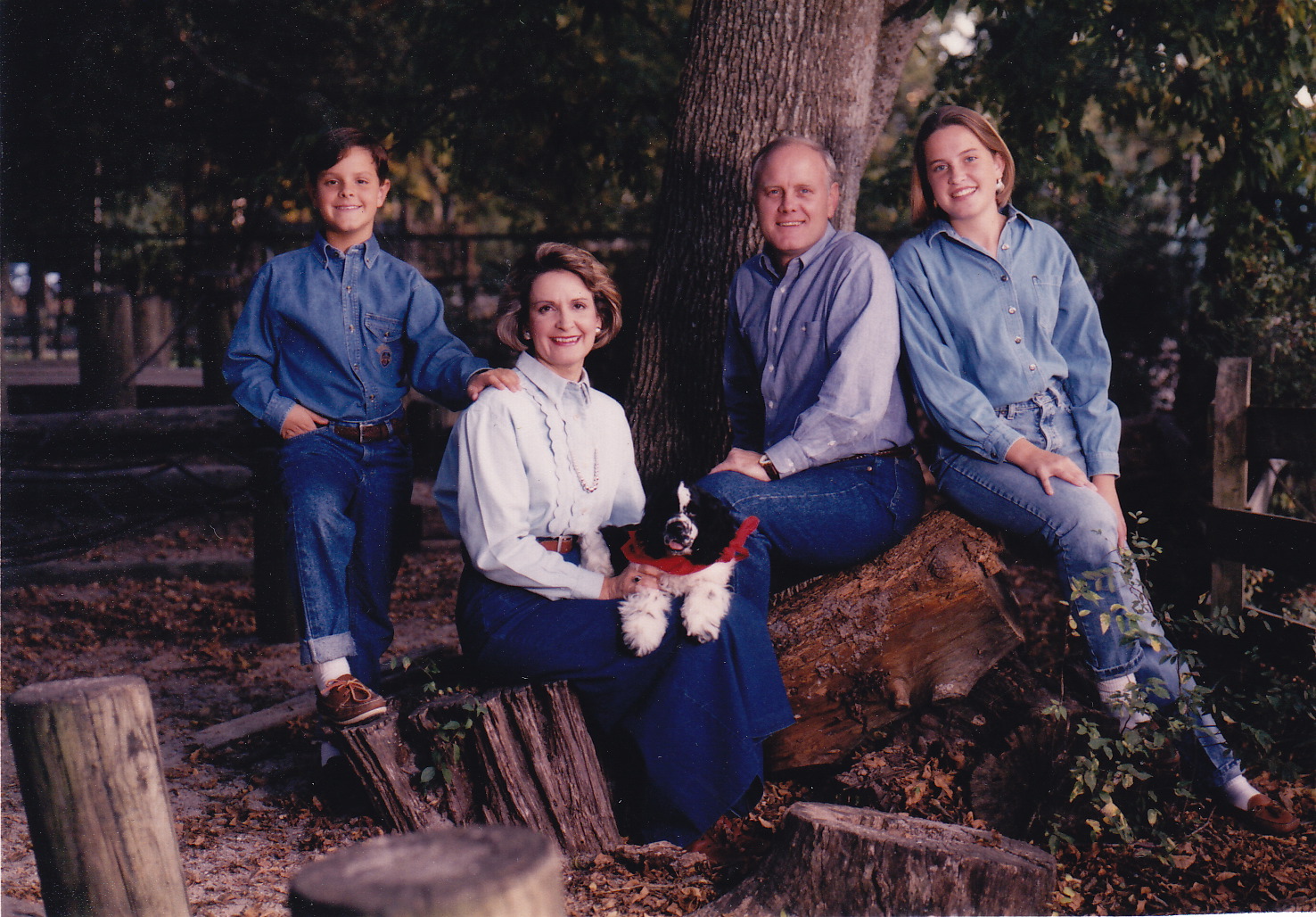
pearce family, 1992; photo by chris pearce

pearce family (with dog Calvin), 1992; photo by chris pearce

I’ve had professionally pictures taken of me a few times in my life. My dad’s brother is a photographer, and for many years he took our family photo for my mom’s annual Christmas card. His directions inevitably led to at least one member of the family putting a hand halfway into a pocket. These sessions, and his staging, provoked howls of irreverent laughter from my brother and me — but after the fact. Always after the fact. Levity was not encouraged during the Pearce family Christmas card picture taking, my uncle being a very somber fellow and my mom and dad taking the portraits very seriously.

When I was in high school, a family friend took pictures of me during my senior year for my yearbook page. (At my college prep school, each senior got an entire page to do with what s/he would. Almost everyone did professional photos with favorite quotations and inside jokes. It was a mixture of trite and precious.)

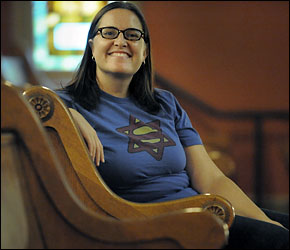
photo by xx

photo by mark gail, washington post

And of course there was also the photo that ran in a Washington Post story about Rosh Hashanah in the fall of 2009. I talked with one of the paper’s religion reporters while volunteering at a pre-High-Holidays event at Sixth & I; she called me back the next day to set up an appointment with a staff photographer. The session took place in the upper balcony of the Sixth & I sanctuary. However, I am wearing my “Super Jew” t-shirt, which perhaps undercuts any professional possibility for that photo.

As Emily when she had her headshots taken — even though she herself is a photographer — I was nervous before the session. Since I was traveling, I had limited wardrobe choices, and I spent half of the morning wishing for various tops that I had left in my closet at home. Then, I don’t wear make-up, but I convinced myself that I should have had it done. Same thing with my hair.

In spite of all of my worrying, I am thrilled with how the pictures turned out. Emily is such a positive, upbeat presence, and she kept saying encouraging things — “You’re doing great!” — in such a way that I actually believed her. And she’s right: It does feel great to know that I have these photos. I’ve updated all of my social media profiles, including the “About Me” page of this blog, on which I had been using an old picture of me taken by my mom during a family vacation to the beach. I was wearing a strapless dress, so in the headshot version it looks like I’m not wearing any clothes, which is probably not exactly what one should be going for in that situation.

But I’ve been using it because it had that indescribable quality of just seeming like me. That’s how I ended up choosing the picture for my senior page. And it’s what I ended up loving about the photos that Emily took: They look like me. No make-up, no-fancy-hair, simple-shirt-wearing me. And that’s what is so empowering.

P.S. If you need a photographer, I obviously highly recommend Emily. Her speciality is birth story photography, but she takes other assignments. And if she’s not available, she can recommend someone else (almost) as fabulous!

the sound of silence

“Truth is one. Paths are many.”

So says Sri Swami Satchidananda (known as Sri Gurudev to his followers), the guru who founded Integral Yoga in New York in 1966 and became the spiritual leader of the worldwide community (and global business) that arose from it.

I just spent four days at the Satchidananda Ashram at Yogaville, south of Charlotteseville, Va., at a silent New Year’s retreat with about 75 other respite seekers. There were probably another 50 non-retreat visitors, and what seemed like a cast of thousands of ashramites (staff, teachers, residents). The staff wears all-white, which is one of the features that occasionally provokes the twinge, “This is a cult.”

What also does so is the cult of personality around Sri Gurudev. His picture is everywhere, often on altars, and at the two ceremonies I attended, there was a chair ostensibly “for” him, but in which sat a large portrait of him, festooned with flowery drape and complete with a pillow for his feet. Most of Judaism does not revere teachers in this way, so I found it a little odd. Certainly unsettling was the fact that a picture of him hung over one of the beds in my room. (I chose the other bed.) Plus, I was forced given the opportunity to view recordings of his talks; he had interesting things to say and wisdom to share, but I can’t say that I’m ready to move to the ashram and become a devotee. Everyone who studied with him (he passed away in 2002) testified to his magnetic presence, so I spent some of my silent time thinking about the nature of leadership.

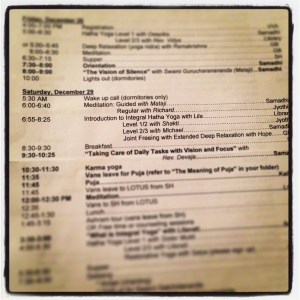
super detailed ashram schedule

super detailed ashram schedule

But if the ashram is a cult, it is one super-organized, Type-A cult. (Then again, what do I know? Probably all cults are well organized. You can’t brainwash people in a haphazard fashion.) So it’s my kind of cult. The schedule I received at check-in was filled with down-to-the-minute activities (e.g., “12:35: Vans leave Lotus for SH” – and they did). All programs started and ended on time (so not Jewish!), and in the location advertised — and changes were posted promptly and in all necessary places. Admonitory signs abound: “Remove shoes,” “Juice for fasters ONLY,” “No early meals,” “Keep this area tidy!” “Sign and date prayer requests.” Adding Hari OM before and OM Shanti after doesn’t make the commands less didactic. Certainly the organization made it easy on us silent types; I never had to write down a clarifying question.

I started feeling the need for silence earlier this year, as the semester intensified. Jews are generally not a silent or a still people; indeed, many times in our history our survival has depended on our not being so. I spend my days in prayer – which requires a minyan (group of 10 people), and much of which is said aloud – and in chevruta (partnered learning), and then in participatory classes (not lectures). I talk and argue and debate and present ideas and listen to ideas all day. As an introvert, this is draining.

There was a good mixture of programming at the retreat: guided and regular meditation, different levels and types of yoga, lectures, workshops, music, ceremonies. The daily schedule, which began at 6:00 a.m., went like so: meditation, yoga, breakfast, program, meditation, lunch, free time, program, yoga, meditation, dinner, program. That makes for a long day, so I didn’t go to every offering and squeezed in some naps instead. I was catching up on a semester’s worth of sleep.

The vegetarian food was great, and at every meal there was something warm, which was so welcome in the weather. The first day it snowed, and then it was overcast and windy the rest of the time. The Blue Ridge Mountains are – besides beautiful – cold. I fasted one day – evening to evening, Jew-style – and discovered that fasting ashram-style, with its yummy fasting juice and regular juices, is a lot easier than Yom Kippur. (Plus, I didn’t have to atone for my sins.) And! I wore comfy clothes the whole time – which, what, because I’m a student: I should wear yoga clothes all the time. Maybe I will.

I could have done without the indoctrination hour, when recordings of Sri Gurudev were broadcast during lunch. One day in extolling the virtues of a vegan diet – and thus the evils of dairy and other animal products – he kept characterizing meat eaters as consumers of “dead corpses.” He’s not wrong, but it was quite unappetizing – and in addition he was preaching to the choir, since we were all right then eating vegetarian food. We were the ultimate captive audience – in silence, and with only one place to eat.

The flip side of that unfortunate aspect of silence is the fact that no one could say anything after the programs and speakers, as I generally think that the follow-up questions people ask are not great. (I saw Tina Fey speak at Sixth & I on her book tour for Bossypants, the much hyped anecdote in which was Fey’s disdain, during publicity junkets for the movie Date Night, for the sexist question that she was constantly asked, and that her co-star Steve Carrell, also a working parent, was never asked: “How do you do it all?” After she spoke, some fool got up and basically asked Tina Fey how she did it all. Tina was much nicer than she had to be in her response.) And indeed, during our closing program, during the hour I finally heard the voices of all of the participants, there was more than one of that person. While most people, as instructed, just shared one meaningful moment or important learning, there were several who apparently decided to use all the words that they hadn’t said in the past four days. It certainly tested my new resolve to see the divine in everyone.

yantra (essentially, the visual representation) of the teachings of sri swami satchidananda

yantra (essentially, the visual representation) of the teachings of sri swami satchidananda

Overall, the experience was exactly what I wanted: silence. I found not talking for the better part of a week extraordinarily easy, especially among strangers. It was a downright relief not to have to make small talk or compare notes. In fact, we were encouraged not to even engage in non-verbal communication, which meant I spent almost the whole time without making eye contact with anyone. It was a little frightening how much I enjoyed that freedom. I was alone with my thoughts, except I didn’t feel alone. I am almost always happy as a clam to be by myself, but the feeling of being in my own world, but uplifted by the energy of others – in meditation, for example – was extraordinary.

And I learned a lot about meditation. I’ve been meditating irregularly, for 5-10 minutes at a time, mostly as a way to calm myself when I’m feeling stressed out. I think it’s been helpful. At the retreat I meditated three times a day, for between ½ hour and an hour. I don’t plan to maintain that kind of schedule, but I do want to have a daily meditation practice, and at a mediation workshop that was offered, I got guidance to help with this goal.

When I called her on my way back to D.C., my mom, after laughing when I told her what a piece of cake four days of silence was for me, asked me what was challenging about the retreat. I had to think, because I am so happy with how it went, all the funny stuff notwithstanding. I did wrestle with how much of the ashram’s worship practices to adopt while in residence; I felt distinctly uncomfortable with some (bowing to altars, saying chants) but I also wanted to respect its customs. It was absolutely clear to me that all faiths are respected (witness the yantra above, the visual representation of Sri Gurudev’s teachings). What was less clear to me was how I, especially as a rabbinical student, could practice both Judaism and Integral Yoga. They’re both pretty intense, time-consuming, all-encompassing ways of life. I don’t know what Sri Gurudev’s answer would be, but I plan to find ways to incorporate the silence and stillness of Integral Yoga into the cacophony that is often my beloved Judaism.

becoming van gogh

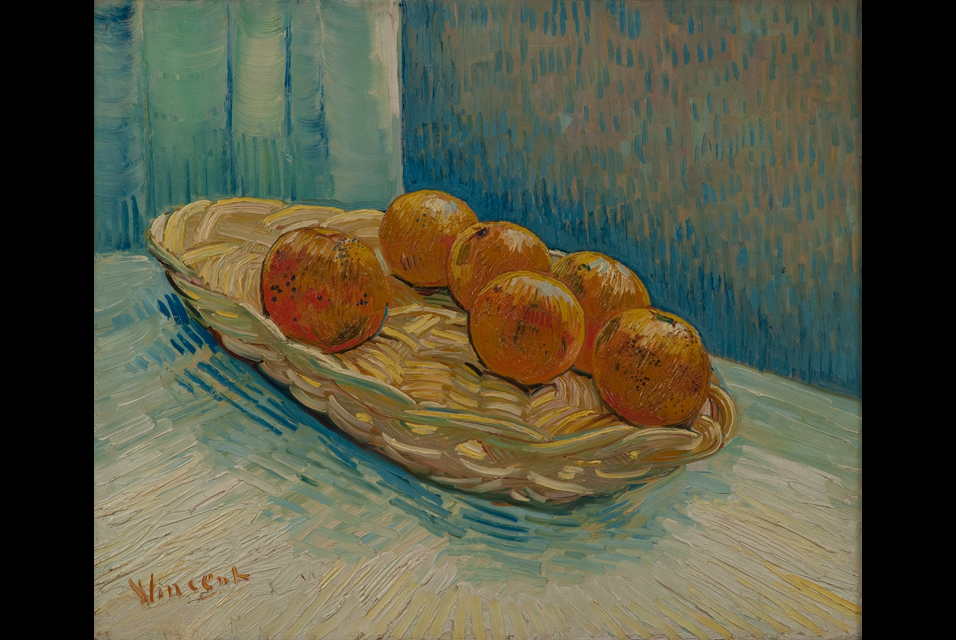
van gogh’s basket with six oranges

At the end of October, my husband attended a nerd conference in Denver, so I tagged along for a bit of a vacation and to see my family that lives in the area. While there I went to see the awesome Van Gogh exhibit at the Denver Art Museum.

“Becoming Van Gogh” is really well done. The special exhibit, featuring more than 70 pieces from 60 different public and private collections, traces Van Gogh’s evolution as an artist during his 10-year career. I didn’t realize quite how brief of a time Van Gogh was active: He only decided to become an artist at age 27, after an unsatisfying start as a pastor and missionary to a working class mining community in rural Belgium. At 37, he died under mysterious circumstances, returning from painting in a wheat field with a gunshot wound. Though the internets claim that it’s “widely accepted” that he killed himself (despite the fact that a gun was never found), the exhibit suggested only that it might have been murder.

The exhibit included many of Van Gogh’s famous works — but alas not Starry Night. Since it’s probably Van Gogh’s iconic work and almost everyone recognizes it, I at first wasn’t that disappointed not to see it. However, I realized (and perhaps this should have been obvious) that there is nothing like seeing a painting in real life, especially Van Gogh’s. The picture of the painting above, for example, barely does justice to the overwhelming brightness of the whites, blues, and oranges in the painting itself. I couldn’t take my eyes off of it.

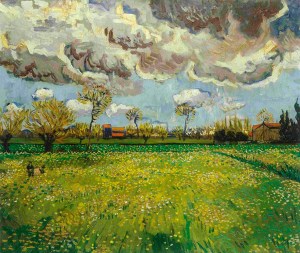
landscape under a stormy sky

van gogh’s landscape under a stormy sky

And now I know that what’s odd about this is that Van Gogh, early in his apprenticeship, did not employ color much at all; his early works can only be described as drab — the palette related to his choice of subject, everyday working folk, whom he desired both to realistically portray and to ennoble as sufferers of the human condition. The Potato Eaters, which was included in the exhibit, is a good example of this early work. It was only after he studied color theory and became obsessed with Japanese woodcuts that his paintings began to evidence the bright hues that would later become his signature. One of my favorites from the exhibit (besides Basket with Six Oranges above) was Landscape Under a Stormy Sky.

I started this post almost two months ago and only just have been able to finish it — and now the exhibit closes in less than a month, and it’s apparently not traveling (not that very many people would/would be able to travel just to see an art exhibit). However, if you can, it’s certainly worth the trip. (And buy your tickets ahead of time! I wasn’t sure what my schedule would be, so I didn’t do so, and visits were sold out through my stay: I had to wheedle my way in, and I was only barely able.)

joseph anton

Joseph Anton, you must live until you die.

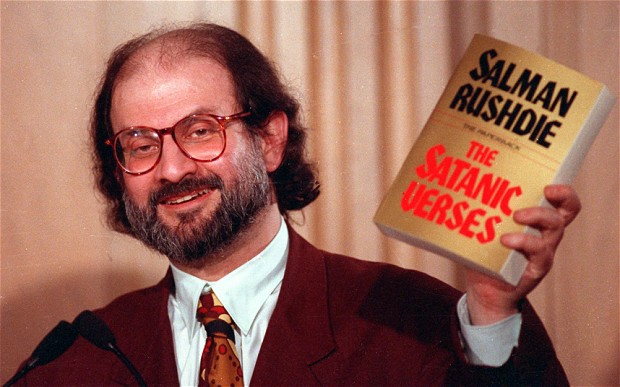
So Salman Rushdie tells his alter-ago – the psuedonym, a combination of the first names of Conrad and Chekhov, respectively, and how he is referred to by his British protection officers – as he embarks on what turns out to be a 13-year journey under a death sentence decreed by Ayatollah Khomeini of Iran on Valentine’s Day in 1989. In this book full of irony, it’s no small irony that the man whose fatwa called for the killing of the London-based Indian expat – for blaspheming Islam in his novel The Satanic Verses – died a few years later while the writer lived on.

First, a confession: I’ve never read anything of Rushdie’s until now. I read an excerpt from this book when it was published in The New Yorker in September, and I was hooked. I tried to read Midnight’s Children a few years ago, and I just couldn’t get into it. It might be time to try something again.

The memoir of his life under the fatwa – with digressions into his child- and young adulthood – is told in the third-person, which is jarring at first but quickly becomes natural. The choice reflects Rushdie’s alienation from himself during this trying period of his life. He is forced to chose the cover name so that the members of the Special Branch of the Metropolitan Police (in charge of personal protection in the United Kingdom) who are his constant companions during the first nine years of the fatwa can refer to him without raising suspicion about his identity; to his extreme dislike and irritation, the men on his detail shorten the name to Joe. Rushdie in other ways ceases to become Salman: He is denounced as Rushdie the apostate (by a large part of the Muslim world), Rushdie the self-aggrandizer (by one of his ex-wives), Rushdie the ungracious (by the British press). His life almost ceases to become his own — and is certainly no longer his intellectual property, as plays and movies and articles and books and stories are written about him and the fatwa. And his new world narrowly circumscribed by what he is “allowed” to do.

Rushdie writes movingly of the pain of those years. Two marriages collapse under their weight, as well as numerous friendships and relationships with colleagues. His interaction with his then eight-year-old son is severely curtailed. For the first few years, he must move every few months, and he is constantly in search of new accommodations. He is almost always afraid – less for himself than for the risk he poses to his loved ones and colleagues. While none of his family is harmed, a foreign translator of The Satanic Verses is murdered and another is almost fatally shot. His publishers face death threats, bookstores carrying his books are bombed. It is for these casualties that Rushdie feels unrelenting guilt.

But Rushdie himself has more than his fair share of trials. Support for free speech — the main issue at hand, as he sees it — does not always come from where he expects, and he feels the betrayal of his colleagues acutely. But he is not always able to confront his accusers (whether erstwhile colleagues or new enemies), which leads to the intermittent, unsent, and often hilarious letters that appear in the text. “It was a time,” Joseph Anton reflects, “where comedy had to be found in dark places.”

The British government in particular is upsetting in its silence and its general inaction on the fatwa. Under house arrest, Rushdie feels like a prisoner, and the resulting depression leads to long periods of writer’s block. His second wife, whom he married just before the fatwa, is breathtaking in her betrayal. But lest the reader began see the author of The Satanic Verses as martyr (another mistaken identity), Rushie is also unflinchingly honest about his own shortcomings: the tactical errors he made in his own defense, the affairs he had (he cheated on three of his four wives).

salman rushdie with the satanic verses in 1992

History plays a large role in this part of Rushdie’s life. He had the misfortune of being targeted by Iranian extremists when U.S. and U.K. citizens were Hezbollah’s hostages in Lebanon; both countries ask for his silence at various times out of fear for their safety. On the other hand, as Rushdie notes at the end of the memoir, he had the fortune of not being this target in the internet age, when the more rapid spread of information might have raised the risk of his detection. (One of the more interesting motifs throughout the book is the development of technology: It begins with him composing drafts of his work on a typewriter and ends with his purchasing of a laptop. The scene of his first encounter with a cellphone is hilarious.)

The book also brought up for me, as a future clergy member, the danger of being on the wrong side of history: For various reasons, stakeholders who by all rights should have been vociferous defenders of free speech were   In addition to politicians and writers, many religious leaders condemned The Satanic Verses on the basis of “offense to Islam,” including the chief rabbi of the United Kingdom, Immanuel Jakobovits, who went even further, declaring that “both Mr. Rushdie and the Ayatollah have abused freedom of speech.” In one of his impossible letters, Rushdie rightly condemns his “making false moral equivalences.”

For indeed as Jews well know, in the words of Heinrich Heine: “Where they burn books they will in the end burn people too.”