the arc of prayer

The rabbinical school curriculum requires that students join what are called “tefila groups,” with a new focus this year: tefila (“prayer”) as a spiritual practice. The idea is for everyone to “practice tefila with a spiritual practice group that shares goals and develops a consistent set of forms for its tefila.”

We were asked to come up with ideas for these spiritual practice groups, and the groups that ultimately formed, after a few weeks of discussion and proposals, included those committed to experience prayer as catharsis, as struggle with the divine (however conceived), as liberation theology, and as obligation. The groups daven together at least once a week and then meet on Thursdays to process the prayer experience as well as the group’s continued goals.

new tallit for rabbinical school; photo by salem pearce (via instagram)

The group I joined is planning to explore the liturgy of shacharit, the morning service, unit by unit, seeking to make a personal connection to each part. As my classmate who proposed the idea explained, he was inspired by a story he heard on NPR about a musician who had digitally remastered Beethoven’s 9th Symphony to make it last 24-hours. His vision for the tefila group was to essentially daven shacharit over an academic year.

We’re working on the selection of liturgical units (unsurprisingly, there are more of them than there are weeks) and schedule for davenning. On the day we pray together, we’re planning to just daven the prayer that we’re focusing on that week (with perhaps the prayer before and after it, so we can look at transitions, too). On Thursday, we’ll be sharing how that experience was for each of us, as well as any creative expression of the personal connection that we’ve made to that prayer.

It’s hard to overstate how excited I am by this prospect. I need to learn the service better (for myself, and as a professional skill), and although technical goals aren’t the point of these groups, I know I won’t but get to know the prayers better.

I can think of so many things that I’d like to do for each weekly unit; knowing that my time is limited, and that I want to push myself in this project, I’d like to commit to making a visual representation — probably a collage — for each prayer. I don’t think of myself as a creative person, so I’m nervous about the prospect, mostly that I won’t be able to achieve something that is meaningful and, more importantly, not cheesy. I’m hoping that a trip to the craft store a) won’t kill me and b) will provide some inspiration. I would also like to write here about my experience each week, hopefully with a picture of my finished product.

We’re starting tomorrow with elohai neshama, a short prayer at the very beginning of shacharit that praises G-d for creating humanity and for helping each person maintain his or her spirit and spirituality. More to come!
feminist teshuvah

I wrote this two weeks ago as a final assignment for the fall seminar for first-year students, which looked at the Torah and Haftarah portions – and critical analysis of both – for Rosh HaShanah and Yom Kippur. We were asked to reflect on something we found interesting or significant from the readings and to present that reflection to the class. I’ve edited it slightly to make it more accessible to readers not in that class.

Thus for me, teshuva between women and G-d implies not just G-d holding me responsible for the ways I have failed as a human being, but also me holding G-d responsible for failing me as a Jewish woman by giving me a world and a people and a text that continue to betray women, often making it difficult for us to uphold our side of the covenant.

I almost fell off of my bed after I read this passage from Tamara Cohen’s essay, “Returning to Sarah,” in Beginning Anew. To say that it resonated with me would be a vast understatement. I don’t think a piece of text has so perfectly spoken to me in 10 years, since I read Anita Diamant’s Choosing a Jewish Life – the main impetus for the Jewish journey that eventually led me here.

The passage gave me permission to be mad at G-d. The tradition I grew up in did not allow that, and my inchoate theology tends towards a G-d that is not directly responsible for the state of things. Our mischegas is our own.

A world and a people and a text that continue to betray women.

[B]etray women.

This is my experience, from growing up in a tradition of strict gender roles, to working at an all girls’ boarding school in North Carolina, to volunteering at the rape crisis center in D.C.

I am grateful to now be a part of a community whose commitment to egalitarianism seems to be firm, but I know this to be an aberration. (And I know that there will be failures on that front; we live in a world of male privilege, after all.)

My life thus far has been a daily, run-into-a-wall encounter between the way that I experience life and a privileged experience of life. And that’s my experience as an upper-middle-class, straight white woman – to say nothing of the experience of people of color, or queer folks.

I feel that betrayal acutely, in ways large and small.

I feel it when last summer’s debt crisis – which almost led to a default and did lead to a downgrade in U.S. credit by world debtors – ended only when the president agreed to a bill rider that prohibited the District of Columbia from directing its own tax revenues to subsidize abortions for District residents.

I feel it in the lack of basic labor protections – standard for most workers in this country – for domestic employees, the women that care for our children, houses, and elders.

I feel it when our secretary of state – our nation’s top diplomat – is asked which fashion designers she prefers.

I feel it when sports teams at my alma mater are referred to as “the Longhorns” . . . and “the Lady Longhorns.”

I feel it when I get mail, as I did yesterday, addressed to “Mr. & Mrs. Joseph Grossberg.”

Last Wednesday at hesbon hanefesh (“account of the soul”) a teacher asked us to reflect on the issue of anger, and he used a text from Rav Natan as a prompt: “Help me break my tendency towards anger. Help me practice patience in all aspects of my life and overcome my anger. I don’t want to be angry or respond harshly to anything . . . I just want to be able to serve you honestly and simply, and to have total trust in you.”

This is not my prayer to G-d. For me there is a distinction between the feeling of anger and acting angrily. I don’t want to do the latter. But I also don’t want to not be angry, when I generally feel that if you’re not angry about the world, you’re not paying attention. (Patience, on the other hand, that I pray for daily.) My anger, my outrage at injustice, is often what motivates me. It’s one of the reasons I’m here.

And if I’m being honest, I have to say that in the drama of the traditional Yom Kippur “scapegoat” sacrifice in the texts that we read, I feel less like the onlookers or even the high priest – and more like the goat. I feel the weighed down by the burden of our society’s sins against women. Like the goat, I am either abandoned in the wilderness – or thrown over a cliff.

So, how can I do the hard work of teshuva (“repentence”) when a great deal of my reflection has left me angry at G-d? Trust after betrayal is incredibly hard, especially when the betrayal “continue[s],” as Cohen notes.

Cohen’s answer is, at least in part, is for us to complete the stories about and to strain to hear the voices of the women of the Torah. We must write our own midrashim and live our own fully integrated lives. So, I’ll definitely try to get that done in the next 19 days.

Hebrew College founder Art Green, in his introduction to S.Y. Agnon’s seminal text on the High Holidays, Yamim Noraim, suggests another, or an additional, model: He notes that Yom Kippur commemorates the giving of the second of the Ten Commandment tablets. (Moses destroyed the first in his anger at the Israelites’ creation of the golden calf.) Green says, “This time the tablets were to be a joint divine-human project. Moses does the carving, G-d does the writing. Every Jew receives or fashions these second tablets on or around Yom Kippur. This is the season when each of us renegotiates our covenant with G-d.”

If I can frame it like that, I’m able see G-d as a partner in the beginning of my teshuva. But it’s also a good thing that I have next year, too.

bat mitzvah

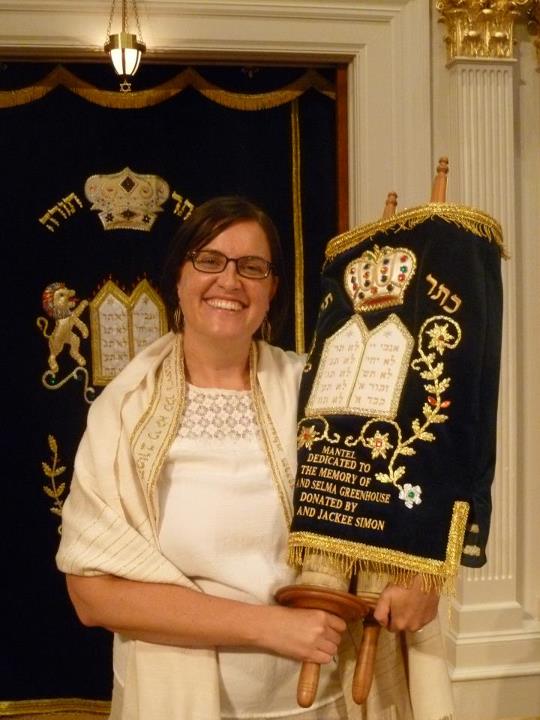
after the ceremony, with the sefer torah; photo by gay lee pearce

My bat mitzvah ceremony was almost two months ago, and with all that has happened since then, it seems even further in the past. But yesterday in Hebrew class our book included a text about the ritual of Orthodox boys’ first haircuts — traditionally at the age of three, on Lag B’Omer, at the tomb of Rabbi Simeon bar Yohai in the Galilean town of Meron, in case you’re interested — and one of the book’s exercises asked us to reflect on one of our own meaningful Jewish rituals. Since I have to do it in Hebrew, I may as well attempt it in English first . . .

I completed the adult b’nai mitzvah class in June, after seven months of study. The group of 15 — all young adults in the D.C. area — met for two hours each week; the class was held at Sixth & I and was the first of its kind for the synagogue. Sixth & I hired an outside rabbi to teach the class, a woman I had first met — and loved! — when she taught one of the sessions of the Jeremiah Fellowship I completed a year ago. As I noted at the end of our ceremony dress rehearsal, I am likely one of the few who can say that her bat mitzvah prepared her for rabbinical school. I don’t know what this first step in my journey to the rabbinate would have been like without all that I gained from the class, the rabbi, and my classmates.

We read about prayer and the liturgy, talked about the holidays, learned how to put on a tallit and lay tefillin. We wrote d’vrei torah and practiced leining our parts of the parshah. Even after all these years of my adult Jewish education, it continues to thrill me that there is always more to learn.

The class was an interesting mix of Jewish backgrounds. A few people had had b’nai mitzvah as teenagers but had not found the experience particularly meaningful and hadn’t been involved in the Jewish community since then. Like me, others had never had one, despite having been raised as Jews, and some of us weren’t raised Jewish. I in particular was in a different place in my Jewish journey than everyone else, as I began visiting and applying to rabbinical schools shortly after the class started. But we all shared a desire to deepen our commitment to Judaism.

In addition to the opportunities for spiritual and intellectual development and liturgical proficiency, the class also gave me a glimpse into the future. A curious thing happens when you say that you are planning to become a rabbi, probably not unlike what happens when you say that you are studying to become a rabbi, or that you are a rabbi: in the class and elsewhere, people began jokingly referring to me as “rabbi,” asking me questions about Judaism, and deferring to my leadership. More than one person whom I do not know well at all wanted to talk about G-d in the course of otherwise fairly pedestrian conversations. In all of those moments I felt acutely inadequate.

I am going to rabbinical school because I don’t have answers, in more than one sense. I need and want to know more to be able to serve the Jewish community, and I am well suited for the rabbinate in part because I don’t require certainty.

The class was my first experience of being a part of a Jewish community with the “rabbi lens.” As rabbinical school became a reality, what I wanted to get out of the class changed. I watched the rabbi teach and observed how she handled the class and its questions. I listened to what others said about why the class was meaningful to them. I led one of the rehearsals when the rabbi couldn’t make it to class. I began to feel less a part of the class and more an aide to the class. Of course, this position came with risks. After a tense second-to-last service rehearsal, in which we were all nervous and on edge, I snapped at one of my classmates. She was understandably upset with me, and righting that wrong and repairing that relationship (which I am happy to report did happen) took on a different import. I felt a power imbalance and a new responsibility — and the crushing guilt that must always come with being a “bad representative” of a group’s leadership. I knew it behooved me to make amends, no matter the extenuating circumstances. I asked myself for the first, but presumably not the last, time, “Can I be a good rabbi if I . . .?”

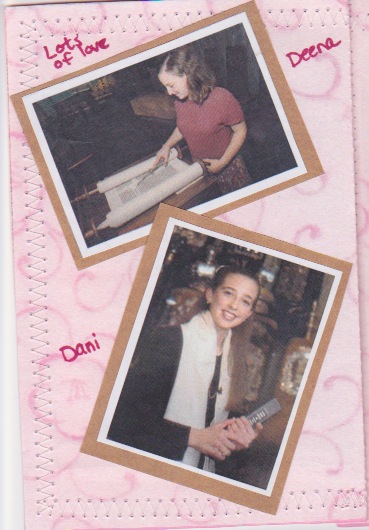
part of the amazing card my friends gave me, with pictures from their own b’nai mitzvah

The service itself was wonderful. For some reason I’ve always been cavalier about milestones, ceremonies, and celebrations. I don’t remember attaching much import to high school or college graduations, and I was fairly blasé even about my wedding (noting again for my reader(s?) that this was not my attitude towards my marriage). And it took me a while to warm to the idea of this one: My cousin found out about it a few months prior and said to me, “Hello!? You have to tell us about these things!” But the excitement came. I practiced every day, I invited friends and family, I got my hair done, and I bought new clothes (a true sign of how meaningful I held the occasion, since I loathe shopping; the best present I’ve ever gotten was when my mom bought me a wedding dress and sent it to me).

At the Saturday morning service on June 4, 2012, I gave my d’var torah, I led the amidah and the second half of the Torah service, and I had two aliyot. Almost of this involved carrying a tune, and the truly hilarious part of the day was finding my family in the social hall downstairs after the ceremony and hearing each of them exclaim as they hugged me, “I didn’t know you could sing!” I didn’t either, and I am happy to now have the confidence that I can lead services and not embarrass myself.

I remember Sixth & I’s rabbi, acting as gabbai while we read Torah, giving me a hug after I finished my aliyah, and saying, “Nice job, rabbi.” I remember that so many of my friends came to support me. I remember my mom’s thrill at meeting the rabbis who helped us lead the service, women who were both holding at least one of their small children after the ceremony. It’s not clear to me what my mom’s conception of being a rabbi is, but she turned to me as we were leaving the synagogue and said, “See? You can be a rabbi *and* have kids!”

I almost started crying when I saw my father-in-law after the service. He has known more than his fair share of tragedy and thus is understandably staid, with a deadpan sense of humor. He drove 12 hours from his home in Louisville, Ky., to attend the service, a generous gesture from a fairly cynical atheist and generally non-practicing Jew. His face lit up when he saw me after the ceremony, and with a huge smile that I’ve never seen, he told me what a great job I did. In my mind I can still see his expression, and I think it would have been enough just to have that memory.

death of a mensch

On Monday I woke up thinking about him, a man I never knew — and didn’t even consider the existence of until last week.

On Sunday I attended the funeral of the father-in-law of the rabbi who taught the b’nai mitzvah class I completed in D.C. last month. Her in-laws are local, and since I consider the rabbi one of my mentors and one of the reasons I decided to go to rabbinical school, I — along with a classmate who also knew her in her past job — made the drive to a small town outside of Boston to be a part of the mitzvah of k’vod hameyt, honoring the dead.

His death on July 4 was a random accident, one so terrible that the rabbi, one of the most articulate and thoughtful people I know, just shook her head when I saw her: “There’s nothing to say.”

There certainly isn’t much to say about his death, although the rabbi who presided over the ceremony did a yeoman’s job. He took to task the chief of police who had declared the accident “an act of G-d.” “Oh, really?” he rejoined scathingly. “That is not G-d.” And then he cautioned the large crowd that allowed only standing room in the sanctuary by the time the service started, “Before you ask, ‘Why?’, I ask you to consider whether there is any answer to that question that you would find satisfactory.”

There was certainly, though, very much to say about his life. From his obituary: “Loved nature, music, writing short stories, studying Torah, discussing politics, dancing with [his wife], and the Red Sox. His goodness and love will be missed.”

The service started with the synagogue’s cantor, who had known him and his wife since she began her job at the congregation. (They were involved in selecting the rabbi as well.) Next was his sister, then his son (my rabbi’s husband), then his daughter. And then his wife.

His son talked about how his father had taught him how to be a father. The rabbi and her husband have two children, and he recalled how much joy his father had gotten out of being a grandfather. And he sounded like the best kind of father and grandfather. The son recalled, “Dad could do anything. Wrote down the wrong gate and missed your flight? Let dad know: he’ll fix it. Don’t understand how student loans work? Ask dad: he’ll explain them. Get lost on the way to an important meeting? Call dad: he”ll get you there.”

A heartbreakingly young woman, his daughter talked about all of her many childhood activities that her dad never missed: Practices, performances, meets, competitions. In school he stayed up late with her the night before a paper was due in case she needed help breaking through writer’s block. She ended up in technology, the same field as his, and she spoke fondly their attending a recent conference together. There he introduced her to a colleague as his daughter; later, the man found her again and said, “When your father introduced you, I didn’t realize that you are actually his daughter. I thought he was saying that you were like a daughter, that he was your mentor.” She recalled at the service, “The colleague wasn’t wrong. He was my father, but he was also my mentor.”

Last was his wife, who was unbelievable. And by that I mean that I almost couldn’t pay attention to what she was saying because she was so unexpectedly poised at a moment when everyone around her, including people who hadn’t even known him, were sobbing. She shared how they had met, in college: two atheist, anti-Jewish Jews. They bonded over activism and late night philosophical talks, but, although she wasn’t all that interested in marriage, she didn’t want to move in with him if they were unmarried. “I told him that I didn’t understand that. If two people wanted to commit to one another, they should just do it, go all the way.” And five months after they met, he asked her to marry him on bended knee and with a toy ring with a green stone (which she promptly dropped, losing the stone, as soon as he handed it to her). So at ages 18 and 19, they were married, in a Jewish ceremony to satisfy their parents — and one entirely in Hebrew “so that we couldn’t understand all the stuff about G-d.”

I wish there had been time to hear more about their journey together from kids to having grandkids, from rebels to pillars of the community, from G-d denying to G-d embracing. But what followed next was well worth that omission.

His wife explained that she had asked people from various points in his life to speak about him because what she had known about him was not all there was to know about him. We then heard from a childhood friend and one from his young adult years, then from a member of the synagogue’s men’s group that he founded, and from a colleague. We heard about his mischievousness, his reflections on Torah, and a vacation dinner in a nice restaurant that ended with his young son covered in spaghetti and chocolate ice cream. A woman from a job or two ago said that after several people had left the company, they committed to getting together for dinner every few months to stay in touch. She had been in charge of scheduling those dinners, and he was always the hardest one to nail down. But, she added, after hearing that day what others had to say about him and his commitment to his family, friends, and community, she understood why he was always so busy.

I loved his wife’s tribute, her acknowledgement that she doesn’t own the memories of him, that all of the community carries pieces of him — then and now. This is how remembrance stays alive, and I am blessed to now be a bearer of his life and death as well.

And then she began to talk about the night he died. They had attended a James Taylor concert, just one of the activities that had begun to form the shape of their (soon-to-be) retired life. They sat on the lawn and talked about their ballroom dancing lessons and their financial future. The last song of the concert, she informed us, was Taylor’s “How Sweet It Is To Be Loved By You.” And the cantor joined her at the podium, and they invited everyone to sing. And when we weren’t spirited enough, his wife admonished us to sing louder and to clap harder. It was hard to do through my tears. But she just laughed and clapped and sang.

In the end, she concluded by thanking him for their 43 years together, declaring, “I regret nothing.”

“I regret nothing.” How many of us can say that about our relationships? About our lives? About anything? How many of us can say that, whether we actually don’t experience regret, or whether we have made peace with our mistakes?

I just want to stop. And thank you, baby.

How sweet it is to be loved by you.