mechitza

I spent this weekend at a Rabbis Without Borders rabbinical student retreat on “Spirituality, Social Justice, and the Rabbinate.” Students from several different schools gathered at the Pearlstone Center in Reisterstown, Md.: Besides Hebrew College, there were contingents from the Reconstructionist Rabbinical School, HUC Los Angeles and Cincinnati campuses, Jewish Theological Seminary, Zeigler School of Rabbinic Studies, Academy of Jewish Religion, and Yeshivat Chovevei Torah. (Update: I very unfortunately forgot to note the fabulous representation from ALEPH – Alliance for Jewish Renewal – Smicha Program *and* International Institute for Secular Humanistic Judaism — which I regret. It was an unintentional mechitza.)

One of these things is not like the other.

YCT is a new-ish school training men to become Modern Orthodox rabbis “who are open, non-judgmental, knowledgeable, empathetic, and eager to transform Orthodoxy into a movement that meaningfully and respectfully interacts with all Jews, regardless of affiliation, commitment, or background.” The idea is to change Orthodoxy from the inside, as one of the students explained.

The impact of their participation that I felt the most was in the davennen. Their school policy requires, in accordance with Orthodox principles, that the YCT students not daven alongside women. The way this is generally achieved in the Orthodox world is via a mechitza, a partition to separate those participating in tefila.

This presented a challenge for the prayer services, since all of the other schools practice egalitarianism, not least in that they admit both women and men. The tefila committee, which met before the retreat (and of which I was not a part), decided on separation via what was dubbed a “tri-chitza“: spaces reserved for men, for women, and for mixed seating. The configuration was used for four of the five services we davenned together; the fifth, lead by the YCT students, was set up in a more traditional way, with seating for men and seating for women.

pearlstone center in reisterstown, md.

the farm at the pearlstone center in reisterstown, md.; photo by salem pearce (via instagram)

As one of the retreat faculty members (who is a huge fan of mechitza) explained, the idea developed as a result of an evening of joyful, raucous, downright Dionysian prayer, after which the rabbis reflected that if women had been present, it might have turned into an orgy. Thenceforth, women and men prayed separately.

On a visceral level, I find mechitza loathsome. Historically it has been a tool for silencing and disempowering women by marginalizing their prayer and limiting their participation: Women are not counted as part of the minyan (the quorum of 10 adults needed for prayer). In many spaces, women are also not allowed to lead tefila, to read Torah, to have aliyot. What’s more, the service often only takes place in front of the men’s side. In extreme cases, women are relegated to a balcony where it might be difficult to see or hear anything at all.

In the Modern Orthodox world, these latter elements are generally not found, but the purpose of a mechitza is still to ensure that people daven with those of the same gender. Which is problematic. It’s heteronormative; it’s based on the false assumption of a gender binary; it creates potentially unsafe situations for genderqueer folks. Ultimately, it is a space created entirely on the terms of and for the needs of cisgendered men.

I go to a pluralistic school, so I am used to experiencing all different kinds of davennen. Hebrew College was founded to challenge the conventional wisdom that the Jewish world can be pluralistic in all settings except for prayer. And we still struggle with community tefila — which, to be honest, usually means that no one is completely satisfied with services. But egalitarianism is our bright line. Everything else goes. This weekend was meant to be about pluralism, too. It is so important, especially for movement-based students, to talk to one another, learn from our differences, and experience other ways of doing Judaism. This weekend suggested that my pluralism might have limits.

To be fair, everyone was pushed out of their comfort zones this weekend. When I walked into the prayer space on Friday morning, I thought, “What? You call this a mechitza?” It was just a table with chairs on either side. Mechitzot can take many forms, to be sure, but they are usually solid partitions, or at least a line of person-high potted plants (as in the case of a Chabad minyan I went to a few times when I was in D.C.). The point is to obscure the sides from one another. This mechitza did not in any way do that, so it was largely symbolic. And I am not denigrating it by so calling it, as much of what is important in Judaism is symbolic, or might seem within the mere letter of the law and not the spirit. Indeed, the symbolic nature of the mechitza made it hurt more, as it seemed to be separation just for separation’s sake. I think that it was probably not the mechitza to which the YCT students are accustomed. Nor was the davennen. For me, the pain stemmed from the fact that because of the mechitza, the space felt like it belonged to just one contingent. I became an outsider, praying on their terms. Most uncomfortable of all, I felt like I was condoning the mechitza with my presence.

But I don’t consider my discomfort and the potential discomfort of the YCT guys to be morally equivalent. Their discomfort is because of an incursion on their male privilege; mine is the result of oppression.

I do feel that it is important to point out that my painful experience had to do with the issue of mechitza and not with YCT students themselves. Their hands are tied, to a certain extent: a condition of their continued enrollment is adherence to the tents of Orthodoxy as laid out by their school. And these are good guys, and I think they are fully aware of the difficulty mechitza presents. But their project is to struggle within Orthodoxy, and that is not my fight.
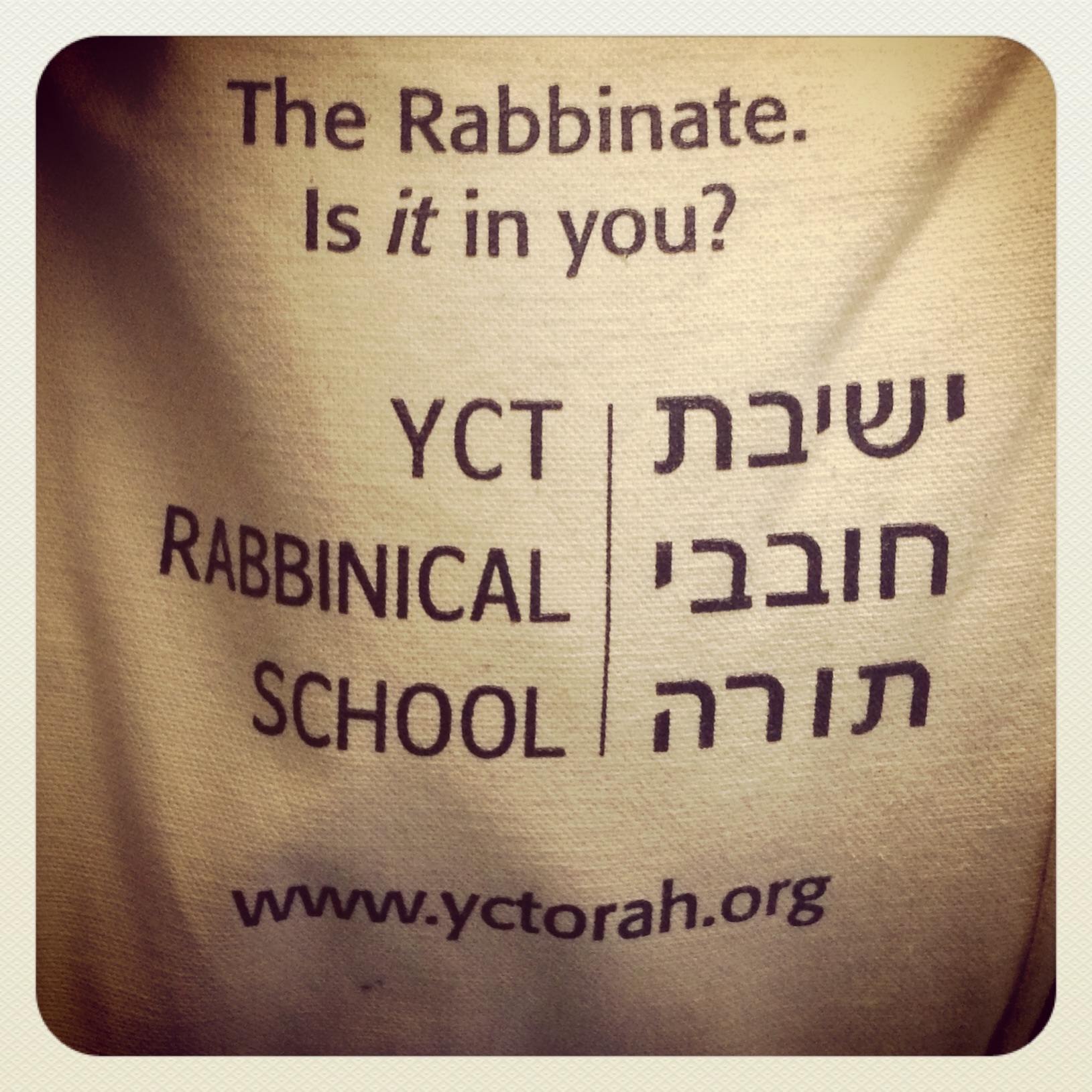
my favorite (problematic) cloth bag; photo by salem pearce (via instagram)

(Sidebar: The first time I encountered YCT was in Washington, D.C., in 2009, at the Jewish Federation’s annual General Assembly, where the institution had a booth. I was just beginning to think about rabbinical school and hadn’t heard of this one. I stopped and spoke with them for at least 20 minutes before they told me that, unfortunately, I was not able to attend their school. “But we hold women in high regard and believe that there is a special place for women in Judaism!” Completely annoyed, I left abruptly, but not without the tote bag they had given me. But as much as I feel a twinge of irritation every time I see it, I continue to own it because it is, hands down, the best cloth bag I’ve ever used. Roomy, more square than rectangular, sturdy, and with wide shoulder straps. It asks, “The Rabbinate. Is it in you?” To which I answer, “Yes! Just not with you.”)

I’ll admit that I took a perverse pleasure in the fact that the men’s section was small, at the edge of the room, and not in front of the tefila leaders or Torah readers. In other words, their experience approximated that of women in Orthodox settings (with the important difference that the separation had been effected at their own request). But I hated that I thought that. And it didn’t alleviate my own hurt. And none of these feelings were conducive to my being in a prayerful space.

I would love to see Orthodox Judaism become a more welcoming space for all Jews. And I don’t know whether I can be any part of it.
she who has a why

[S]he who has a why can bear almost any how. -Frederick Nietzsche

The second week in January I took an interfaith seminar called “Experiencing Islam” in conjunction with Andover Newton Theological Seminary (ANTS), which shares the hill with Hebrew College. I had lunch on one day with an ANTS student, and I told her (a short version of) the story of my journey to the rabbinate. One of the weird things I find about being a new rabbinical student is that, after months of talking about nothing else, I am no longer regularly asked — and I don’t ask any of my classmates of themselves — why I want to be a rabbi.

In talking with my future colleague, I found myself thinking back to the high holidays in October of 2011, almost a year-and-a-half ago. I went to Sixth & I’s Yom Kippur services at Calvary Baptist Church, which Rabbi Shira Stutman led. During the service, Elissa Froman gave a talk. In her introduction, Shira noted that Elissa was planning to start HUC-JIR Rabbinical School the next summer. And I remember having a twinge of jealousy and wanting that (or some version of that, with perhaps another rabbinical school substituted) to be said about me. This wasn’t the beginning of my decision to apply to rabbinical school, as I had already been thinking seriously about it (as much as two or three years before), but Elissa was certainly motivation to really get going.

I don’t know Elissa well, although I should. We have similar interests, are involved in some of the same organizations, and have many mutual friends. Unfortunately, what I know most about Elissa is that she is sick (which is of course not the sum of her identity).

Elissa was diagnosed with Hodgkin’s lymphoma more than six years ago and has had two relapses, as well as a bone marrow transplant, and she’s been in the hospital for the past year dealing with complications from treatment. (This is information that she, her family, and others authorized by her family have shared publicly.) Elissa didn’t go to rabbinical school last summer, as she had planned. And that plan was a deferment from the year before. And I’m guessing that it’s probably not in the cards this summer, either (although, who knows?). It does seem like she has yet a struggle ahead of her.

In October, a friend of Elissa’s started a fundraising page for her and her family, as her stay in the hospital stretched into its eighth month. My friend Eve sent an email to our Jeremiah cohort about the effort, encouraging everyone to give: “Maybe some of you know her better than I, but, ever since meeting her back in the early 2000s, her work and life have been an inspiration.” (If you want to donate to this effort, you can do so here.) The page and its success are certainly a testament to the impact that Elissa has had on so many people. As the page’s creator wrote in the introduction:

If you are here, it is because you know and love Elissa Froman. You know the impact she has had on the people lucky enough to surround her, you are those people. Or maybe you know of her. You know of her advocacy work, her commitment to community, social justice, civil rights, and making the world a better place.

The morning that Eve sent her email, my classmate Lisa (also a former D.C.-er and friend of Elissa) led the Torah service at school. I also happened to be at the front of the room because I had an aliyah (the honor of saying the blessings before and after the Torah reading). As we sang mi sheberiach (the prayer for healing that is usually said in the middle of the Torah service), we shared with each other later that we had both been thinking about Elissa. All of this is to say that her presence is far-reaching.

And if you need even more evidence of Elissa’s awesomeness, watch this video that her friends made for her 29th birthday.

A year before Eve sent her email, to the day, Elissa wrote the last post that appears on her blog, where she’s chronicled her battle with cancer and her plans to go to rabbinical school. (By the way, you should read all of her blog. It is touching and heartbreaking and funny and honest and all the things that make a blog worth reading.) That last post was also written mere days after she spoke on Yom Kippur. In it, Elissa reflects on the five years since her diagnosis and expresses hope for the next five years, during which she was to finish her rabbinical school education.

It’s obviously painful to read in retrospect. I met with Elissa shortly after she wrote the post. We had coffee in the middle of the day, and I excitedly told her about my first visit to a rabbinical school and my plans for more visits and applications. And she shared with me her hopes for her rabbinate. We talked about how great it would be to one day be colleagues with similar interests, working as rabbis for social justice organizations.

Elissa’s been on my mind recently, and not just because I told the story of my journey to the rabbinate. Elissa’s sister recently sent an update on her progress — as she does regularly — to friends of Froman. And as many of you know, last semester (my first in rabbinical school) was very challenging for me, emotionally and spiritually. While I don’t think I’ve ever treated this experience flippantly, I always want to remember that first and foremost I am able to have this experience. This is a blessing and a privilege.

So Elissa, I’ll go to rabbinical school for both of us — until you join me.

UPDATE: Elissa Froman passed away on Friday, March 22, 2013 (11 Nisan 5773). May her memory be always for a blessing.

You can make a gift in her honor to the National Council of Jewish Women, her longtime employer.

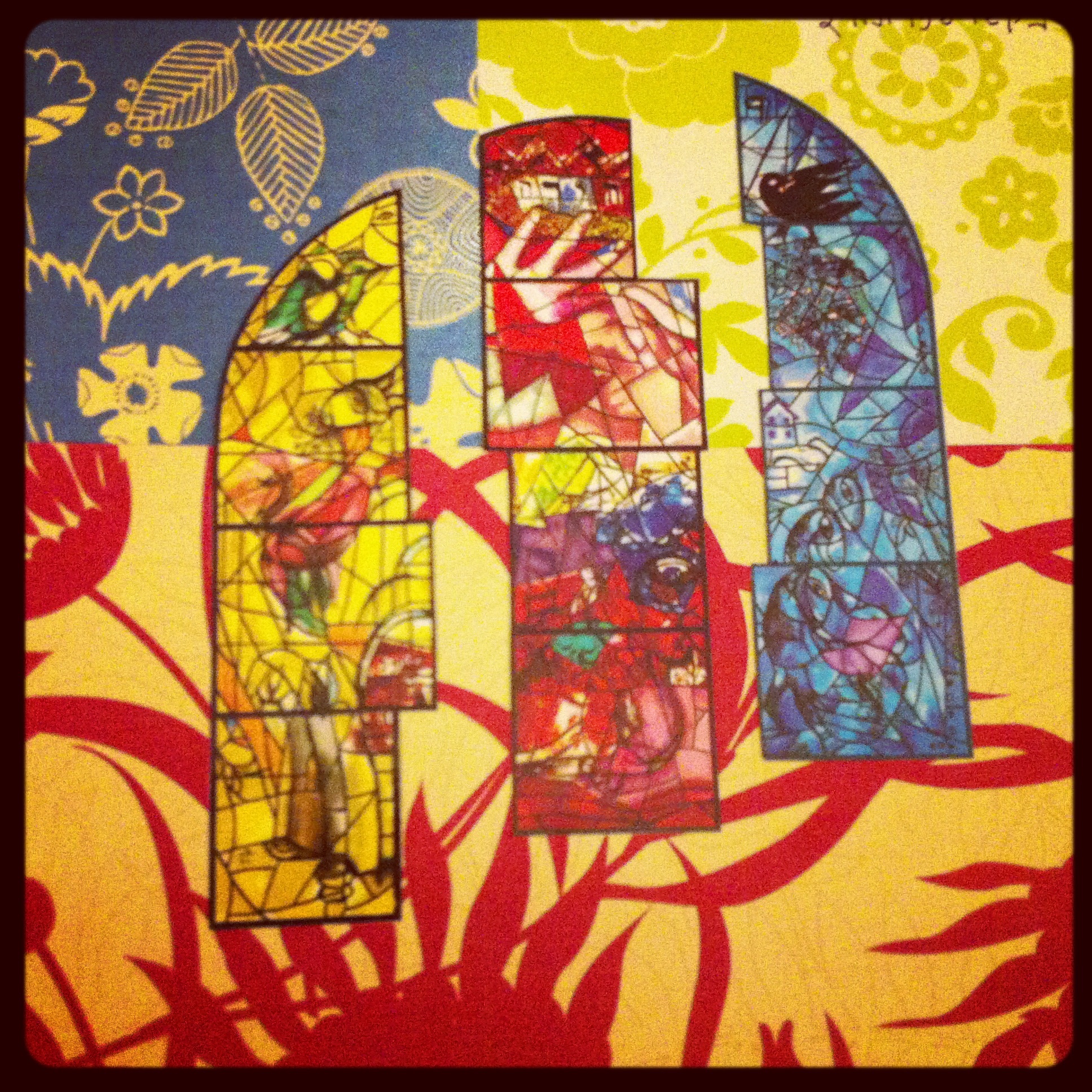
seek always g-d’s face

בקשו פניו תמיד collage; photo by salem pearce (via instagram)

Last week the “Year of Shacharit” tefila group looked at the section of the prayerbook between baruch sheamar and ashrei (up next). As the group’s faculty advisor noted as he began leading us through the davenning, there are just “so many words” here. (Included in the section are a passage from II Chronicles as well as Psalms 100, 19, 34, 90, 91, 135, 136, 33, 92, and 93).) And it’s a mostly overlooked part of the liturgy.

The ideas in this section that most struck me while we prayed were seeking, wandering, and joy.

One of the first phrases that he brought to our attention was backshu fanav tamid, “seek always G-d’s face,” a quote from Psalm 105. Hebrew College Rabbinical School founder Art Green uses the idea in the title for one of his books on Jewish spirituality, Seek My Face. As he notes in his introduction, “Personal journeys seldom have a clear beginning, and they rarely have a definite end. If there is an end to our journey, surely it is one that leads to some measure of wisdom, and thence back to its own beginning. But somewhere along the way, we come to realize that we must know where we have been going, why we have been going. Most of all, we come to understand as best we can the One who sends us on our way.”

From here, the liturgy recounts G-d’s covenant with Abraham, Isaac, and Jacob and our wandering in the desert — making explicit Art’s move above: seeking implies wandering. A journey.

The psalms that follow urge praise and bask in the comfort of the surety of G-d. One of my favorite phrases is one that we end up singing a fair amount during the morning service at school: ivdu et Adonai b’simcha, bo’u l’fanav birnana, “worship the Lord in joy; come before the Lord with flowery singing.” It’s not every far into this section of the prayerbook, but I think it’s a great finale to the actions thus far: Wander and seek — and then rejoice.

During our davenning our facilitator asked us to reflect: In what ways does G-d protect me as I wander?

G-d protects me by giving me the strength to handle whatever I encounter.

G-d protects me by reminding me of G-d’s previous promises to my ancestors.

G-d protects me by giving me support in form of family and friends.

G-d protects me by guiding me to resources.

G-d protects me by giving me health and wealth.

Seek G-d and G-d’s strength; seek always G-d’s face.

Worship the Lord in joy; come before the Lord in flowery singing

______________________________________________________

This post is part of a series about my year-long tefila (“prayer”) group. Read other posts about the group here. View my artwork inspired by the group here.

RAPE

Trigger warning: This post is about my struggle over the past few months with being triggered by various events, as result of my many years of volunteering at the rape crisis center in D.C. It doesn’t contain details of any sexual assault, but it nevertheless may be upsetting for survivors.

This is a hard post to write for many reasons — and not just because it’s highly personal. But I process by writing, and this issue has become part of my rabbinical school experience. And it will likely come up again.

I realized two weeks ago that I’ve been re-traumatized — and have been in that process for a few months — by a confluence of events. When it finally occurred to me, I felt enormous relief. Being able to put a name and a reason to what I’d been feeling was incredibly comforting. Then I felt stupid: How could I have not realized what was happening, and how could I not have realized how long it had been going on? I’d been feeling overly emotional, on edge, scared, out of control, hurt by things that were not personal, unable to hear anything about sexual assault without intense pain. And on and on. Basically, I felt crazy, and I didn’t know why. And I’ve felt this way before, and I’ve had this realization before. I just had to get there. AGAIN.

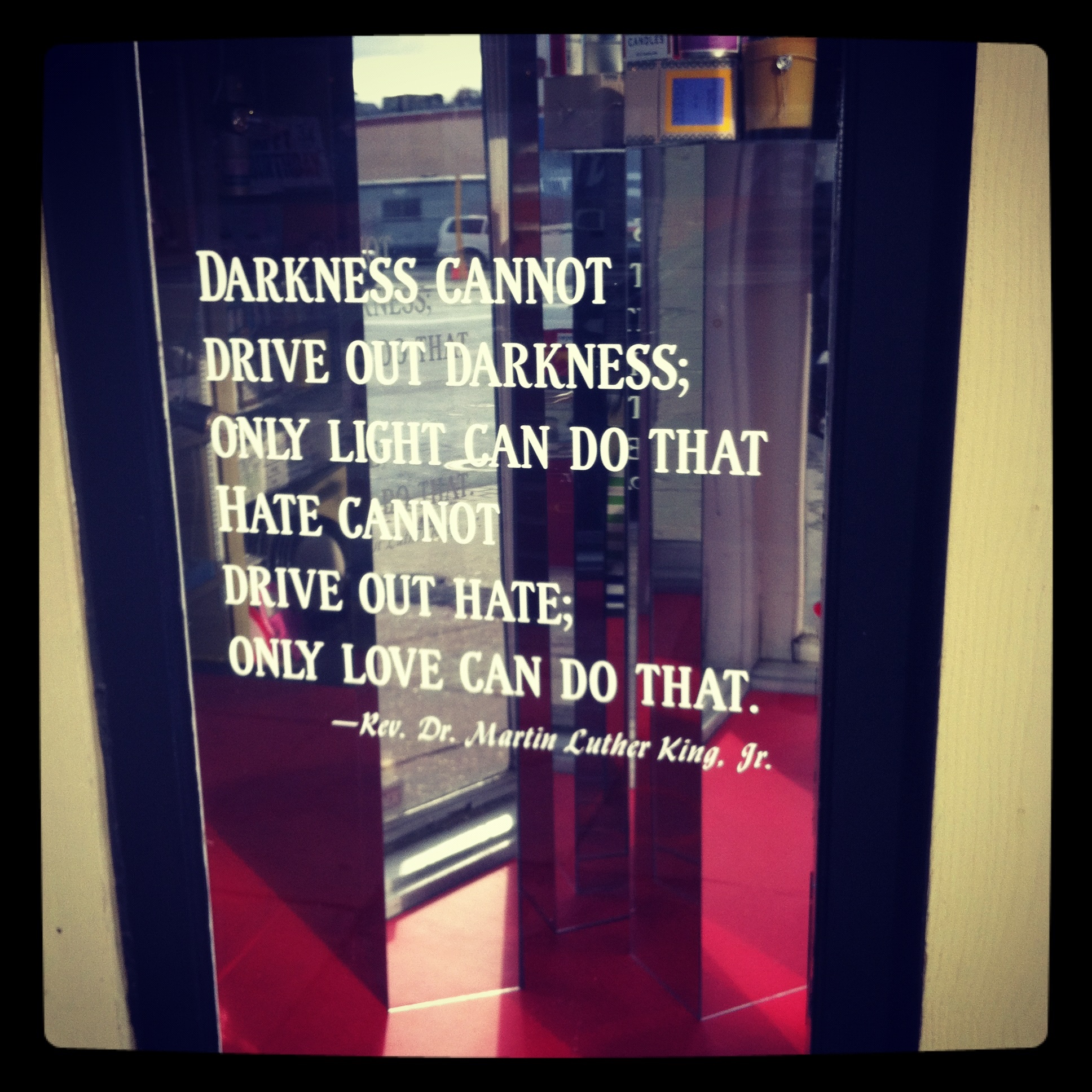
mlk quote on store window; photo by salem pearce (via instagram)

It started during the pre-semester seminar at school, in which we looked at the Torah and Haftarah readings for the high holidays. One day in class we started talking about trauma. I don’t remember how we got there, and I don’t remember how we got out of there. I just remember sitting in chair, my brain screaming, “No! No! NO! No-stop-talking-stop-talking-please.” I wanted the ground to open and swallow me up. The presentation I wrote for the end of the seminar was,in retrospect, a clue that things were getting difficult.

I underestimated how triggering rabbinical school would be. By which I mean that I didn’t think about it at all. This, too, seems foolish in retrospect. There is no shortage of abusive texts in the Jewish tradition, and I think I’ve only touched a handful so far. From stories of sexual assault in the Tanakh to an explanation in the Talmud that women die in childbirth for not observing halakha, the fear and disgust of women is  . . . everywhere. When we read and discussed the story of the gang rape and dismemberment of an unnamed woman in Judges, I wanted to weep.

Compounding the experiences of reading these texts is being a Hebrew College student — a wonderful experience, but also one that has left me feeling more vulnerable than usual. This is a very earnest community, and I am asked to share of myself often — or at least more than I was in my everyday life in D.C. I thus feel more emotionally “raw” than I have in the past.

And then there was a sexual assault on the campus of Andover Newton Theological Seminary (ANTS), which shares the hill with Hebrew College. The president of ANTS came to an all-school meeting to . . . I don’t know: Give us more information about it? I couldn’t stay in the room to hear it. I was terrified. I had no idea what kind of training the president had, so I didn’t trust that she wouldn’t saying anything triggering. Was she going to tell us what happened? What ANTS was doing? Whether the rapist was a member of the community or a stranger? To what end? I don’t even think that “sharing information” serves any purpose, since the only way to stop rape is for rapists to stop raping. There’s simply nothing a potential victim can do to ensure his/her safety.

And then there was the election. With all of the rape. I am glad that dominant narrative was that these old men need to just stop talking — and I rejoiced when they all, to a one, lost their elections — but I still stand in shock that our nation’s leaders, to say nothing of their constituents, think it’s acceptable to make such callous statements about sexual assault survivors.

And then a friend of mine was raped.

Hence the title of my post. It has been as though in every direction I turned there was in front of me a giant neon sign. It hasn’t been this bad in many years. Most of the time, I can say “ouch,” and then move on. But not this time. This time, I felt buried under the avalanche.

I feel better now, better than I have in a while. It’s an unbelievably empowering action to be able to name what is going on. I am also doing more self-care, recognizing that some of my self-destructive behavior was a result of being triggered.

I know I’m going to feel “normal” again soon. I also know that I’m not going to make it through another five-and-a-half years if I don’t. I’m beginning to think about how to deal with what Phyllis Trible calls “texts of terror.” I hope that I’ll be able to try on a variety of options for engaging with these texts and with my tradition. There are women at Hebrew College who have done a lot of work in this area. I’ve thought about doing some writing, to perhaps give [my] voice to the voiceless.

For now, I am grateful just to feel more like myself. Which is challenging enough without the experience of trauma.

why have kids?

First: I don’t know whether I want children. I’ve never felt a strong desire for children. I have felt pressure from my mom and from (what I perceive is, more on that below) Jewish tradition. I’m mostly undecided, and I think I could be okay not having kids. I do wonder though, if it were socially acceptable, whether I would just decide not to. Which is strange to me, since I am not usually ruled by others’ expectations. I think part of it is the fact that relatively few people choose not to have kids, so I wonder if I’m missing something. I also wonder how to know that I won’t regret that decision. Deciding to become a rabbi has only intensified my anxiety about this issue: I don’t know any rabbis without children.

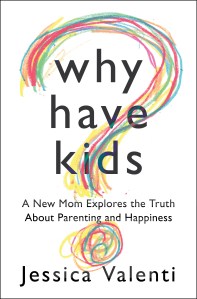
Over the holidays I read (on my Kindle app on my iPhone) Jessica Valenti’s Why Have Kids? A New Mom Explores the Truth About Parenting and Happiness. It’s a short and quick read, and it in no way answers its own question. I was left with the overwhelming feeling that there is no rational reason to have kids. People do it because they want to, because they are expected to, because they were faced with an unintended pregnancy — all valid reasons. But it’s not necessarily going to make you a happier or more fulfilled person (at least not for a long while).

The book is divided into two parts: LIES and TRUTH. The first category includes “Children Make You Happy,” “Breast is Best,” “‘The Hardest Job in the World'”; the former, of “‘Bad’ Mothers Go to Jail,” “Smart Women Don’t Have Children,” and “Women Should Work.” Obviously, some of these are provocative, but Valenti does manage in some way to take on some of the sacred cows of motherhood. Much of the book draws from first-mother accounts, and the stories, quite frankly, are horrifying — and played into my worst fears. The standout in the book is her (unfortunately ill-formed) argument for the need in our country to move from individual to community parenting — thus requiring us to advocate for “government and workplace policies that honor parenting for everyone.” That’s a world into which I would want to bring children. Valenti just doesn’t really offer a way to get there.

Interestingly, related issues were raised last Shabbat in a Jewish context; at Temple Beth Zion, a congregant, the aunt of one of my classmates, gave a d’var Torah about the Biblical imperative to procreate, from the weekly parshah, Bereshit. In the first account of the creation of humans — the only humans at the time — in Genesis 1:28, G-d tells them, “Be fruitful and multiply and fill the earth and subdue it.” The talk was intensely personal, and it deeply resonated with me.

At my request, she sent me a copy of her d’var. Speaking from her perspective as “a Jewish woman who chose not to give birth or be the primary raiser of children,” she talked about her struggle with that decision and her exploration for its validation in Jewish tradition. She grew up in a different time, when women were told that being a mother was part of having a full life. (I’m actually not sure that things have changed that much, though perhaps the messages are less explicit.) She began to speak with women older than she and discovered that this might not be the case. After much agonizing, she related, “I felt at the end of the day that primary parenting is a huge responsibility and a lot of work that, while potentially quite wonderful, was not one of the major life works that I wanted to take on.”

She explained that she made that decision with the belief that it was in opposition to Jewish law and practice. At the time, she identified as a secular Jew, so whether there was support for her choice in Jewish tradition was not of import. When she became more religious mid-life (when having children was no longer an option), she began to explore what Jewish texts actually have to say on the issue. There are in the Tanakh examples of women who do not have children — most notably Dvora — which is to say nothing of the men and women who cannot have children. She also cited the story of Jacob’s reaction to Rachel in her despair over not having children; a 15th century rabbi interprets it as anger at her forgetting her basic worth as a human being.

Wrapping up, she asked, “What does it mean to be a mensch (human) in regards to procreation and the domination of the planet by human beings in the 21st century? What is our holy work and what is our holy work today as we explore our connection back to the very first mitzvah — of procreation?” Citing the writing of Rav Kook (the first chief rabbi of British Mandate Palestine) on the issue — his view is that procreation is not mere instinct but pursuit of divine goodness, to be found everywhere — she concluded,

From my point of view this means that procreation originally set the precedent for human holy activity that now includes all activity that nurtures the human race.

Oh my God! I forgot to have children!Thus, her work as a mentor and advocate for Jewish women is her holy work — born of the Biblical mandate to “be fruitful and multiply.”

This decision weighs on me, and it’s something I’ll continue to wrestle with as my window for having children continues to close because of my age. The d’var giver joked that she didn’t want to have the realization of a woman in a t-shirt she saw: “Oh my God! I can’t believe I forgot to have to have children!” Like her, I want “to make an active, intelligent decision about whether or not I [am] going to give birth and raise children.”

feminist teshuvah

I wrote this two weeks ago as a final assignment for the fall seminar for first-year students, which looked at the Torah and Haftarah portions – and critical analysis of both – for Rosh HaShanah and Yom Kippur. We were asked to reflect on something we found interesting or significant from the readings and to present that reflection to the class. I’ve edited it slightly to make it more accessible to readers not in that class.

Thus for me, teshuva between women and G-d implies not just G-d holding me responsible for the ways I have failed as a human being, but also me holding G-d responsible for failing me as a Jewish woman by giving me a world and a people and a text that continue to betray women, often making it difficult for us to uphold our side of the covenant.

I almost fell off of my bed after I read this passage from Tamara Cohen’s essay, “Returning to Sarah,” in Beginning Anew. To say that it resonated with me would be a vast understatement. I don’t think a piece of text has so perfectly spoken to me in 10 years, since I read Anita Diamant’s Choosing a Jewish Life – the main impetus for the Jewish journey that eventually led me here.

The passage gave me permission to be mad at G-d. The tradition I grew up in did not allow that, and my inchoate theology tends towards a G-d that is not directly responsible for the state of things. Our mischegas is our own.

A world and a people and a text that continue to betray women.

[B]etray women.

This is my experience, from growing up in a tradition of strict gender roles, to working at an all girls’ boarding school in North Carolina, to volunteering at the rape crisis center in D.C.

I am grateful to now be a part of a community whose commitment to egalitarianism seems to be firm, but I know this to be an aberration. (And I know that there will be failures on that front; we live in a world of male privilege, after all.)

My life thus far has been a daily, run-into-a-wall encounter between the way that I experience life and a privileged experience of life. And that’s my experience as an upper-middle-class, straight white woman – to say nothing of the experience of people of color, or queer folks.

I feel that betrayal acutely, in ways large and small.

I feel it when last summer’s debt crisis – which almost led to a default and did lead to a downgrade in U.S. credit by world debtors – ended only when the president agreed to a bill rider that prohibited the District of Columbia from directing its own tax revenues to subsidize abortions for District residents.

I feel it in the lack of basic labor protections – standard for most workers in this country – for domestic employees, the women that care for our children, houses, and elders.

I feel it when our secretary of state – our nation’s top diplomat – is asked which fashion designers she prefers.

I feel it when sports teams at my alma mater are referred to as “the Longhorns” . . . and “the Lady Longhorns.”

I feel it when I get mail, as I did yesterday, addressed to “Mr. & Mrs. Joseph Grossberg.”

Last Wednesday at hesbon hanefesh (“account of the soul”) a teacher asked us to reflect on the issue of anger, and he used a text from Rav Natan as a prompt: “Help me break my tendency towards anger. Help me practice patience in all aspects of my life and overcome my anger. I don’t want to be angry or respond harshly to anything . . . I just want to be able to serve you honestly and simply, and to have total trust in you.”

This is not my prayer to G-d. For me there is a distinction between the feeling of anger and acting angrily. I don’t want to do the latter. But I also don’t want to not be angry, when I generally feel that if you’re not angry about the world, you’re not paying attention. (Patience, on the other hand, that I pray for daily.) My anger, my outrage at injustice, is often what motivates me. It’s one of the reasons I’m here.

And if I’m being honest, I have to say that in the drama of the traditional Yom Kippur “scapegoat” sacrifice in the texts that we read, I feel less like the onlookers or even the high priest – and more like the goat. I feel the weighed down by the burden of our society’s sins against women. Like the goat, I am either abandoned in the wilderness – or thrown over a cliff.

So, how can I do the hard work of teshuva (“repentence”) when a great deal of my reflection has left me angry at G-d? Trust after betrayal is incredibly hard, especially when the betrayal “continue[s],” as Cohen notes.

Cohen’s answer is, at least in part, is for us to complete the stories about and to strain to hear the voices of the women of the Torah. We must write our own midrashim and live our own fully integrated lives. So, I’ll definitely try to get that done in the next 19 days.

Hebrew College founder Art Green, in his introduction to S.Y. Agnon’s seminal text on the High Holidays, Yamim Noraim, suggests another, or an additional, model: He notes that Yom Kippur commemorates the giving of the second of the Ten Commandment tablets. (Moses destroyed the first in his anger at the Israelites’ creation of the golden calf.) Green says, “This time the tablets were to be a joint divine-human project. Moses does the carving, G-d does the writing. Every Jew receives or fashions these second tablets on or around Yom Kippur. This is the season when each of us renegotiates our covenant with G-d.”

If I can frame it like that, I’m able see G-d as a partner in the beginning of my teshuva. But it’s also a good thing that I have next year, too.

so it begins

I just completed my first week of school (well, sort of). Sunday and Monday were orientation, and Tuesday through Friday were the first four days of a pre-semester seminar. My classes will start in earnest next week.

It’s hard to relate all of the feelings I’ve had in the past week. Frankly, it’s been overwhelming, but in the best way possible. I’ve loved meeting my new classmates, the returning students, and the faculty, as well as beginning to learn as a class and to pray as a community.

I’ve also spent a fair amount of the week in a kind of emotional suspended animation: I’m waiting for the other shoe to drop. “It can’t really be that for once in my life I am in the right place.” “I can’t actually be doing what I supposed to be doing.” I know that not everything about this school and my experience as a student is or will be perfect. But I have never known peace like this.

First things first! The best thing about rabbinical school so far: I get to sing every day, and no one cares if (that?) I sing out of tune. I get to sing during morning prayers, and most communal time starts with a niggun (wordless melody). Even my class does! (Indeed, the fact that my admissions interview ended with a niggun solidified for me that Hebrew College was the right place for me.)

hebrew college’s selichot leader; photo by dena trugman (via instagram)

One of my favorite parts of the last week has been selichot, which unfortunately won’t be a regular occurrence throughout the year. Selichot are poems and prayers said during the Jewish month of Elul, which precedes the High Holidays. They explore themes of penitence and G-d’s mercy — not, perhaps, the most cheerful of topics — and at Hebrew College start at 7:00 a.m., before the morning service — giving an idea of how moving they must be to draw a crowd. (I have a limited music vocabulary, so I can only try to explain why.) In fact, more than one returning student told me that, despite the early hour, they were not to missed. Many of the tunes have strong beats and feature repeating lines, facilitating participation. And the Hebrew College tradition in many of the songs is that anyone can take a verse, while we all take the chorus together; I’ve loved hearing the variety of experience, accuracy, and ability that results. In this setting, not everyone sings well, but anyone can sing. I’ve never had an experience like selichot before, and I find that the songs stay with me all day.

Orientation was great mix of practical and spiritual. We met administrators, did icebreakers, told and heard personal journey stories, and started learning about core elements of the Hebrew College curriculum: personal and spiritual growth, tefila (prayer), beit midrash (literally, “house of interpretation”) and hevruta (study partners), and (good, old-fashioned) learning. I was particularly struck by something the director of admissions said as he welcomed us to orientation. He noted that school begins at an odd moment in the Jewish calendar, during the month Elul, a time of preparation for the High Holidays in which we reflect on teshuvah (literally, “return”). We atone for our sins by trying to make right our relationships with our fellow human beings and with G-d. Taking the first step in a new journey may feel out of sync with the prevalent theme of repentance, but, he said, “I know that for many us this beginning may represent a return in a very real way.”

This combination (which doesn’t even include the practical side of rabbinic education, which is to come in the curriculum), exemplified in the orientation schedule and in the introduction to the core elements of the school’s curriculum, is the essence of what I was looking for in a graduate program. I know I would not have been happy in a purely academic setting (as for example a Ph.D. program). I ultimately want to use my knowledge of Judaism in the service of others, and I am so excited to be an institution that recognizes the importance of spiritual and personal growth.

hannah, whose story is read on the first day of Rosh Hashanah

The seminar for first-year students is about the passages from the Tanakh that we read in synagogue on Rosh Hashanah and Yom Kippur. We’re looking at the primary texts in the Hebrew Bible as well as a variety of commentary on them: sections of Talmud and other rabbinic sources, modern and contemporary perspectives, and Israeli poetry. The rabbi who teaches the course is our class advisor (and will be teaching one of our fall semester courses); he assigned a text, Beginning Anew: A Woman’s Companion to the High Holy Days, as part of his commitment to looking at the primary texts through a feminist lens. I am thrilled that this perspective is given such importance, especially since so many of the High Holidays’ stories feature women.

This week marked for me the beginning of the hevruta study experience, as mentioned, a hallmark of the Hebrew College curriculum. Every morning after selichot, shacharit (morning prayer), and our facilitated Elul reflection, the first-year students split up into pairs to work, in the beit midrash, on the assignments for class that day. We switch partners every day (although we will eventually choose permanent study partners for the year). I was nervous about this part of the learning process. I’ve had a few experiences with hevruta learning, but nothing this consistent or systematic, and I have always thrived well in a very traditional, individual learning setting (lecture by professor and supplementary reading). I wasn’t sure I was going to like working in hevruta. To be sure, I chose Hebrew College in part because of its emphasis on hevruta learning, but I did so with trepidation, anticipating that it would be a challenge, pushing me out of my safety zone.

On Tuesday my first partner, who spent last year in Israel studying in hevruta, told me that it would ruin me for me classroom learning. I’m not sure I’m ready to go quite that far, but I have absolutely loved this week, completely confounding my expectations. It helps that I’ve jibed well with the four classmates that I’ve worked with so far: I’ve really appreciated their different strengths, and partnered learning has helped me to realize my own strengths (to wit, and unsurprisingly, grammar and translation of the Hebrew texts).

My final thought from this first week takes me back to the first day of orientation, Sunday — and my birthday. When I first found out the week’s schedule, I had the fleeting thought that it would be an odd way to spend my birthday (not least because I’d be among a fair number of strangers), but the more I considered, the more I thought that it might actually be perfect. The director of admissions in particular made a big deal of it, leading the group in “Happy Birthday” singing not once but twice, and when I thanked everyone after blowing out my candles, I said, “There is no place or group of people I would rather be on my birthday.”

And it really was true: I am incredibly privileged to be able to pursue this dream. What better gift could I ask for on my birthday than to be taking the first step on that journey?

bat mitzvah

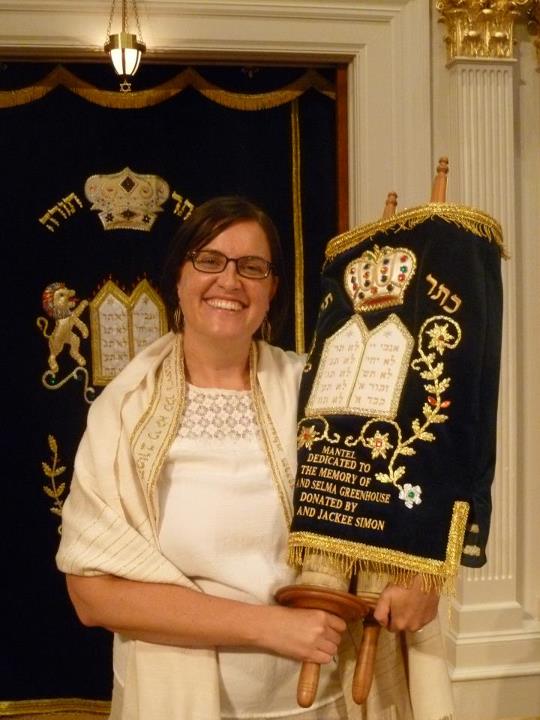
after the ceremony, with the sefer torah; photo by gay lee pearce

My bat mitzvah ceremony was almost two months ago, and with all that has happened since then, it seems even further in the past. But yesterday in Hebrew class our book included a text about the ritual of Orthodox boys’ first haircuts — traditionally at the age of three, on Lag B’Omer, at the tomb of Rabbi Simeon bar Yohai in the Galilean town of Meron, in case you’re interested — and one of the book’s exercises asked us to reflect on one of our own meaningful Jewish rituals. Since I have to do it in Hebrew, I may as well attempt it in English first . . .

I completed the adult b’nai mitzvah class in June, after seven months of study. The group of 15 — all young adults in the D.C. area — met for two hours each week; the class was held at Sixth & I and was the first of its kind for the synagogue. Sixth & I hired an outside rabbi to teach the class, a woman I had first met — and loved! — when she taught one of the sessions of the Jeremiah Fellowship I completed a year ago. As I noted at the end of our ceremony dress rehearsal, I am likely one of the few who can say that her bat mitzvah prepared her for rabbinical school. I don’t know what this first step in my journey to the rabbinate would have been like without all that I gained from the class, the rabbi, and my classmates.

We read about prayer and the liturgy, talked about the holidays, learned how to put on a tallit and lay tefillin. We wrote d’vrei torah and practiced leining our parts of the parshah. Even after all these years of my adult Jewish education, it continues to thrill me that there is always more to learn.

The class was an interesting mix of Jewish backgrounds. A few people had had b’nai mitzvah as teenagers but had not found the experience particularly meaningful and hadn’t been involved in the Jewish community since then. Like me, others had never had one, despite having been raised as Jews, and some of us weren’t raised Jewish. I in particular was in a different place in my Jewish journey than everyone else, as I began visiting and applying to rabbinical schools shortly after the class started. But we all shared a desire to deepen our commitment to Judaism.

In addition to the opportunities for spiritual and intellectual development and liturgical proficiency, the class also gave me a glimpse into the future. A curious thing happens when you say that you are planning to become a rabbi, probably not unlike what happens when you say that you are studying to become a rabbi, or that you are a rabbi: in the class and elsewhere, people began jokingly referring to me as “rabbi,” asking me questions about Judaism, and deferring to my leadership. More than one person whom I do not know well at all wanted to talk about G-d in the course of otherwise fairly pedestrian conversations. In all of those moments I felt acutely inadequate.

I am going to rabbinical school because I don’t have answers, in more than one sense. I need and want to know more to be able to serve the Jewish community, and I am well suited for the rabbinate in part because I don’t require certainty.

The class was my first experience of being a part of a Jewish community with the “rabbi lens.” As rabbinical school became a reality, what I wanted to get out of the class changed. I watched the rabbi teach and observed how she handled the class and its questions. I listened to what others said about why the class was meaningful to them. I led one of the rehearsals when the rabbi couldn’t make it to class. I began to feel less a part of the class and more an aide to the class. Of course, this position came with risks. After a tense second-to-last service rehearsal, in which we were all nervous and on edge, I snapped at one of my classmates. She was understandably upset with me, and righting that wrong and repairing that relationship (which I am happy to report did happen) took on a different import. I felt a power imbalance and a new responsibility — and the crushing guilt that must always come with being a “bad representative” of a group’s leadership. I knew it behooved me to make amends, no matter the extenuating circumstances. I asked myself for the first, but presumably not the last, time, “Can I be a good rabbi if I . . .?”

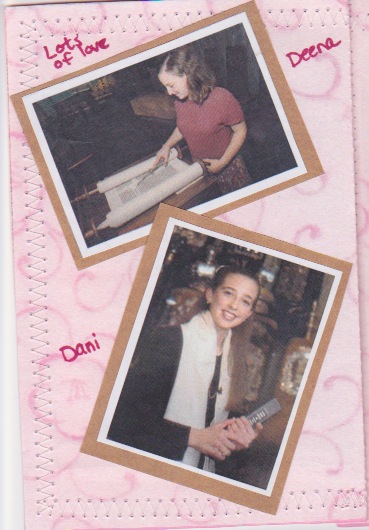
part of the amazing card my friends gave me, with pictures from their own b’nai mitzvah

The service itself was wonderful. For some reason I’ve always been cavalier about milestones, ceremonies, and celebrations. I don’t remember attaching much import to high school or college graduations, and I was fairly blasé even about my wedding (noting again for my reader(s?) that this was not my attitude towards my marriage). And it took me a while to warm to the idea of this one: My cousin found out about it a few months prior and said to me, “Hello!? You have to tell us about these things!” But the excitement came. I practiced every day, I invited friends and family, I got my hair done, and I bought new clothes (a true sign of how meaningful I held the occasion, since I loathe shopping; the best present I’ve ever gotten was when my mom bought me a wedding dress and sent it to me).

At the Saturday morning service on June 4, 2012, I gave my d’var torah, I led the amidah and the second half of the Torah service, and I had two aliyot. Almost of this involved carrying a tune, and the truly hilarious part of the day was finding my family in the social hall downstairs after the ceremony and hearing each of them exclaim as they hugged me, “I didn’t know you could sing!” I didn’t either, and I am happy to now have the confidence that I can lead services and not embarrass myself.

I remember Sixth & I’s rabbi, acting as gabbai while we read Torah, giving me a hug after I finished my aliyah, and saying, “Nice job, rabbi.” I remember that so many of my friends came to support me. I remember my mom’s thrill at meeting the rabbis who helped us lead the service, women who were both holding at least one of their small children after the ceremony. It’s not clear to me what my mom’s conception of being a rabbi is, but she turned to me as we were leaving the synagogue and said, “See? You can be a rabbi *and* have kids!”

I almost started crying when I saw my father-in-law after the service. He has known more than his fair share of tragedy and thus is understandably staid, with a deadpan sense of humor. He drove 12 hours from his home in Louisville, Ky., to attend the service, a generous gesture from a fairly cynical atheist and generally non-practicing Jew. His face lit up when he saw me after the ceremony, and with a huge smile that I’ve never seen, he told me what a great job I did. In my mind I can still see his expression, and I think it would have been enough just to have that memory.

death of a mensch

On Monday I woke up thinking about him, a man I never knew — and didn’t even consider the existence of until last week.

On Sunday I attended the funeral of the father-in-law of the rabbi who taught the b’nai mitzvah class I completed in D.C. last month. Her in-laws are local, and since I consider the rabbi one of my mentors and one of the reasons I decided to go to rabbinical school, I — along with a classmate who also knew her in her past job — made the drive to a small town outside of Boston to be a part of the mitzvah of k’vod hameyt, honoring the dead.

His death on July 4 was a random accident, one so terrible that the rabbi, one of the most articulate and thoughtful people I know, just shook her head when I saw her: “There’s nothing to say.”

There certainly isn’t much to say about his death, although the rabbi who presided over the ceremony did a yeoman’s job. He took to task the chief of police who had declared the accident “an act of G-d.” “Oh, really?” he rejoined scathingly. “That is not G-d.” And then he cautioned the large crowd that allowed only standing room in the sanctuary by the time the service started, “Before you ask, ‘Why?’, I ask you to consider whether there is any answer to that question that you would find satisfactory.”

There was certainly, though, very much to say about his life. From his obituary: “Loved nature, music, writing short stories, studying Torah, discussing politics, dancing with [his wife], and the Red Sox. His goodness and love will be missed.”

The service started with the synagogue’s cantor, who had known him and his wife since she began her job at the congregation. (They were involved in selecting the rabbi as well.) Next was his sister, then his son (my rabbi’s husband), then his daughter. And then his wife.

His son talked about how his father had taught him how to be a father. The rabbi and her husband have two children, and he recalled how much joy his father had gotten out of being a grandfather. And he sounded like the best kind of father and grandfather. The son recalled, “Dad could do anything. Wrote down the wrong gate and missed your flight? Let dad know: he’ll fix it. Don’t understand how student loans work? Ask dad: he’ll explain them. Get lost on the way to an important meeting? Call dad: he”ll get you there.”

A heartbreakingly young woman, his daughter talked about all of her many childhood activities that her dad never missed: Practices, performances, meets, competitions. In school he stayed up late with her the night before a paper was due in case she needed help breaking through writer’s block. She ended up in technology, the same field as his, and she spoke fondly their attending a recent conference together. There he introduced her to a colleague as his daughter; later, the man found her again and said, “When your father introduced you, I didn’t realize that you are actually his daughter. I thought he was saying that you were like a daughter, that he was your mentor.” She recalled at the service, “The colleague wasn’t wrong. He was my father, but he was also my mentor.”

Last was his wife, who was unbelievable. And by that I mean that I almost couldn’t pay attention to what she was saying because she was so unexpectedly poised at a moment when everyone around her, including people who hadn’t even known him, were sobbing. She shared how they had met, in college: two atheist, anti-Jewish Jews. They bonded over activism and late night philosophical talks, but, although she wasn’t all that interested in marriage, she didn’t want to move in with him if they were unmarried. “I told him that I didn’t understand that. If two people wanted to commit to one another, they should just do it, go all the way.” And five months after they met, he asked her to marry him on bended knee and with a toy ring with a green stone (which she promptly dropped, losing the stone, as soon as he handed it to her). So at ages 18 and 19, they were married, in a Jewish ceremony to satisfy their parents — and one entirely in Hebrew “so that we couldn’t understand all the stuff about G-d.”

I wish there had been time to hear more about their journey together from kids to having grandkids, from rebels to pillars of the community, from G-d denying to G-d embracing. But what followed next was well worth that omission.

His wife explained that she had asked people from various points in his life to speak about him because what she had known about him was not all there was to know about him. We then heard from a childhood friend and one from his young adult years, then from a member of the synagogue’s men’s group that he founded, and from a colleague. We heard about his mischievousness, his reflections on Torah, and a vacation dinner in a nice restaurant that ended with his young son covered in spaghetti and chocolate ice cream. A woman from a job or two ago said that after several people had left the company, they committed to getting together for dinner every few months to stay in touch. She had been in charge of scheduling those dinners, and he was always the hardest one to nail down. But, she added, after hearing that day what others had to say about him and his commitment to his family, friends, and community, she understood why he was always so busy.

I loved his wife’s tribute, her acknowledgement that she doesn’t own the memories of him, that all of the community carries pieces of him — then and now. This is how remembrance stays alive, and I am blessed to now be a bearer of his life and death as well.

And then she began to talk about the night he died. They had attended a James Taylor concert, just one of the activities that had begun to form the shape of their (soon-to-be) retired life. They sat on the lawn and talked about their ballroom dancing lessons and their financial future. The last song of the concert, she informed us, was Taylor’s “How Sweet It Is To Be Loved By You.” And the cantor joined her at the podium, and they invited everyone to sing. And when we weren’t spirited enough, his wife admonished us to sing louder and to clap harder. It was hard to do through my tears. But she just laughed and clapped and sang.

In the end, she concluded by thanking him for their 43 years together, declaring, “I regret nothing.”

“I regret nothing.” How many of us can say that about our relationships? About our lives? About anything? How many of us can say that, whether we actually don’t experience regret, or whether we have made peace with our mistakes?

I just want to stop. And thank you, baby.

How sweet it is to be loved by you.

lift up your head

part of parshah naso in the sefer torah; photo by kera bartlett

On Saturday, I read the following reflection at the ceremony for my adult b’nai mitzvah class at Sixth & I Historic Synagogue (more on the ceremony in a later post). The speech is called a d’var Torah (literally, “word of Torah”), a close study on one aspect of the weekly portion of the Torah that is read that week in synagogue. It’s traditional for a bar or bat mitzvah to write and give such a speech at his/her ceremony. The parshah last week was Naso, Numbers 4:21–7:89.

Naso et rosh.

Thus begins our parshah, with a directive generally translated as “Take a census.” But it literally means, “Lift up the head.” It’s G-d’s command to Moses to number the groups of Levites entrusted with the care of the Tabernacle. And at its essence, a census is a just a list.

In his book The List: The Uses and Pleasures of Cataloguing, my friend Bob Belknap grapples with the ancient literary tradition of lists in the authors of the American Renaissance: Emerson, Whitman, Melville, Thoreau. He’s puzzled by his graduate school roommate’s dismissive attitude towards such sections of text, “I just skip over all that stuff.” Indeed, Bob’s love of lists may be unique: Most of us, when confronted with a lengthy enumeration – say, of the descendents of a patriarch in the Torah – at best skim. Almost all of us desperately search for the beginning of the next paragraph: Why on earth should we care about the names of each man who get us from Seth to Noah?

What has been described as our parshah’s overall theme, order and structure, is evidenced in its abundance of lists: G-d tells Moses to take a census; G-d spells out who is to be counted; G-d enumerates the specific parts of the Tabernacle that the Levites are responsible for; G-d lays out procedures for the physically impure, for betrayal, for a wife accused of adultery; G-d explains the laws of the nazarite. And via one of the more challenging examples of a list, repetition, G-d tells us about the dedication offerings from the twelve chieftains of Israel, each of whom brings the exact same gifts. And those gifts take a paragraph each time to describe. So the parshah ends with a list of 12 identical lists.

I wonder how these sections struck Moses at the revelation at Mount Sinai (if it’s the case that, as some postulate, Moses received then the entire Torah and not just the Decalogue). I assume he took a moment to read what G-d had given him before he went down to the Israelites and proclaimed it a sacred text. I like to imagine Moses as editor, sitting atop the mountain with a red pen, trying to reason with G-d. “There may be an opportunity here to cut this part down a bit. No one’s going to read all this 12 times in a row.”

But as my friend argues in his book, “The value of lists is that they ask us to make them meaningful.” If we are engaged in the text – and as Jews we are asked to engage with Torah – we have to consider these challenging sections.

Lists catalogue and lists omit; they highlight differences and they emphasize similarities; they create patterns of possibility and they make assessments of importance. They honor the fallen, the lost, the loved.

Naso et rosh.

Through the years, commentators have expounded on the various meanings of this verb. Rashi sees naso as a play on words: He connects its meaning of “to lift or raise” with the function of the Levites who are engaged in carrying parts of the Tabernacle.

Another rabbi understands its connotation of pride: When one shows or feels pride, one lifts up one’s head and stands tall; the Torah wants to tell us that the Levites were proud of their responsibility.

Yet another rabbi interprets the verb as a metaphor for lifting up one’s spiritual station: The Levites were given an incredibly important task that helped them reach an elevated ability of patience and coping with adversity.

I can think of another meaning. As any student knows, engaging with a text often finds us hunched over, staring into the pages of a book. But as any teacher knows, in a classroom deeper meaning takes root when students are actively listening instead of reading the bullet points of a lecture on a handout. With naso et rosh, G-d is reminding to consider that deeper meaning, to ponder that larger picture. “I’m giving you these lists, instead of narrative, to make you stop. Lift up your head and behold me.” The stories in the Torah – of creation, of the flood, of Abraham and Isaac, of Sodom and Gomorrah, of Jacob and his sons, of the Exodus out of Egypt – don’t make us stop. These are great stories, and we want to keep our heads down and find out what happens.

But we’re also called to be like Moses at the end of the parshah, which concludes with him standing by himself (and I imagine, with his head raised), listening to G-d speaking to him from above the cover of the ark.

In these moments, we can reflect, dwell, exult in detail, even rejoice in minutiae. As my friend so beautifully puts it in his book, lists challenge us to stop: “The rhythm of the repetition interrupts the forward drive of the text, and for a moment we are invited to dance.”